
Crawlkit vs fnel
Side-by-side comparison to help you choose the right AI tool.

Crawlkit
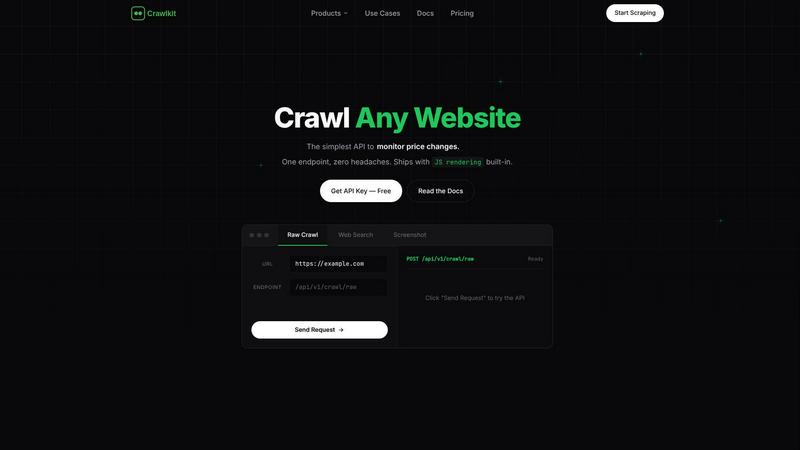
CrawlKit is the reliable API platform that turns any website into structured data with a single call.
Last updated: February 28, 2026

fnel
Fnel gives solo founders real-time funnel analytics to instantly fix conversion leaks.
Last updated: March 1, 2026
Visual Comparison
Crawlkit
fnel
Feature Comparison
Crawlkit
Unified API for Diverse Sources
Crawlkit consolidates access to a wide array of data sources under one simple API. Whether you need data from LinkedIn company pages, Instagram profiles, Google Search results, or mobile app stores, you use the same consistent request format and authentication. This eliminates the need to integrate and manage multiple specialized scraping tools or APIs, drastically simplifying your data stack and reducing code complexity.
Robust Anti-Bot Infrastructure Abstraction
The platform's core engineering magic lies in its handling of the hardest parts of web scraping. It automatically manages rotating proxies, executes JavaScript for single-page applications, bypasses CAPTCHAs, and respects dynamic rate limits. This infrastructure is continuously updated against evolving anti-bot measures, guaranteeing high success rates and delivering complete, rendered page data without requiring any developer intervention or custom configuration.
Developer-First SDKs and Playground
Crawlkit is built for seamless integration into developer workflows. It provides official SDKs for popular languages like Node.js, allowing you to start fetching structured data in minutes with just a few lines of code. The interactive Playground lets you test API endpoints in real-time, see the parsed JSON output, and generate ready-to-use code snippets, making prototyping and debugging incredibly straightforward.
Transparent, Credit-Based Pricing
Crawlkit employs a clear, pay-as-you-go pricing model based on credits. Each API endpoint has a fixed credit cost, and you only pay for successful requests. Credits never expire, there are no monthly commitments or hidden fees, and volume discounts apply automatically. This model provides predictable costs, aligns spending directly with value received, and offers flexibility for projects of any scale without lock-in.
fnel
Real-Time Funnel Visualization
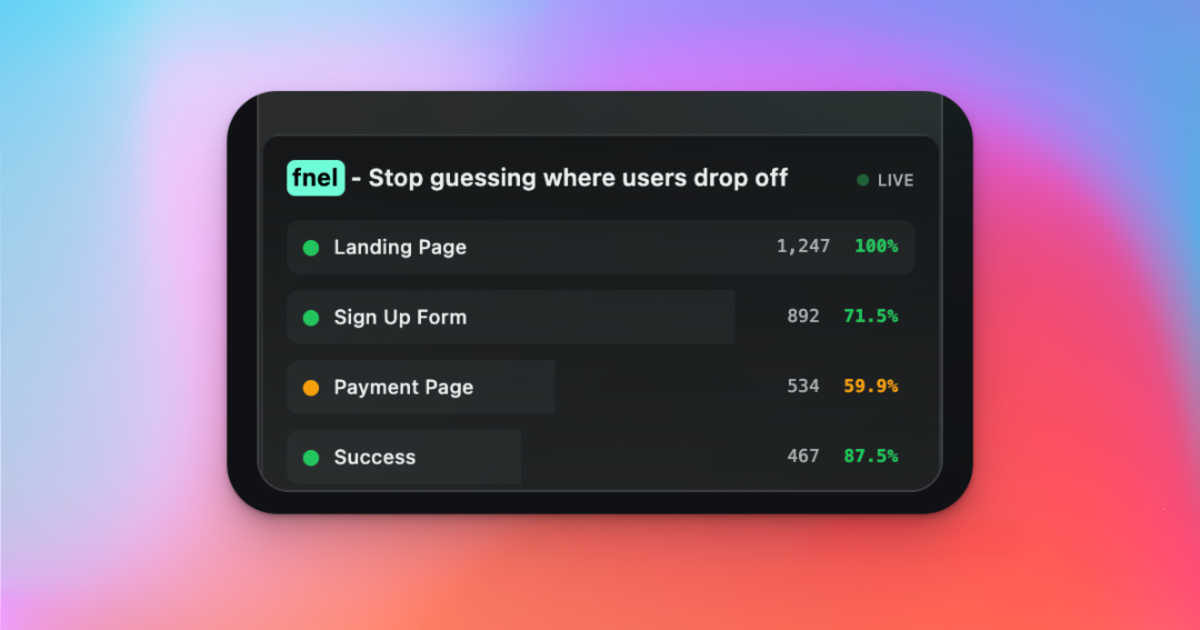
fnel provides instant, visual representations of your key user pathways, such as SaaS signups or e-commerce checkouts. The dashboard displays each step of the funnel with clear user counts and conversion percentages, allowing you to see drop-off points as they happen. This live data feed eliminates guesswork and enables you to react immediately to performance issues, turning analytics from a historical report into an active management tool for your growth experiments.
Smart Drop-Off Alerts
The platform proactively monitors your funnels for anomalous behavior. Using automatic detection algorithms, fnel identifies when a specific step suddenly underperforms and triggers an alert. For instance, you might receive a notification highlighting a "High drop-off detected at Payment Page (40.1%)". This feature ensures you are never caught off guard by conversion leaks, allowing you to investigate and fix issues like broken forms or confusing UI before they significantly impact your revenue or user acquisition.
A/B Test Validation at the Funnel Level
Move beyond superficial click rates. fnel allows you to validate A/B test variants based on their actual impact on your funnel conversion. You can compare how different pricing page designs or CTA buttons affect progression through critical steps like signup and activation. The tool provides confidence intervals, showing you not just which variant "won," but whether the improvement is statistically significant for your core business metrics, leading to more reliable optimization decisions.
One-Line Code Integration
Designed for ultimate developer simplicity, fnel requires only a single snippet to be added to your project. This minimal setup gets you from installation to viewing live funnel data in mere minutes, with zero complex configuration needed. This lightweight design philosophy respects the time constraints of solo builders and small teams, removing the traditional friction of schema definition and property mapping associated with heavier analytics suites.
Use Cases
Crawlkit
CRM and Sales Intelligence Enrichment
Automatically enrich lead and contact records in your CRM with fresh, structured data. Use the LinkedIn API to pull job titles, company information, and professional details. This transforms manual research into an automated pipeline, enabling sales teams to personalize outreach at scale and gain deeper insights into their prospects directly within their existing tools.
Competitive and Market Intelligence
Systematically track competitors' digital footprints. Monitor their Instagram for follower growth and engagement trends, scrape their app store reviews for user sentiment analysis, or track their public job postings on LinkedIn to infer hiring strategies. Crawlkit turns sporadic manual checks into structured, historical datasets for strategic analysis.
Social Media Monitoring and Analytics
Build dashboards to track brand mentions, campaign performance, or industry trends across the web. Use the Search API to gather news and forum mentions, while the Instagram API provides precise metrics on public profiles. This enables marketing teams to measure ROI, understand audience sentiment, and identify influencers or trending content.
Product and Review Aggregation
Create a comprehensive view of your product's reputation by aggregating user reviews from multiple app stores (Play Store, App Store). Analyze competitor products by scraping their detail pages and review sections. This data is crucial for product managers to prioritize feature development, understand user pain points, and conduct competitive benchmarking.
fnel
Optimizing SaaS User Activation
For SaaS founders, the journey from signup to activated user is critical. fnel allows you to track steps like landing page visit, signup form completion, email verification, onboarding progress, and final activation. By visualizing where prospects stall—perhaps at email verification or during a tutorial—you can pinpoint friction points. This enables targeted improvements, such as streamlining the verification process or refining onboarding guidance, directly boosting your activation rate and product-led growth.
Reducing E-Commerce Cart Abandonment
E-commerce store owners can use fnel to map the checkout funnel from cart view, through shipping information input, to payment submission and order confirmation. The real-time visualization reveals exactly which step causes the most shoppers to leave. Identifying a major drop-off at the payment page, for example, could lead to testing different payment gateways, simplifying form fields, or adding more trust signals, ultimately recovering lost sales and increasing average order value.
Measuring Agency Lead Generation ROI
Marketing agencies and consultants can implement fnel to track lead generation campaigns for clients. By setting up a funnel for form submission, lead qualification, and booked discovery call, they can attribute conversions directly to specific campaigns or ad spends. This moves reporting beyond vanity metrics like clicks, providing concrete proof of which efforts actually fill the pipeline and generate billable work, thereby justifying marketing budgets and optimizing ad spend.
Validating New Product Feature Adoption
When launching a new feature, indie hackers can create a custom funnel to monitor user engagement. Steps might include accessing the new feature area, interacting with key elements, and completing a desired action. fnel helps you see if users are discovering the feature and where they disengage. This rapid feedback loop is invaluable for iterating on the feature's UX/UI before a full-scale rollout, ensuring development effort translates into genuine user value.
Overview
About Crawlkit
Crawlkit is a sophisticated web data extraction platform engineered specifically for developers and data teams. It addresses the core frustration of modern web scraping: the immense operational overhead. Instead of wrestling with rotating proxies, headless browsers, CAPTCHAs, and rate limits, Crawlkit provides a single, reliable API that abstracts away this complexity. The platform is built on a robust infrastructure designed for high success rates and scalability, ensuring consistent data access even as target websites update their anti-bot protections. Its primary value proposition is enabling users to focus entirely on data analysis and application logic, not on building and maintaining fragile scraping infrastructure. With a developer-first philosophy, it offers a simple REST API and SDKs for popular languages, making it accessible for projects of any scale, from one-off data pulls to enterprise-level data pipelines. From a business perspective, it turns the variable cost and risk of in-house scraping into a predictable, fixed-cost utility. For the data engineer, it eliminates the endless cycle of parser maintenance and infrastructure tuning, offering a "set it and forget it" solution for reliable data ingestion.
About fnel
In the crowded landscape of digital analytics, fnel emerges as a focused beacon for the independent builder. It is a dedicated funnel analytics tool engineered specifically for solo founders, indie hackers, and early-stage startups. Its core mission is to cut through the overwhelming noise and complexity of platforms like Google Analytics or Mixpanel. fnel operates on a singular, powerful premise: to show you exactly where potential customers abandon your critical user journeys in real-time. By integrating just one line of code, users can deploy comprehensive event tracking and gain immediate access to clear, actionable funnel visualizations. This streamlined, developer-friendly approach dismantles the traditional barriers of lengthy configuration and confusing dashboards. The value proposition is profound clarity without the overhead. Instead of wrestling with generic data, you receive direct insights into your signup, onboarding, and conversion funnels, enabling swift, informed decisions to plug leaks and boost growth. Whether you're validating a new product idea, managing a side project, or scaling your first SaaS, fnel provides the essential intelligence to build smarter and faster, ensuring you spend minimal time on analytics and maximum time on product development.
Frequently Asked Questions
Crawlkit FAQ
What happens if a request fails?
Crawlkit operates on a "refund on failure" policy. If an API request fails to return the requested structured data, the credits spent on that request are automatically refunded to your account. The platform's infrastructure is designed for high reliability, but this guarantee ensures you only pay for successful, usable data.
Do credits expire?
No, purchased credits never expire. You can buy a bulk pack of credits and use them at your own pace, whether over weeks, months, or years. This provides maximum flexibility and eliminates pressure to use the service within a specific billing cycle, making it ideal for both sporadic and continuous data needs.
Can I request a new data source or API?
Yes. Crawlkit encourages users to talk to them about needed APIs that are not yet available. They have a policy of building custom data source APIs based on user demand. This means the platform can evolve to meet your specific project requirements, extending its value beyond the currently listed integrations.
How is Crawlkit different from building my own scraper?
Building your own scraper involves significant hidden costs: ongoing maintenance of parsers, managing proxy networks, solving CAPTCHAs, handling rate limits, and ensuring scalability. Crawlkit abstracts all this operational burden. You trade variable engineering time and infrastructure cost for a fixed, predictable API cost, allowing your team to focus on deriving insights from data, not collecting it.
fnel FAQ
How is fnel different from Google Analytics or Mixpanel?
fnel is purpose-built with a laser focus on funnel analysis for speed and simplicity. Unlike GA or Mixpanel, which are powerful but complex platforms requiring extensive setup and schema management, fnel delivers step-level insights and automatic drop-off detection out of the box. It eliminates days of configuration and overwhelming dashboards, providing solo founders with just the critical data they need—where users leave and what to fix next—without the noise.
Is there a free plan available?
Yes, fnel offers a completely free Starter plan designed for validation and early-stage use. It includes up to 5,000 events per month and allows tracking for up to 3 funnels, complete with a real-time dashboard and basic drop-off analysis. You can start using it immediately without providing a credit card, making it a risk-free way to understand your user journeys before upgrading for more capacity.
What are the details of the Pro and Lifetime plans?
The Pro plan is priced at $12 per month (or $9.99/month when billed annually). It includes up to 100,000 events/month, unlimited funnel tracking, advanced drop-off analysis, data export capabilities (CSV/JSON), and priority support. The Lifetime Access plan is a one-time payment that includes all Pro features permanently, along with lifetime updates, early access to new features, and premium support, representing significant long-term value for committed founders.
How long does setup take?
Setup is designed to be exceptionally fast. By adding a single line of code (the fnel snippet) to your application, you can complete the integration in under five minutes. There is no complex configuration or schema definition required. Once the snippet is live and you begin sending track events, your funnel visualizations will populate in the dashboard in real-time, allowing you to gain insights almost immediately.
Alternatives
Crawlkit Alternatives
Crawlkit is a developer-centric platform in the web data extraction and analytics category. It provides a robust API to simplify accessing website data and screenshots by handling complex infrastructure like proxies and anti-bot systems internally. This allows technical teams to bypass operational headaches and focus on their core data workflows. Users explore alternatives for various practical reasons. Cost considerations, specific feature requirements like data point limits or export formats, and the need for a different user interface—such as a visual scraper versus an API-first tool—are common drivers. The scale of a project, from a simple one-time scrape to a massive, ongoing data pipeline, also significantly influences the choice. When evaluating options, key criteria include the platform's reliability and success rate against modern websites, its scalability and performance under load, and the total cost of ownership. Security and data handling practices are paramount, as is the quality of developer experience, including API design, documentation, and available SDKs.
fnel Alternatives
Fnel is a dedicated funnel analytics tool designed for solo founders and early-stage startups. It simplifies user behavior tracking by focusing on real-time funnel visualizations with a minimal one-line code setup, allowing users to quickly identify and fix conversion drop-offs. Users often explore alternatives for various reasons. Some may require more advanced features like comprehensive user segmentation or deeper attribution modeling as they scale. Others might seek different pricing models, such as a free tier for bootstrapped projects or enterprise-level support for larger teams. Platform needs also vary, with some users preferring all-in-one analytics suites or tools that integrate more deeply with their existing tech stack. When evaluating alternatives, consider your primary need. Is it ease of setup, depth of insight, or specific integrations? Assess the total cost of ownership, not just the subscription fee, including the time needed for implementation and maintenance. Finally, prioritize tools that match your technical skill level and long-term growth trajectory to avoid outgrowing the solution too quickly.