
Renderly vs Seedance 2.0
Side-by-side comparison to help you choose the right AI tool.

Renderly
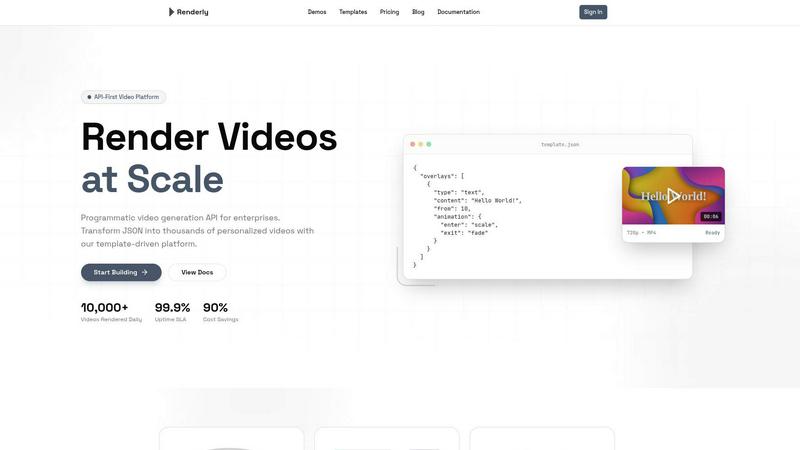
Renderly's API transforms JSON into thousands of personalized videos programmatically.
Last updated: February 28, 2026

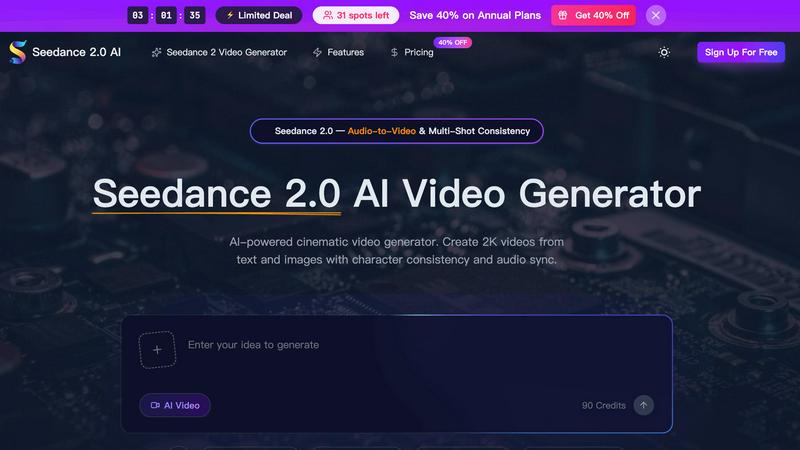
Seedance 2.0 creates cinematic AI videos from text or images with consistent characters and audio sync.
Last updated: February 28, 2026
Visual Comparison
Renderly
Seedance 2.0
Feature Comparison
Renderly
Programmatic Video Generation API
The cornerstone of Renderly is its RESTful API, designed for high-volume, automated video creation. Developers can send a POST request with a JSON payload containing template references and dynamic variables to instantly trigger a render. The API provides endpoints for checking job status, managing render queues, and retrieving finished videos, complete with webhook support for asynchronous workflows. This feature turns video production into a programmable utility, seamlessly integrable into any software stack for automated, data-driven content pipelines.
Template-Driven JSON Configuration
Renderly utilizes a powerful template system where videos are defined and controlled through JSON configuration files. Users create a master template in the online editor, specifying scenes, layers (text, images, video clips), animations, and timing. Dynamic elements are marked as variables. To generate personalized videos, the API simply swaps these variables with values from an incoming JSON object. This approach offers immense flexibility, version control capabilities, and the ability to manage complex video designs as code, enabling consistent branding and rapid iteration.
Enterprise-Grade Scalable Infrastructure
Built on a cloud-native, auto-scaling architecture, Renderly's infrastructure is engineered for demanding workloads. It automatically provisions resources to handle spikes from one to thousands of concurrent rendering jobs, ensuring consistent performance and speed regardless of volume. This eliminates the need for businesses to manage their own rendering farms or worry about capacity planning, providing an elastic, reliable backbone for mission-critical video production at any scale.
Transparent Credit-Based Pricing
Renderly employs a transparent, consumption-based pricing model centered on credits. Users pay only for the seconds of video they actually render, with costs decreasing through volume discounts. This model contrasts with fixed monthly subscriptions or expensive per-video fees of competitors, directly enabling the advertised up to 90% cost savings. The pricing is designed to be predictable and scalable alongside business needs, aligning cost directly with output.
Seedance 2.0
Cinematic 2K Text-to-Video Generation
Seedance 2.0's foundation is its powerful text-to-video capability, which interprets natural language prompts to generate videos up to 12 seconds long in stunning 2K resolution. Users can describe intricate scenes, specify character actions, and dictate complex camera movements like zooms, pans, and tracking shots. The AI renders these descriptions with a sophisticated understanding of cinematic principles, producing clips with realistic textures, accurate lighting, and natural motion that are immediately suitable for professional broadcast and commercial applications.
Multi-Shot Character Consistency Engine
This is a cornerstone feature that sets Seedance 2.0 apart. Its advanced multi-shot storytelling engine can "lock in" the visual identity of a character—including precise facial features, clothing details, and body proportions—across an unlimited number of different shots and camera angles. This allows creators to build episodic narratives, short films, or branded content series where characters remain visually identical from scene to scene, enabling coherent storytelling that was previously difficult to achieve with AI video tools.
Native Audio Generation & Lip-Sync
Unlike models that generate silent video, Seedance 2.0 produces synchronized audio natively in a single pass. The AI creates a complete soundscape, including ambient Foley effects, background music, and—most impressively—phoneme-accurate lip-sync for dialogue in over 8 languages. This feature also supports an audio-to-video mode, where users can upload their own voiceover, and the AI will animate a character's mouth movements to match the speech with near motion-capture precision, drastically simplifying the production pipeline.
Advanced Image & Video-to-Video Conversion
Beyond text, Seedance 2.0 can animate static images and extend existing video clips. The image-to-video mode breathes life into product photos, concept art, or portraits by adding natural, cinematic motion while meticulously preserving the original composition and fine details. The video extension capabilities allow creators to seamlessly lengthen their generated clips, providing greater flexibility in editing and storytelling without compromising on the consistency of style or quality.
Use Cases
Renderly
Personalized Marketing & Communication
Businesses can generate thousands of unique video messages for email campaigns, product launches, or customer win-backs. By merging a customer database (names, purchase history) with a video template, Renderly can produce individualized videos that address each recipient by name, showcase relevant products, or celebrate milestones, dramatically increasing engagement rates compared to static content.
Bulk Social Media Content Creation
Content teams and agencies can automate the production of social media clips for platforms like TikTok, Instagram Reels, and YouTube Shorts. A single template can be adapted with different text overlays, hashtags, and product images to create hundreds of variations for A/B testing, regional campaigns, or daily posting schedules, freeing creators from repetitive editing tasks.
Data Visualization & Reporting
Transform complex datasets into compelling motion graphics and explainer videos. Renderly can take structured data (e.g., quarterly sales figures, user analytics, sports statistics) and dynamically generate charts, graphs, and animated text summaries within a video format. This is ideal for creating automated weekly report videos, investor updates, or interactive educational content.
E-commerce & Onboarding Sequences
E-commerce platforms can integrate Renderly to create personalized video receipts, shipping notifications, or product tutorials featuring the specific items a customer purchased. Similarly, SaaS companies can automate user onboarding by generating welcome videos that include the new user's name and company logo, providing a tailored and engaging first experience directly through their app.
Seedance 2.0
Independent Film & Short Film Production
Aspiring and independent filmmakers can leverage Seedance 2.0 to produce high-concept short films, animated sequences, and proof-of-concept trailers without the need for large crews, actors, or expensive equipment. The multi-shot consistency allows for the creation of recurring characters, while the native audio generation handles dialogue and sound design, enabling solo creators to realize complex visual narratives that were once resource-prohibitive.
Marketing & Advertising Content Creation
Marketing teams and agencies can rapidly prototype and produce commercial advertisements, product demonstration videos, and social media campaign content. The ability to generate a consistent brand spokesperson or animated product across multiple videos ensures cohesive messaging. The 2K professional output means the content is ready for use across digital platforms, television, and online advertising, speeding up time-to-market for campaigns.
Educational & Explainer Video Development
Educators and instructional designers can create engaging animated explainer videos and educational content. Complex concepts can be visualized through custom-generated scenes and characters. The audio-to-video feature is particularly useful for synchronizing narration with animated visuals, making lessons more dynamic and accessible while allowing for easy updates and localization into different languages.
Concept Art & Storyboarding Visualization
Artists, game developers, and writers can use Seedance 2.0 to bring their static concept art, character designs, and storyboards to life. By uploading an image, they can see their creations move and interact in a realistic environment, providing a powerful tool for pitching ideas, testing visual concepts, and creating dynamic portfolios that showcase not just a single moment, but a scene in motion.
Overview
About Renderly
Renderly is a modern video infrastructure platform engineered to automate and scale video production through code. It fundamentally shifts the paradigm from manual, time-consuming video editing to a programmatic, API-driven approach. At its core, Renderly allows developers and creators to transform simple JSON data into thousands of unique, high-quality videos. This is achieved via a template-driven system where users design a video template once and then dynamically populate it with personalized text, images, and data variables via API calls. The platform serves a dual audience: developers in need of a robust, reliable API for embedding video generation into applications (like for marketing automation, user onboarding, or data visualization), and content creators or marketing teams looking to produce bulk social media content, personalized customer messages, or data-driven motion graphics without manual effort. Its primary value proposition is threefold: unprecedented scalability to handle from one to hundreds of thousands of concurrent renders, significant cost reduction (advertised as up to 90% savings), and a developer-first experience that prioritizes seamless integration, comprehensive documentation, and enterprise-grade reliability with a 99.9% uptime SLA.
About Seedance 2.0
Seedance 2.0 represents a paradigm shift in AI-powered video creation, moving beyond simple animation to offer a full-fledged cinematic video generator. At its core, it is an advanced AI model capable of transforming text descriptions, static images, or audio inputs into high-quality, 2K resolution videos. Its groundbreaking V2 motion synthesis engine is designed for creators who demand professional-grade output, enabling the generation of videos with realistic physics, smooth motion, and complex lighting effects. The platform is engineered for a diverse user base, including independent filmmakers, content creators, marketing teams, and product designers who need to produce engaging visual content rapidly and without extensive technical resources. The primary value proposition of Seedance 2.0 lies in its unique combination of multi-shot character consistency and native audio generation, allowing for the creation of coherent, episodic content with synchronized sound in a single, streamlined workflow. This eliminates the traditional barriers of maintaining visual continuity and separate audio post-production, positioning Seedance 2.0 not just as a tool, but as a collaborative AI director for the next generation of digital storytelling.
Frequently Asked Questions
Renderly FAQ
What kind of videos can I create with Renderly?
You can create a wide variety of video content, including personalized marketing messages, social media clips, data-driven motion graphics, explainer videos, and automated reports. The platform supports text overlays, images, animations, and scene transitions, all configurable via JSON templates. The limit is primarily defined by your template design and the dynamic data you feed into the API.
How does the API integration work?
Integration is straightforward. First, you design a template using Renderly's online editor or by defining a JSON structure. This template includes placeholder variables. Then, you use Renderly's SDKs or direct REST API calls from your application. You send a POST request to the /render endpoint with your template ID and a JSON object containing the values for your variables. The API returns a job ID, and you can poll the /status endpoint or use webhooks to retrieve the final video URL upon completion.
Is Renderly suitable for high-volume, enterprise workloads?
Absolutely. Renderly is built specifically for enterprise-scale video generation. Its auto-scaling, cloud-native infrastructure is designed to handle thousands of concurrent render jobs reliably, backed by a 99.9% uptime SLA. Features like comprehensive documentation, webhooks, SOC 2 compliance, and volume discounts are all tailored to meet the security, reliability, and performance demands of large organizations.
How does the credit-based pricing model calculate costs?
You purchase credits, and each credit corresponds to a second of rendered video output (at standard definition). The cost per credit decreases with higher volume purchases. You are only charged for the final duration of each video you generate. The platform provides a cost calculator tool to help estimate expenses, and billing is transparent, with detailed usage reports to track consumption.
Seedance 2.0 FAQ
What is the maximum video length and resolution Seedance 2.0 can generate?
Seedance 2.0 can generate videos up to 12 seconds in duration at a full 2K HD resolution (2048x1080 pixels). The platform supports various aspect ratios including 16:9, 9:16 for social media, 1:1, and cinematic 21:9, providing flexibility for different distribution channels. The video extension feature can be used to create longer sequences by seamlessly lengthening existing clips.
How does the Multi-Shot Character Consistency work?
The consistency engine uses advanced AI to create a unique, stable "identity signature" for each character you generate based on your initial prompt or uploaded image. Once this signature is established, you can reference the same character in subsequent prompts for different shots, scenes, or actions. The AI will maintain the core visual attributes—like face shape, hair, clothing color, and style—across all generated videos, ensuring the character remains recognizable and consistent.
Can I use my own audio or voiceover with Seedance 2.0?
Yes, absolutely. Seedance 2.0 features a dedicated audio-to-video mode. You can upload your own pre-recorded voiceover, dialogue, or soundtrack. The AI will then generate a video where the character's lip movements and facial expressions are synchronized to match your audio track with high accuracy. This allows for precise narrative control and the use of specific voice talent or branded audio.
What makes Seedance 2.0 different from other AI video generators?
Seedance 2.0 distinguishes itself through two primary, integrated capabilities: true multi-shot character consistency and native, synchronized audio generation. Many competitors focus solely on generating individual video clips without maintaining character identity across scenes or require separate tools for adding sound. Seedance 2.0 combines a professional 2K cinematic output, a 30% faster V2 generation engine, and these unified features into a single platform designed for coherent, production-ready storytelling.
Alternatives
Renderly Alternatives
Renderly is a video infrastructure platform that automates video production through code, falling into the category of programmable video generation and editing tools. It enables users to create thousands of personalized or data-driven videos via API or an online editor, moving beyond manual rendering. Users often explore alternatives for various reasons. These can include budget constraints, the need for different feature sets like more advanced editing or simpler interfaces, or specific platform requirements such as deeper integration with certain tech stacks or different output formats. When evaluating other options, key considerations should be the core automation capabilities, API robustness, scalability for bulk projects, ease of use for your team's skill set, and the overall cost structure. The right fit balances technical power with your specific production workflow needs.
Seedance 2.0 Alternatives
Seedance 2.0 is a powerful AI video generation platform, part of a competitive landscape where creators and businesses seek tools to bring visual stories to life. Users often explore alternatives for various practical reasons, including budget constraints, specific feature requirements not fully met, or a need for a different user experience and integration capabilities with their existing workflow. When evaluating other options, it's crucial to look beyond surface-level claims. Key considerations should include the underlying model's architecture and scale, which directly impact output quality and creativity. The efficiency of operation, especially for generating longer or complex scenes, is vital for practical use. Furthermore, the breadth of capabilities, such as supporting multi-modal tasks or offering extensive language support, can determine how versatile a tool is for diverse projects. --- FAQ_SEPARATOR--- [
{"question": "What is Seedance 2.0?", "answer": "Seedance 2.0, powered by the GLM 5 model, is a next-generation AI platform specializing in high-quality video generation, alongside advanced chat and image creation capabilities."},
{"question": "Who is Seedance 2.0 for?", "answer": "It is designed for developers, researchers, and businesses seeking a powerful, versatile AI tool for complex creative, analytical, and agentic applications requiring text, image, and video generation."},
{"question": "What are the main features of Seedance 2.0?", "answer": "Key features include a massive 745B parameter Mixture-of-Experts architecture for efficiency, a 128K context window for long-form processing, and state-of-the-art performance in reasoning, coding, and multi-modal generation."},
{"question": "Why choose Seedance 2.0?", "answer": "It offers exceptional performance rivaling leading models, with efficient inference, extensive language support, and is built for real-world, complex applications beyond basic generation tasks."}
]