
MeloLingua vs Psychiatry Exams
Side-by-side comparison to help you choose the right AI tool.

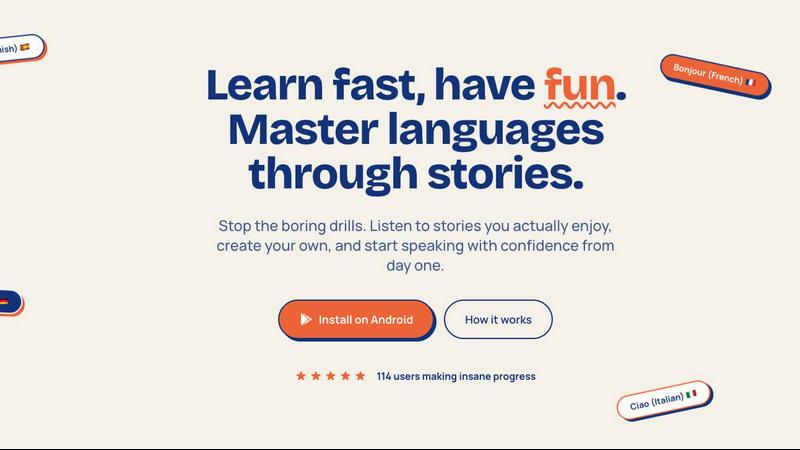
MeloLingua teaches languages through personalized stories, helping you listen, create, and speak confidently.
Last updated: February 28, 2026

Psychiatry Exams
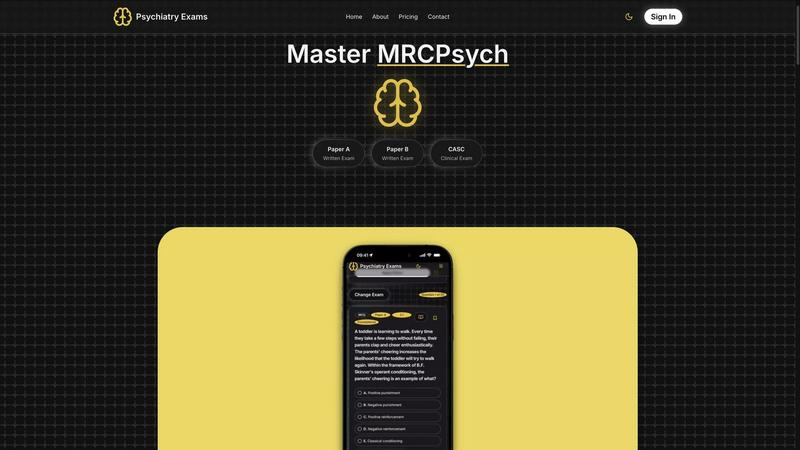
Master MRCPsych exams with AI explanations, recalled questions, and expert community support.
Last updated: March 1, 2026
Visual Comparison
MeloLingua
Psychiatry Exams
Feature Comparison
MeloLingua
AI-Powered Personal Story Generation
This is the engine of MeloLingua's innovative approach. Users input details about their interests, profession, or daily life, and the AI crafts coherent, level-appropriate short stories using that personal data. This ensures every lesson's vocabulary and grammar are immediately relevant, embedding language structures within the context of the learner's own world, which dramatically improves retention and emotional connection to the material.
Native Audio with Synchronized Text
Each personally generated story is accompanied by high-quality audio recorded by native speakers. Learners can listen while following along with perfectly synchronized text, creating a powerful dual-coding experience. This feature trains the ear to recognize the natural rhythm, intonation, and pronunciation of the language within a meaningful context, building listening comprehension skills far more effectively than artificial drills.
Interactive Tap-to-Learn Vocabulary
As users engage with their story's text, they can tap on any word or phrase to receive an instant definition, translation, and contextual example. This on-demand, in-context learning method allows for organic vocabulary acquisition exactly when curiosity strikes, eliminating the need to pause and switch to a separate dictionary app and keeping the flow of comprehension seamless.
AI Pronunciation Feedback & Speaking Practice
MeloLingua doesn't just teach passive comprehension; it actively builds speaking skills. Users can record themselves reading sentences or phrases from their story. The AI then analyzes their pronunciation, providing specific, actionable feedback on intonation, rhythm, and individual phonemes. This creates a safe, private space for deliberate practice, turning personal stories into tools for articulate self-expression.
Psychiatry Exams
Verified Recalled Question Bank
The cornerstone of the platform is its extensive library of over 2,400 questions, including 1,960 directly recalled from recent MRCPsych exam sittings. These questions are not simply archived; they are meticulously adapted, verified for accuracy, and contextualized by a team of eight NHS Consultants. This provides trainees with an unparalleled insight into the format, style, and clinical focus of the actual exams, offering a significant strategic advantage over generic commercial question banks.
AI-Powered Explanations & Syllabus Mapping
Every question is supported by comprehensive, multi-layered explanations generated by advanced AI systems (Claude Opus 4.5, Gemini 3, GPT 5.2) that are specifically trained on the official Royal College of Psychiatrists syllabus. This ensures explanations are not just factually correct but are pedagogically aligned with college learning objectives. The entire content library is mapped to the full syllabus for Paper A, Paper B, and CASC, giving users confidence they are covering all necessary material.
Active Learning & Peer Community
Psychiatry Exams moves beyond passive memorization through its innovative "Earn AI Credits" system. Users earn credits by contributing and peer-reviewing questions, which deepens their own understanding. This active engagement is supported by a vibrant, consultant-moderated WhatsApp community with dedicated discussion channels for each exam sitting, fostering collaborative learning, motivation, and real-time support from peers and experts.
Spaced Repetition Flashcard System
To combat knowledge decay and promote long-term retention, the platform integrates a sophisticated flashcard system utilizing spaced repetition algorithms. Users can create flashcards from any question or concept, and the system schedules reviews at optimal intervals to cement learning. This transforms isolated facts into durable knowledge, crucial for both exam success and clinical application.
Use Cases
MeloLingua
The Professional Seeking Career Advancement
A marketing manager needing to present to international clients can generate stories about campaign strategies, market analysis, and client meetings. This allows them to learn precise business vocabulary and formal sentence structures within their professional domain, leading to more confident and nuanced communication in work settings, rather than relying on generic travel phrases.
The Hobbyist Connecting with a Global Community
A photographer, chef, or guitarist can create stories around their craft—describing techniques, equipment, or creative processes. This enables them to engage deeply with forums, tutorials, and social media communities in the target language, transforming a personal passion into a bridge for authentic cultural and social connection.
The Traveler Preparing for Immersive Experiences
Instead of learning phrases for fictitious scenarios, a traveler can generate stories about their actual itinerary, dining preferences, and planned activities. Practicing language related to their specific journey—from asking for directions to a particular landmark to discussing food allergies—leads to more practical, confident, and enriched travel experiences.
The Lifelong Learner with Specific Personal Goals
Someone aiming to read literature, understand films, or communicate with a partner's family can tailor content to those exact objectives. They can generate stories that incorporate cultural nuances, familial terms, or narrative styles found in media, creating a direct and motivating link between daily practice and their ultimate, personal fluency goals.
Psychiatry Exams
The Systematic Exam Candidate
A trainee at the start of their revision cycle uses the platform's full syllabus coverage and mapped study notes to create a structured study plan. They work through topics methodically, using the recalled question bank to test their knowledge and the AI explanations to fill gaps in understanding, ensuring no part of the curriculum is missed.
The Active Contributor
A user seeking to deepen their conceptual grasp engages heavily with the active learning model. They regularly submit recalled questions for peer review and provide feedback on others' submissions. This process of creation and critique forces a higher-order engagement with the material, solidifying their knowledge and earning AI credits in the process.
The Community-Driven Learner
A trainee who finds solitary revision demotivating leverages the platform's integrated community. They participate in WhatsApp group discussions on challenging topics, join consultant-moderated group calls, and use the peer support network to stay accountable, share resources, and reduce the isolation of exam preparation.
The Last-Minute Revise
In the final weeks before the exam, a candidate uses the platform to focus on high-yield practice. They take timed mock exams built from recalled questions, use the flashcard system to rapidly review weak areas identified by analytics, and seek clarification on tricky points through the community, ensuring their preparation is targeted and efficient.
Overview
About MeloLingua
MeloLingua represents a paradigm shift in language acquisition, moving away from the sterile, one-size-fits-all approach of traditional apps. At its core, it is a language learning platform engineered around the profound power of personal narrative. The fundamental premise is simple yet revolutionary: you learn best when the material is intrinsically meaningful to you. Instead of drilling disconnected vocabulary lists or rehearsing scripted dialogues about booking hotels, MeloLingua generates short, natural stories based on your unique life—your career, hobbies, daily routines, and personal goals. This transforms the learning process from a chore into an engaging exploration of self-expression in a new language. By listening to native-level audio of your own story, following synchronized text, and practicing pronunciation with AI feedback, you build listening confidence and speaking fluency in a context that matters. It's designed for the motivated learner who finds generic content disengaging and seeks a deeper, more consistent, and personally resonant path to language mastery. The value proposition is clear: achieve natural, confident communication by making the language your own, from day one.
About Psychiatry Exams
Psychiatry Exams is a transformative digital platform engineered to redefine preparation for the MRCPsych examinations. It addresses the core challenges faced by psychiatry trainees: the exorbitant cost of commercial resources, the fragmentation of study materials, and the passive, often isolating nature of traditional revision. The platform consolidates the entire exam ecosystem—from official syllabus content and high-yield question banks to mock exams and peer support—into a single, intelligent, and mobile-friendly membership. Its primary user base consists of dedicated psychiatry trainees across all stages, from CT1 to ST6, who seek not just to pass their exams but to build a consultant-level clinical understanding.
The platform's revolutionary value proposition lies in its synthesis of authentic, recalled exam content with cutting-edge pedagogical technology. Unlike static question banks, it leverages a vast repository of questions verified by NHS Consultants and enriches them with AI-powered explanations from leading models like Claude Opus and GPT-5.2, all trained on the Royal College syllabus. More than just a study tool, Psychiatry Exams pioneers an active learning methodology. It incentivizes users to contribute to and peer-review the question bank, turning passive consumers into engaged creators. This, combined with a consultant-moderated community and a sophisticated flashcard system, transforms exam preparation from a solitary financial burden into a dynamic, collaborative, and intellectually rigorous journey that builds critical thinking skills essential for future practice.
Frequently Asked Questions
MeloLingua FAQ
How does learning through personal stories differ from traditional methods?
Traditional methods often rely on memorization and decontextualized exercises, which can feel abstract and forgettable. MeloLingua's story-based approach embeds grammar and vocabulary within narratives about your life. This creates emotional hooks and real-world context, which cognitive science shows significantly enhances memory encoding, retention, and the ability to recall and use language spontaneously.
What if I'm a complete beginner? Will the stories be too complex?
The AI is designed to scale complexity based on your designated proficiency level. For a true beginner, stories will utilize high-frequency vocabulary and simple sentence structures, gradually increasing in sophistication as you progress. The content remains personal and comprehensible, ensuring you are always learning within your "i+1" zone—understanding most of the input while being gently challenged.
Can I use MeloLingua to learn any language?
The available languages depend on MeloLingua's current library of native speaker audio and AI models. While the provided context doesn't specify a list, the platform's design is inherently multi-language. The core methodology—generating personal stories and providing synchronized audio—can be applied to any language for which the necessary linguistic infrastructure and voice recordings are in place.
Is the AI pronunciation feedback accurate and helpful?
The AI feedback system is engineered to analyze key aspects of speech, such as vowel/consonant accuracy, word stress, and sentence-level intonation patterns. While it may not replicate the nuanced ear of a human tutor, it provides consistent, immediate, and objective feedback on specific pronunciation points, allowing for targeted practice that builds muscle memory and auditory self-awareness effectively.
Psychiatry Exams FAQ
How accurate and reliable are the recalled questions?
The recalled questions are the platform's most valued asset. Every submitted question undergoes a rigorous verification and adaptation process by a panel of eight NHS Consultants who are familiar with the MRCPsych exam. This ensures clinical accuracy, relevance to the current syllabus, and appropriateness for training purposes, making them a highly reliable reflection of the exam's content and style.
What makes the AI explanations better than standard answer rationales?
The AI explanations are powered by state-of-the-art models specifically fine-tuned on the Royal College syllabus and psychiatric textbooks. This means they provide nuanced, context-rich explanations that link back to core learning objectives, rather than just stating a correct answer. They synthesize consultant expertise with the latest evidence, offering deeper insights into the "why" behind each answer.
How does the "Earn AI Credits" system work?
The system incentivizes active participation. Users earn +2 AI credits for each question they submit to the bank. If their submitted question is approved by the consultant moderators, they receive a +3 credit bonus. These credits can be used within the platform, fostering a collaborative ecosystem where users contribute to and benefit from the collective knowledge pool.
Is the platform sufficient as a standalone resource for MRCPsych?
Psychiatry Exams is designed as a comprehensive, all-in-one hub that consolidates the key resources needed to pass: a question bank, syllabus notes, mock exams, and a learning community. While it covers the entire syllabus and uses official reading lists, most successful candidates view it as a primary, interactive core resource that effectively replaces expensive commercial question banks and courses, though it may be supplemented with personal note-taking and textbook reading.
Alternatives
MeloLingua Alternatives
MeloLingua is a unique language learning app that focuses on personal storytelling. It belongs to the broader category of language acquisition tools, but it carves its own niche by generating lessons from a user's own life and interests, moving away from generic vocabulary drills. This approach makes learning deeply relevant and engaging from the very first lesson. Users may explore alternatives for various practical reasons. Common considerations include budget constraints and subscription pricing models, the need for specific features like offline access or support for less common languages, and compatibility with different devices or operating systems. Personal learning style preferences, such as a desire for more traditional grammar instruction or a different type of interactive content, also drive this search. When evaluating other options, it's wise to consider what truly motivates your learning journey. Look for a method that aligns with your goals, whether that's conversational fluency, travel preparation, or professional development. The ideal platform should fit seamlessly into your daily routine, offer content that holds your interest, and provide the right balance of instruction, practice, and feedback to build your confidence.
Psychiatry Exams Alternatives
Psychiatry Exams is a comprehensive digital learning platform in the education and learning category, specifically engineered to support psychiatry trainees preparing for the challenging MRCPsych examinations. It consolidates high-yield resources into a single, intelligent membership. Candidates often explore alternatives for various reasons, including budget constraints, a preference for different learning methodologies, or the need for a platform with a specific feature focus, such as pure question banks versus in-depth theory modules. The search for a different user experience or community structure also drives this exploration. When evaluating any study tool, key considerations should include the clinical accuracy and provenance of its content, the depth and pedagogical value of its explanations, and how well it supports active, critical thinking over rote memorization. Alignment with the official syllabus and the quality of expert or peer support are also crucial differentiators.