
Interactive Circle of Fifths vs Psychiatry Exams
Side-by-side comparison to help you choose the right AI tool.

Interactive Circle of Fifths
Master scales and chords effortlessly with the Interactive Circle of Fifths, your essential tool for musical growth.
Last updated: March 1, 2026

Psychiatry Exams
Master MRCPsych exams with AI explanations, recalled questions, and expert community support.
Last updated: March 1, 2026
Visual Comparison
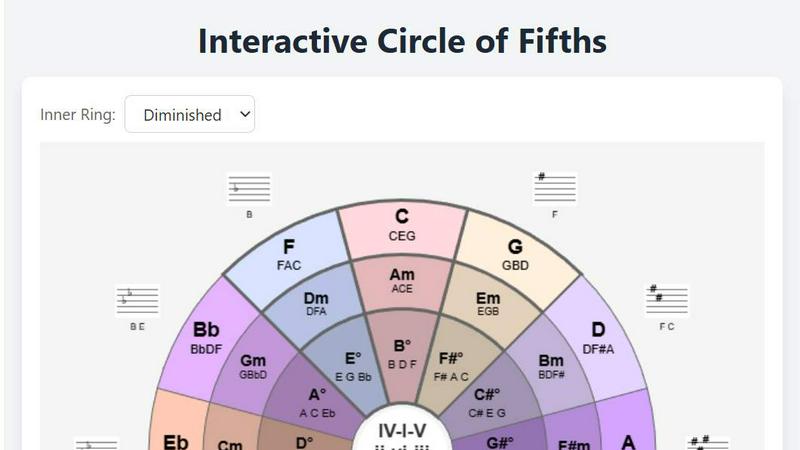
Interactive Circle of Fifths
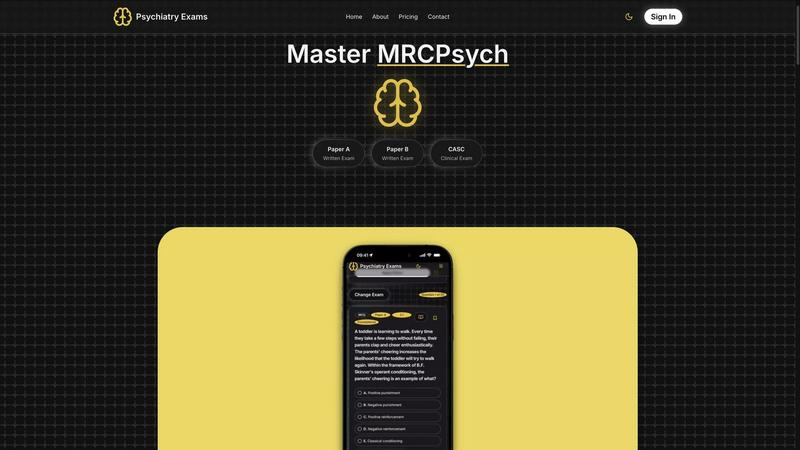
Psychiatry Exams
Feature Comparison
Interactive Circle of Fifths
Visualizers for Piano and Guitar
The Interactive Circle of Fifths includes dedicated visualizers for both piano and guitar, allowing users to see chord diagrams and fingerings in real-time. This feature enhances learning by providing a practical way to visualize how chords are structured and how to play them effectively on each instrument.
Extensive Scale Library
This tool offers an extensive library of musical scales, including the pentatonic, blues, diatonic, and diminished scales. Each scale is thoroughly explained, demonstrating its unique qualities and applications, which empowers users to diversify their musical toolkit and improve their improvisation skills.
Harmonized Scale and Chord Sequencer
With the harmonized scale feature, users can explore how chords relate to each note within a scale. The integrated chord sequencer allows musicians to create and experiment with their own chord progressions, giving them the freedom to compose and innovate in a structured manner.
Interactive Learning Experience
The Interactive Circle of Fifths transforms learning into an engaging experience by audibly demonstrating how different chords interact within various scales. This interactive approach helps reinforce theoretical concepts, making it easier for users to internalize complex musical ideas and apply them in practice.
Psychiatry Exams
Verified Recalled Question Bank
The cornerstone of the platform is its extensive library of over 2,400 questions, including 1,960 directly recalled from recent MRCPsych exam sittings. These questions are not simply archived; they are meticulously adapted, verified for accuracy, and contextualized by a team of eight NHS Consultants. This provides trainees with an unparalleled insight into the format, style, and clinical focus of the actual exams, offering a significant strategic advantage over generic commercial question banks.
AI-Powered Explanations & Syllabus Mapping
Every question is supported by comprehensive, multi-layered explanations generated by advanced AI systems (Claude Opus 4.5, Gemini 3, GPT 5.2) that are specifically trained on the official Royal College of Psychiatrists syllabus. This ensures explanations are not just factually correct but are pedagogically aligned with college learning objectives. The entire content library is mapped to the full syllabus for Paper A, Paper B, and CASC, giving users confidence they are covering all necessary material.
Active Learning & Peer Community
Psychiatry Exams moves beyond passive memorization through its innovative "Earn AI Credits" system. Users earn credits by contributing and peer-reviewing questions, which deepens their own understanding. This active engagement is supported by a vibrant, consultant-moderated WhatsApp community with dedicated discussion channels for each exam sitting, fostering collaborative learning, motivation, and real-time support from peers and experts.
Spaced Repetition Flashcard System
To combat knowledge decay and promote long-term retention, the platform integrates a sophisticated flashcard system utilizing spaced repetition algorithms. Users can create flashcards from any question or concept, and the system schedules reviews at optimal intervals to cement learning. This transforms isolated facts into durable knowledge, crucial for both exam success and clinical application.
Use Cases
Interactive Circle of Fifths
Beginner Music Education
For beginners, the Interactive Circle of Fifths serves as an essential educational tool, providing foundational knowledge of music theory. It simplifies complex concepts and enables newcomers to learn chord progressions and scales through interactive visualization, making the learning process enjoyable and effective.
Advanced Composition
Advanced musicians can leverage the Interactive Circle of Fifths to explore sophisticated chord progressions and harmonization techniques. By experimenting with the chord sequencer and harmonized scales, they can create unique compositions that push the boundaries of their musical creativity.
Improvisation Practice
Musicians looking to enhance their improvisational skills can use the extensive scale library to practice playing over different chord progressions. The tool's ability to visualize how chords relate to scales allows users to make informed choices in their improvisation, leading to more dynamic performances.
Teaching Tool for Instructors
Music educators can incorporate the Interactive Circle of Fifths into their teaching methodologies to demonstrate chord relationships and scales to their students. Its visual and auditory features provide a multifaceted approach to music theory, making it a valuable resource in the classroom setting.
Psychiatry Exams
The Systematic Exam Candidate
A trainee at the start of their revision cycle uses the platform's full syllabus coverage and mapped study notes to create a structured study plan. They work through topics methodically, using the recalled question bank to test their knowledge and the AI explanations to fill gaps in understanding, ensuring no part of the curriculum is missed.
The Active Contributor
A user seeking to deepen their conceptual grasp engages heavily with the active learning model. They regularly submit recalled questions for peer review and provide feedback on others' submissions. This process of creation and critique forces a higher-order engagement with the material, solidifying their knowledge and earning AI credits in the process.
The Community-Driven Learner
A trainee who finds solitary revision demotivating leverages the platform's integrated community. They participate in WhatsApp group discussions on challenging topics, join consultant-moderated group calls, and use the peer support network to stay accountable, share resources, and reduce the isolation of exam preparation.
The Last-Minute Revise
In the final weeks before the exam, a candidate uses the platform to focus on high-yield practice. They take timed mock exams built from recalled questions, use the flashcard system to rapidly review weak areas identified by analytics, and seek clarification on tricky points through the community, ensuring their preparation is targeted and efficient.
Overview
About Interactive Circle of Fifths
The Interactive Circle of Fifths is an innovative musical tool that serves as a bridge between music theory and practical application, tailored for musicians at all levels. This dynamic platform demystifies the relationships between chords in various keys, promoting a richer understanding of harmony and scale construction. It caters to beginners who are just starting their musical journey, as well as advanced musicians seeking to refine their skills and explore intricate chord progressions. By providing both visual and auditory representations of chord interactions, users can effectively grasp the connections between different musical elements. The product features intuitive visualizers for piano and guitar, making it easier to learn fingerings while simultaneously understanding theoretical concepts. Additionally, it covers a diverse range of scales, including pentatonic, blues, diatonic, and diminished, positioning the Interactive Circle of Fifths as an essential resource for anyone looking to expand their musical vocabulary and enhance their improvisation skills.
About Psychiatry Exams
Psychiatry Exams is a transformative digital platform engineered to redefine preparation for the MRCPsych examinations. It addresses the core challenges faced by psychiatry trainees: the exorbitant cost of commercial resources, the fragmentation of study materials, and the passive, often isolating nature of traditional revision. The platform consolidates the entire exam ecosystem—from official syllabus content and high-yield question banks to mock exams and peer support—into a single, intelligent, and mobile-friendly membership. Its primary user base consists of dedicated psychiatry trainees across all stages, from CT1 to ST6, who seek not just to pass their exams but to build a consultant-level clinical understanding.
The platform's revolutionary value proposition lies in its synthesis of authentic, recalled exam content with cutting-edge pedagogical technology. Unlike static question banks, it leverages a vast repository of questions verified by NHS Consultants and enriches them with AI-powered explanations from leading models like Claude Opus and GPT-5.2, all trained on the Royal College syllabus. More than just a study tool, Psychiatry Exams pioneers an active learning methodology. It incentivizes users to contribute to and peer-review the question bank, turning passive consumers into engaged creators. This, combined with a consultant-moderated community and a sophisticated flashcard system, transforms exam preparation from a solitary financial burden into a dynamic, collaborative, and intellectually rigorous journey that builds critical thinking skills essential for future practice.
Frequently Asked Questions
Interactive Circle of Fifths FAQ
How does the Interactive Circle of Fifths help with music theory?
The Interactive Circle of Fifths visually demonstrates the relationships between chords and scales, enabling users to understand music theory concepts more clearly. By providing both visual and auditory examples, it makes complex ideas more accessible.
Is the Interactive Circle of Fifths suitable for all skill levels?
Yes, the tool is designed for musicians of all skill levels, from complete beginners to advanced players. Its comprehensive features cater to a wide range of learning needs, ensuring everyone can benefit from its resources.
Can I use the Interactive Circle of Fifths for both piano and guitar?
Absolutely! The Interactive Circle of Fifths includes dedicated visualizers for both piano and guitar, allowing users to learn fingerings and chords specific to each instrument, enhancing their overall musical abilities.
What types of scales are included in the Interactive Circle of Fifths?
The tool features an extensive library of scales, including pentatonic, blues, diatonic, and diminished scales. Each scale is explained in detail, helping users understand its applications and unique characteristics in various musical contexts.
Psychiatry Exams FAQ
How accurate and reliable are the recalled questions?
The recalled questions are the platform's most valued asset. Every submitted question undergoes a rigorous verification and adaptation process by a panel of eight NHS Consultants who are familiar with the MRCPsych exam. This ensures clinical accuracy, relevance to the current syllabus, and appropriateness for training purposes, making them a highly reliable reflection of the exam's content and style.
What makes the AI explanations better than standard answer rationales?
The AI explanations are powered by state-of-the-art models specifically fine-tuned on the Royal College syllabus and psychiatric textbooks. This means they provide nuanced, context-rich explanations that link back to core learning objectives, rather than just stating a correct answer. They synthesize consultant expertise with the latest evidence, offering deeper insights into the "why" behind each answer.
How does the "Earn AI Credits" system work?
The system incentivizes active participation. Users earn +2 AI credits for each question they submit to the bank. If their submitted question is approved by the consultant moderators, they receive a +3 credit bonus. These credits can be used within the platform, fostering a collaborative ecosystem where users contribute to and benefit from the collective knowledge pool.
Is the platform sufficient as a standalone resource for MRCPsych?
Psychiatry Exams is designed as a comprehensive, all-in-one hub that consolidates the key resources needed to pass: a question bank, syllabus notes, mock exams, and a learning community. While it covers the entire syllabus and uses official reading lists, most successful candidates view it as a primary, interactive core resource that effectively replaces expensive commercial question banks and courses, though it may be supplemented with personal note-taking and textbook reading.
Alternatives
Interactive Circle of Fifths Alternatives
The Interactive Circle of Fifths is a dynamic educational tool designed to help musicians grasp music theory, focusing on the intricate relationships between chords and scales. As a resource that caters to all skill levels, it proves invaluable for both beginners and seasoned players looking to enhance their understanding of harmony. Users often seek alternatives to the Interactive Circle of Fifths due to factors such as pricing, specific features that may better suit their needs, or compatibility with different platforms. When exploring alternatives, it is essential to consider the breadth of features offered, such as visualization tools and the variety of scales available. Additionally, users should assess how well an alternative integrates with their preferred instrument and whether it provides a user-friendly experience. Ultimately, the right choice will depend on individual learning styles and specific musical goals.
Psychiatry Exams Alternatives
Psychiatry Exams is a comprehensive digital learning platform in the education and learning category, specifically engineered to support psychiatry trainees preparing for the challenging MRCPsych examinations. It consolidates high-yield resources into a single, intelligent membership. Candidates often explore alternatives for various reasons, including budget constraints, a preference for different learning methodologies, or the need for a platform with a specific feature focus, such as pure question banks versus in-depth theory modules. The search for a different user experience or community structure also drives this exploration. When evaluating any study tool, key considerations should include the clinical accuracy and provenance of its content, the depth and pedagogical value of its explanations, and how well it supports active, critical thinking over rote memorization. Alignment with the official syllabus and the quality of expert or peer support are also crucial differentiators.