
Agent to Agent Testing Platform vs PoYo API
Side-by-side comparison to help you choose the right AI tool.

Agent to Agent Testing Platform
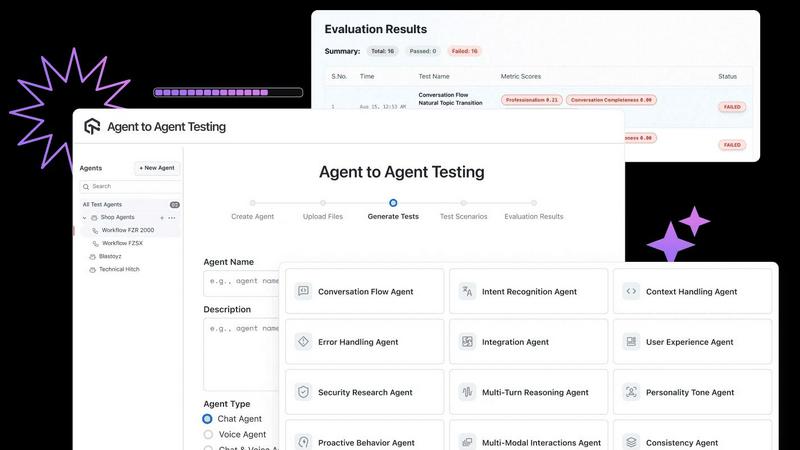
TestMu AI validates AI agents for bias, toxicity, and reliability across all interaction modes.
Last updated: February 28, 2026

PoYo API
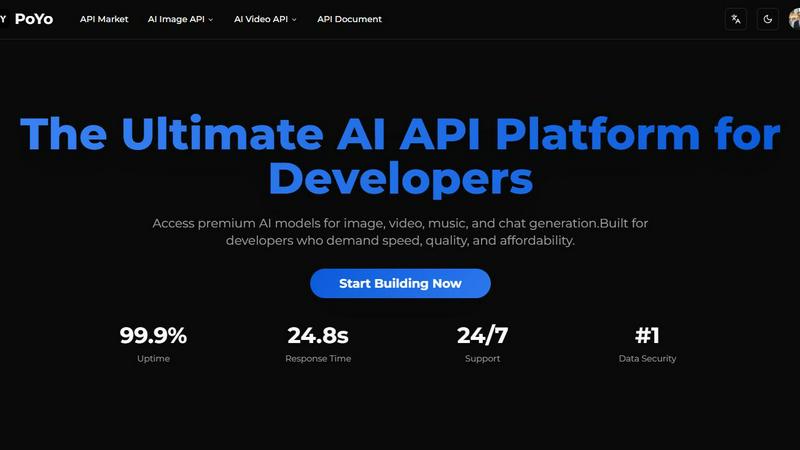
PoYo API gives developers one unified platform for premium AI image, video, music, and chat generation.
Last updated: February 28, 2026
Visual Comparison
Agent to Agent Testing Platform
PoYo API
Feature Comparison
Agent to Agent Testing Platform
Autonomous Multi-Agent Test Generation
The platform deploys a suite of over 17 specialized AI agents, each designed to probe different aspects of the Agent Under Test (AUT). These include agents focused on personality tone, data privacy, intent recognition, and more. This multi-agent system autonomously generates diverse, complex test scenarios that simulate real human conversation patterns, uncovering edge cases and interaction failures that manual or scripted testing would inevitably miss, ensuring comprehensive behavioral validation.
True Multi-Modal Understanding and Testing
Going far beyond text-based analysis, this feature allows testers to define requirements using diverse inputs such as images, audio files, and video. By uploading PRDs or directly specifying multi-modal prompts, teams can gauge how their AI agent processes and responds to real-world, mixed-media inputs. This ensures the agent's performance is robust across all interaction types it is designed to handle, mirroring actual user environments.
Diverse Persona-Based Synthetic User Testing
To test like real humans, the platform enables simulations using a wide variety of predefined and custom user personas, such as an "International Caller" or a "Digital Novice." Each persona exhibits different behaviors, needs, and interaction styles. This diversity ensures the AI agent is evaluated for effectiveness and empathy across the entire spectrum of its intended user base, highlighting potential biases or performance drops with specific demographics.
Integrated Regression Testing with Risk Scoring
The platform facilitates end-to-end regression testing for AI agents with intelligent risk scoring. After changes or updates, it automatically re-runs test suites and provides a detailed risk assessment, highlighting potential areas of concern. This allows teams to prioritize critical issues, optimize testing efforts, and maintain a high standard of quality and reliability throughout the agent's development lifecycle with clear, actionable insights.
PoYo API
Unified Multi-Model API Gateway
PoYo API consolidates access to a vast library of over 500 specialized AI models for image, video, music, and chat generation through a single, consistent endpoint. This eliminates the need for developers to manage disparate API keys, documentation, and billing systems from multiple providers. The unified gateway standardizes request and response formats, streamlining the development process and allowing for rapid prototyping and switching between state-of-the-art models like Nano Banana, Sora 2, Claude Sonnet, and Suno v5 without rewriting core application logic.
Flexible Credit-Based Pricing Model
Departing from the industry norm of rigid monthly subscriptions, PoYo employs a transparent, pay-as-you-go credit system. Users purchase credits that never expire and are consumed based on the specific model and task complexity. This model provides exceptional financial flexibility, enabling startups to control costs tightly and large enterprises to scale usage based on real demand without vendor lock-in. The pricing is notably competitive, with features like uniform pricing for different image resolutions offering clear value against competitors.
Enterprise-Grade Infrastructure & Security
The platform is built with professional and security-conscious teams in mind. It guarantees 99.9% uptime and ultra-low latency, supporting high-concurrency requests essential for public-facing applications. Security is paramount; API keys are stored with encryption following industry standards, and a zero-knowledge architecture ensures sensitive credentials remain protected. Comprehensive audit logging provides teams with the necessary tools for compliance monitoring and security oversight.
Developer-Centric Tools & Support
PoYo prioritizes developer experience with practical tools that accelerate integration. This includes a free playground for testing all models without commitment, a simple two-endpoint async API for easy implementation, and webhook support for efficient task lifecycle management. Crucially, this is backed by 24/7 technical support from human experts and robust monitoring systems, ensuring developers receive actionable help and can maintain reliable service for their own end-users.
Use Cases
Agent to Agent Testing Platform
Pre-Production Validation for Customer Service Chatbots
Before launching a new customer support chatbot, enterprises can use the platform to simulate thousands of customer inquiries, from simple FAQ retrieval to complex, multi-issue troubleshooting. This validates the agent's accuracy, escalation logic, policy adherence, and tone, ensuring it reduces live agent handoffs and maintains brand professionalism before interacting with real customers.
Compliance and Safety Auditing for Financial Voice Assistants
Banks and fintech companies deploying voice-activated assistants for balance inquiries or transactions require stringent compliance checks. The platform tests for data privacy violations, hallucination of financial data, and appropriate security escalation protocols. It autonomously probes for toxic or biased responses under stress, ensuring the agent meets strict regulatory and ethical standards.
Scalable Performance Benchmarking for Sales AI Agents
Sales teams implementing AI agents for lead qualification can benchmark performance at scale. The platform uses diverse buyer personas to test the agent's ability to recognize purchase intent, handle objections, and provide accurate product information across countless simulated conversations, providing metrics on effectiveness and conversion pathway reliability.
Continuous Monitoring and Improvement of Healthcare Assistants
For healthcare providers using AI for patient intake or symptom triage, consistent and accurate performance is critical. The platform enables continuous regression testing after every model update, checking for hallucinations in medical advice, maintaining empathy in tone, and ensuring correct handoff to human professionals, thereby mitigating risk and improving patient trust over time.
PoYo API
Content Creation & Marketing Automation
Marketing teams and content agencies can leverage PoYo to automate and scale the generation of visual and audio assets. This includes creating unique social media graphics, promotional videos, and custom background music for campaigns. By integrating the API into their workflows, they can produce high-volume, on-brand content dynamically, responding to trends in real-time while significantly reducing reliance on manual design work and stock media libraries.
Next-Generation SaaS Applications
SaaS developers can embed advanced AI capabilities directly into their products using PoYo as the engine. For instance, a design tool could integrate AI image generation for mockups, a video editing platform could offer AI-powered scene extension, or a productivity app could include an intelligent chat assistant. This allows SaaS companies to enhance their feature set and competitive edge without investing millions in training their own foundational models.
AI-Powered Entertainment & Media
Gaming studios, interactive media producers, and entertainment platforms can use PoYo's diverse APIs to create immersive, dynamic experiences. This ranges from generating in-game assets and character dialogues on-the-fly, to composing adaptive soundtracks, or even creating short narrative video clips for interactive stories. The API's low latency and high concurrency make it suitable for real-time or near-real-time applications in entertainment.
Research, Prototyping & Innovation
Researchers, indie developers, and innovation labs benefit from PoYo's accessible playground and flexible pricing to experiment with the frontier of AI. They can rapidly prototype new applications, compare the outputs of hundreds of leading models for a specific task, and validate concepts before committing to large-scale development. This lowers the barrier to entry for exploring generative AI's potential across countless domains.
Overview
About Agent to Agent Testing Platform
Agent to Agent Testing Platform represents a paradigm shift in quality assurance, engineered specifically for the unpredictable and autonomous nature of modern AI agents. As enterprises rapidly deploy conversational AI across chatbots, voice assistants, and phone-calling agents, traditional testing frameworks—designed for deterministic, static software—fail to capture the dynamic, multi-turn complexities of agentic systems. This platform is the first AI-native quality and assurance framework built to close that critical gap. It provides a unified environment to rigorously validate AI behavior before production, simulating thousands of real-world user interactions across chat, voice, and multimodal channels. By moving beyond simple prompt checks to evaluate full conversational flows, it empowers development and QA teams to proactively uncover long-tail failures, edge cases, and subtle interaction flaws. The core value proposition lies in its autonomous, multi-agent testing approach, which leverages over 17 specialized AI agents to generate tests, assess key metrics like bias, toxicity, and hallucination, and ensure reliability, safety, and policy compliance at scale. It is designed for organizations that rely on AI for customer service, sales, support, and other mission-critical interactions, offering them the confidence that their AI agents will perform as intended for every user.
About PoYo API
PoYo API stands as a paradigm shift in the developer-centric AI landscape, moving beyond a simple aggregation of models to become a holistic infrastructure platform. It is engineered for developers, startups, and established enterprises who seek to integrate cutting-edge generative AI—spanning images, video, music, and conversational chat—without the operational overhead typically associated with managing multiple vendor APIs. Its core value proposition is a trifecta of simplicity, performance, and cost-efficiency. By providing a single, unified API key and a standardized interface to over 500 premium AI models, PoYo dramatically reduces integration complexity and development time. This is further amplified by a unique credit-based pricing model that eschews recurring subscriptions, allowing teams to pay only for actual consumption and scale predictably. Underpinning this accessibility is a robust foundation of enterprise-grade security, 99.9% uptime SLA, and sub-50ms response times, ensuring that applications built on PoYo are not only powerful and affordable but also production-ready and reliable from day one.
Frequently Asked Questions
Agent to Agent Testing Platform FAQ
What makes Agent-to-Agent Testing different from traditional QA?
Traditional QA is built for deterministic software with predictable inputs and outputs. AI agents, however, are probabilistic and engage in dynamic, multi-turn conversations. Agent-to-Agent Testing is a native framework designed for this complexity. It uses other AI agents to generate and evaluate full conversational flows across modalities, testing for emergent behaviors, reasoning flaws, and real-world interaction patterns that scripted tests cannot replicate.
What key metrics does the platform evaluate for an AI agent?
The platform provides deep, actionable evaluation across a plethora of key AI performance and safety metrics. This includes assessing the agent for bias and toxicity in its responses, identifying hallucinations (fabricated information), and measuring effectiveness, accuracy, empathy, and professionalism. It also validates specific functional logic like escalation protocols and data privacy compliance.
Can I test voice and phone-calling agents, or is it only for chatbots?
Absolutely. The platform is built for true multi-modal testing. It supports the validation of AI agents across all major interaction channels: text-based chat, voice assistants, and inbound/outbound phone-calling agents. You can define test scenarios that simulate authentic voice or hybrid interactions, ensuring your agent performs reliably regardless of how the user communicates.
How does the platform handle test scenario creation?
The platform offers two powerful approaches. First, it provides autonomous test generation where its library of specialized AI agents creates diverse, production-like scenarios. Second, it allows teams to access a library of hundreds of pre-built scenarios or create completely custom scenarios tailored to specific business needs and user journeys, offering both flexibility and comprehensive coverage.
PoYo API FAQ
How does the credit-based pricing work?
Credits are the universal currency on PoYo. You purchase a pack of credits (which do not expire) and different AI models consume a specific number of credits per task. For example, generating an image with Nano Banana 2 might cost $0.025 worth of credits, while a more complex video generation with Sora 2 Pro might cost $0.50. You only pay for the tasks you successfully complete, and your credit balance scales with your usage, eliminating monthly subscription fees.
Is there a free tier or way to test the API?
Yes, PoYo provides a comprehensive free testing environment. You can access the interactive playground on each model's page to experiment with generation parameters, submit prompts, and see outputs without spending any credits or providing a credit card. This allows you to evaluate model quality, fine-tune your requests, and ensure the API meets your needs before any financial commitment.
What happens if a generation task fails?
PoYo's system is designed with developer cost in mind. If a generation task fails due to a system or model error on PoYo's side, you are not charged any credits for that attempt. The platform also provides manual retry options from your dashboard for full control over your workflow, ensuring you only pay for successful, usable outputs.
How does the API handle long-running tasks like video generation?
For tasks that take longer to process, such as video generation, PoYo uses an efficient asynchronous API design. You submit a task and receive a unique task ID. You can then either poll for results using this ID or, more efficiently, configure a webhook URL to which PoYo will send an instant automatic callback notification the moment your task is completed, enabling seamless integration into automated workflows.
Alternatives
Agent to Agent Testing Platform Alternatives
Agent to Agent Testing Platform is a specialized AI-native quality assurance framework designed for validating the behavior of autonomous AI agents. It belongs to the AI Assistants and agentic systems testing category, focusing on multi-turn, multimodal interactions that traditional software QA tools cannot adequately assess. Users often explore alternatives for various reasons, including budget constraints, the need for different feature sets like integration with specific development environments, or requirements for a more general-purpose testing solution that covers non-agentic software as well. Some may seek platforms with different pricing models or those that focus on a narrower aspect of testing, such as only chat-based interfaces. When evaluating an alternative, key considerations should include the platform's ability to simulate complex, real-world user interactions across your required channels (voice, chat, etc.), its methodology for generating edge-case tests, and the depth of its validation for security, compliance, and operational logic. The ideal solution should provide scalable, automated testing that mirrors production complexity to ensure agent reliability and safety before deployment.
PoYo API Alternatives
PoYo API is a unified platform providing developers with streamlined access to over 500 premium AI models for generating images, videos, music, and chat. It falls within the AI Assistants and generative AI API category, designed to simplify integration through a single key and a flexible credit system. Developers often explore alternatives for various reasons. These can include specific budgetary constraints, the need for different or more specialized AI models not covered, or requirements for a particular deployment model like on-premise solutions. Platform-specific needs, such as deeper integration with certain cloud ecosystems or different support structures, also drive the search for other options. When evaluating alternatives, key considerations should include the breadth and quality of the available AI models, the transparency and structure of the pricing model, and the reliability measured in uptime and latency. Security protocols and the quality of developer support are also critical factors that can significantly impact the success of an AI-powered project.