
conceptviz vs Postproxy
Side-by-side comparison to help you choose the right AI tool.

conceptviz
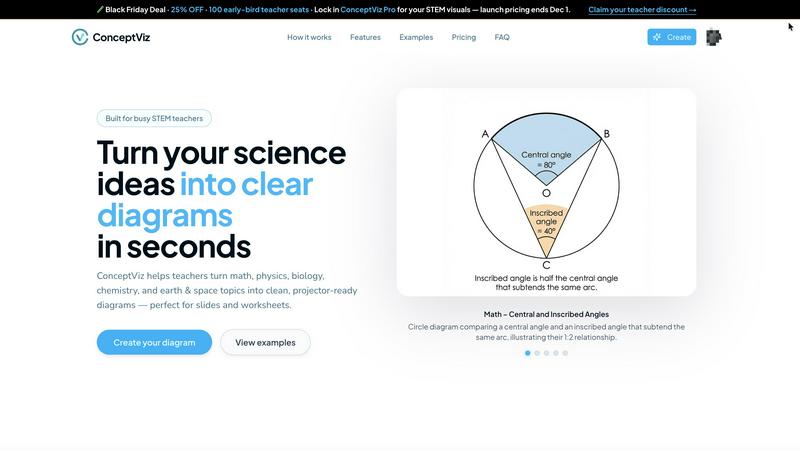
ConceptViz instantly creates clear, classroom-ready science and math diagrams from your text descriptions.
Last updated: February 28, 2026

Postproxy
Postproxy's single API publishes your content reliably across all major social networks.
Last updated: February 28, 2026
Visual Comparison
conceptviz
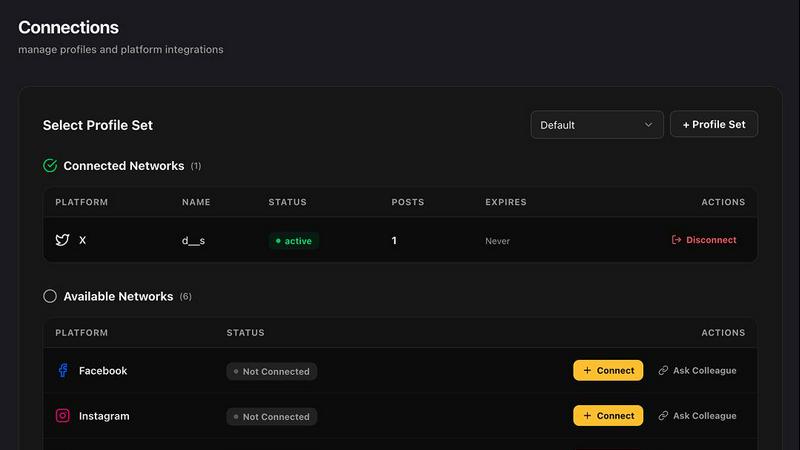
Postproxy
Feature Comparison
conceptviz
Subject & Grade-Level Presets
ConceptViz is built with pedagogical intelligence, offering quick-start presets for core STEM subjects including Physics, Biology, Chemistry, Earth & Space, and Math. Crucially, these presets are tuned with grade-level awareness, working with U.S. grade bands like elementary, middle, and high school. This ensures the generated diagram's complexity, terminology, and detail are automatically appropriate for the intended audience, eliminating the need for manual simplification or complex redesign.
Projector-Ready Clarity & Design
Every diagram is engineered for maximum legibility in real educational environments. ConceptViz prioritizes thick, high-contrast lines and large, readable labels against simple, uncluttered backgrounds. This design philosophy minimizes visual noise, guaranteeing that visuals stay sharp and comprehensible whether displayed on a classroom projector from a distance or examined closely on a printed handout, ensuring no student misses a key detail.
Slide & Worksheet Friendly Output
The tool is designed for seamless integration into existing educational workflows. Diagrams are generated in a widescreen aspect ratio ideal for modern presentation slides (PowerPoint, Google Slides) and come with clean, light backgrounds perfect for printing on worksheets. Users can download high-resolution PNG images and instantly paste them into their teaching materials without any need for cropping, resizing, or reformatting.
Context-Aware AI Generation
At its core, ConceptViz uses AI fine-tuned to understand STEM terminology and instructional context. When a user describes a diagram in plain English (e.g., "convex lens ray diagram with object between F and 2F"), the AI interprets the request with subject-matter accuracy. This goes beyond simple icon placement; it understands relationships, standard labeling conventions, and appropriate representations to create a diagram that is not just an image, but a correct visual explanation.
Postproxy
Unified Multi-Platform API
Postproxy's cornerstone feature is its single API endpoint that manages publishing across all supported social networks. This eliminates the need for developers to learn, implement, and maintain separate SDKs and integration logic for Facebook, Instagram, LinkedIn, X, and YouTube. A single POST request with your content and target profiles is all that's required, dramatically reducing code complexity and integration time while ensuring consistency across your publishing pipeline.
Automated Platform Compliance & Content Adaptation
Each social media platform has unique and often shifting rules regarding media formats, text limits, and post validation. Postproxy intelligently handles this "inconsistent rules" problem by automatically transforming and validating your content to meet each platform's specific requirements. This includes formatting text, resizing or converting media, and ensuring compliance, so the same core message publishes successfully everywhere without manual tweaking.
Robust Operational Reliability & Error Handling
Postproxy is engineered with operational failures in mind. It provides "delivery guarantees" by automatically managing rate limits, quotas, and flaky endpoints. The system includes intelligent retry mechanisms, clear publish state reporting, and handles silent drops or delayed errors that typically plague direct API integrations. This transforms publishing from an error-prone task into a deterministic process where success and failure states are explicit and actionable.
Centralized Authentication & Account Management
Dealing with OAuth tokens, app reviews, permission scopes, and account sprawl across multiple clients or brands is a significant burden. Postproxy centralizes all authentication, securely storing tokens and handling automatic refresh cycles. This simplifies connecting and managing dozens of social media profiles and pages, providing a single control plane for access and permissions without the platform-specific bureaucracy.
Use Cases
conceptviz
Accelerating Lesson Preparation for Teachers
STEM teachers can transform lesson planning from a scavenger hunt for suitable images into an efficient creation process. Instead of spending hours searching stock sites or clumsily drawing in basic software, they can generate precise, tailored diagrams for their specific lesson plan in seconds. This allows for more dynamic, responsive teaching where visuals perfectly match the day's learning objectives and the teacher's unique explanatory approach.
Creating Differentiated Learning Materials
Educators can quickly produce multiple versions of a diagram to support differentiated instruction. For example, a biology teacher can generate a simple plant cell diagram for introductory students and a more detailed, organelle-rich version for advanced learners using the same core prompt adjusted for grade level. This enables customized support within inclusive classrooms without multiplying prep time.
Enhancing Academic Papers and Research Presentations
Graduate students and researchers can use ConceptViz to produce clean, publication-quality figures for papers, theses, and conference presentations. The tool's ability to generate precise technical diagrams—like a detailed titration setup or a mitosis sequence—based on a descriptive prompt saves significant time compared to using complex vector software, allowing researchers to focus on their science rather than graphic design.
Supporting Student Projects and Study Aids
Students can leverage ConceptViz to create accurate visuals for their own science fair projects, study guides, or presentation assignments. By describing a concept they are learning, they can generate a professional diagram to reinforce their own understanding and improve the quality of their work. This empowers students to become active creators of their learning resources.
Postproxy
Automating AI-Generated Content Workflows
Teams using Large Language Models (LLMs) or AI agents to generate social content can integrate Postproxy as the final, reliable output layer. Instead of building custom adapters for each platform to normalize AI output, they can send generated content directly to Postproxy's API. This enables fully automated pipelines where AI creates content and Postproxy ensures it is properly formatted and published across all chosen networks without manual intervention.
Powering Multi-Client Social Media Management Tools
Agencies and SaaS platforms that manage social media for multiple clients face immense complexity with account sprawl and platform access. Postproxy acts as a unified backend, allowing these tools to offer multi-platform publishing without building complex, fragile integrations in-house. It handles authentication for all client accounts and provides a stable interface, letting the tool focus on its core UI and client management features.
Enhancing No-Code/Low-Code Automation
Users of automation platforms like n8n, Zapier, or Make can leverage Postproxy to create robust, multi-step workflows that include social publishing. A workflow can trigger from a new blog post, CRM update, or scheduled event, generate a summary, and then use a single Postproxy action node to publish it everywhere, replacing multiple, less reliable platform-specific nodes and simplifying the entire automation build.
Enabling Event-Driven and Scheduled Publishing at Scale
Development teams can integrate Postproxy's API directly into their CI/CD pipelines, internal dashboards, or product-led growth engines. This allows for publishing based on system events—like a new product launch, version update, or milestone achievement—directly from their core systems. Whether publishing ten announcements or ten thousand promotional posts, the same reliable logic applies, enabling scalable, programmatic communication.
Overview
About conceptviz
ConceptViz is a specialized AI-powered diagram generator engineered to transform abstract STEM concepts into crystal-clear, classroom-ready visuals. It directly addresses the chronic time sink and frustration educators face when sourcing or creating accurate scientific illustrations. The platform serves a core mission: to turn a simple text description into a projector-ready diagram in seconds. Its primary value proposition is not just speed, but context-aware accuracy and pedagogical suitability. It is meticulously built for STEM teachers, curriculum developers, students, and academic researchers who require precise, legible, and instructionally sound visuals. Unlike generic design tools or cluttered stock photo sites, ConceptViz is fine-tuned with subject-specific presets (Physics, Biology, Chemistry, Earth & Space, Math) and grade-level awareness, ensuring the output matches the complexity required for an elementary lesson versus a graduate-level paper. By focusing on high-contrast lines, readable labels, and minimal visual noise, it guarantees that diagrams remain effective from the front row to the back of a classroom or within a printed worksheet, fundamentally shifting lesson prep from a chore of visual hunting to a seamless act of creation. It empowers users to generate custom, accurate diagrams that perfectly match their specific teaching narrative or research focus, saving hours of preparation time.
About Postproxy
Postproxy is a transformative infrastructure layer designed to solve the complex, operational nightmare of multi-platform social media publishing. At its core, it is a unified API that abstracts away the chaos of dealing with individual platform APIs like Instagram, Facebook, YouTube, LinkedIn, and X. For developers, automators, and businesses scaling their digital presence, Postproxy replaces a tangled web of platform-specific integrations, OAuth flows, and inconsistent rules with a single, reliable endpoint. Its primary value proposition is turning publishing from a fragile, high-maintenance task into predictable, scalable infrastructure. It is explicitly built for modern tech stacks, seamlessly integrating with automation tools like n8n and Zapier, content generation pipelines powered by LLMs, and CI/CD workflows. By handling authentication, rate limits, content adaptation, retries, and analytics automatically, Postproxy allows teams to focus on creating and strategizing content rather than debugging API failures and managing platform bureaucracy.
Frequently Asked Questions
conceptviz FAQ
What makes ConceptViz different from other AI image generators?
Unlike general-purpose AI art tools, ConceptViz is specifically fine-tuned for STEM education and research. It prioritizes factual accuracy, pedagogical appropriateness, and classroom-ready design over artistic style. Features like subject presets, grade-level awareness, and output optimized for projectors and handouts are built specifically for educational use cases, which generic tools do not address.
Do I need any design or drawing skills to use it?
No design or drawing skills are required. The entire process is driven by text description. You simply select your subject and grade level, type a plain-English description of the diagram you need, and ConceptViz generates a complete, formatted visual. The platform is built specifically for educators and researchers, not graphic designers.
What file formats are available for download?
ConceptViz provides high-resolution PNG downloads. This format is universally compatible with all major presentation software (like PowerPoint and Google Slides), document editors, and is ideal for both digital display and high-quality printing on worksheets or paper handouts.
Can I use the generated diagrams for commercial purposes, like in a textbook?
The provided content indicates a focus on classroom, research, and personal educational use. For definitive licensing terms regarding commercial publication, such as in textbooks or commercial curricula, users should consult ConceptViz's official Terms of Service or license agreement, as these rights can vary and are typically clarified by the provider.
Postproxy FAQ
What platforms does Postproxy support?
Postproxy currently supports publishing to Instagram, Facebook, YouTube, LinkedIn, and X (formerly Twitter). The platform handles each network's unique API, converting your content and media to meet their specific format requirements and publishing rules through a single, unified request.
How does Postproxy handle authentication for my social accounts?
Postproxy manages the entire OAuth flow for you. You connect your social media accounts through a secure onboarding process. Postproxy then securely stores the necessary tokens and automatically handles token refreshes in the background, eliminating the need for you to manage platform-specific authentication logic or worry about expired tokens.
What happens if a post fails on one platform?
Postproxy provides explicit publish states for every platform targeted in a request. If a post fails on one network due to a rate limit, quota, or content error, Postproxy will automatically retry according to its logic where possible and report the specific failure reason. Posts to other platforms in the same request will continue independently, and you receive clear, actionable status updates for each.
Is Postproxy suitable for high-volume publishing?
Absolutely. Postproxy is designed to turn publishing into scalable infrastructure. It handles rate limits and quotas intelligently, and its unified API means the process for publishing ten items is identical to publishing ten thousand. This deterministic logic, combined with robust error handling, makes it ideal for businesses and tools that need to publish content at scale reliably.
Alternatives
conceptviz Alternatives
ConceptViz is a specialized AI-powered tool in the content creation and data visualization category, designed to generate clear, classroom-ready science and math diagrams from simple text prompts. It stands out by focusing on pedagogical accuracy and projector-ready clarity for STEM educators. Users often explore alternatives for various reasons, such as budget constraints, the need for different subject matter beyond STEM, or a requirement for more advanced design customization and editing features. Platform compatibility and specific workflow integrations are also common deciding factors. When evaluating an alternative, consider its core specialization versus general-purpose design capabilities. Key criteria include the accuracy and appropriateness of generated content for your audience, the tool's ease of use and speed, output quality for your intended medium (like projection or print), and the overall value relative to its cost and learning curve.
Postproxy Alternatives
Postproxy is a developer-centric social media publishing API, falling into the category of automation and integration tools. It simplifies the complex process of posting to multiple platforms like Instagram, Facebook, and LinkedIn by providing a single, unified endpoint. This approach handles the technical intricacies of authentication, content formatting, and platform-specific rules behind the scenes. Users often explore alternatives for various practical reasons. These can include budget constraints, the need for different feature sets like advanced analytics or niche platform support, or a preference for a different user interface, such as a full dashboard versus a pure API. Some may seek tools that integrate more tightly with their existing marketing stack or offer different scalability options. When evaluating alternatives, key considerations should include the specific social platforms you need to support, the required level of technical integration (API vs. no-code builder), the robustness of features like scheduling, analytics, and content adaptation, and of course, the total cost of ownership. Security, reliability, and the quality of developer documentation are also critical factors for long-term success.