
Interactive Circle of Fifths vs Polym
Side-by-side comparison to help you choose the right AI tool.

Interactive Circle of Fifths
Master scales and chords effortlessly with the Interactive Circle of Fifths, your essential tool for musical growth.
Last updated: March 1, 2026

Polym uses cognitive science and audio to help you actively remember essential knowledge.
Last updated: March 1, 2026
Visual Comparison
Interactive Circle of Fifths
Polym
Feature Comparison
Interactive Circle of Fifths
Visualizers for Piano and Guitar
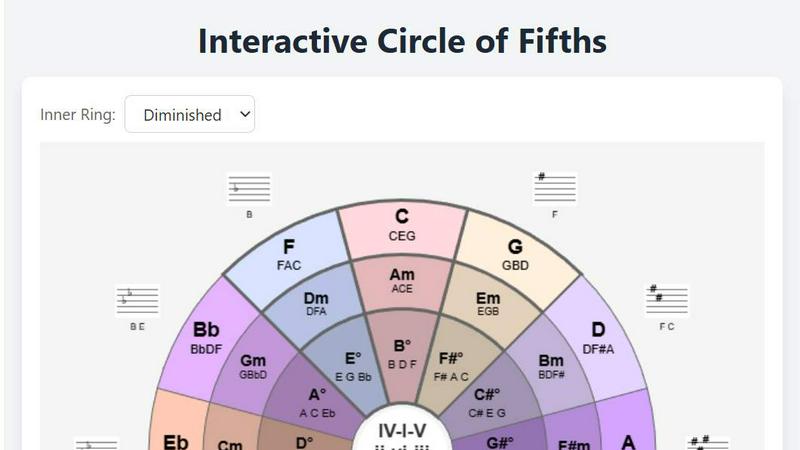
The Interactive Circle of Fifths includes dedicated visualizers for both piano and guitar, allowing users to see chord diagrams and fingerings in real-time. This feature enhances learning by providing a practical way to visualize how chords are structured and how to play them effectively on each instrument.
Extensive Scale Library
This tool offers an extensive library of musical scales, including the pentatonic, blues, diatonic, and diminished scales. Each scale is thoroughly explained, demonstrating its unique qualities and applications, which empowers users to diversify their musical toolkit and improve their improvisation skills.
Harmonized Scale and Chord Sequencer
With the harmonized scale feature, users can explore how chords relate to each note within a scale. The integrated chord sequencer allows musicians to create and experiment with their own chord progressions, giving them the freedom to compose and innovate in a structured manner.
Interactive Learning Experience
The Interactive Circle of Fifths transforms learning into an engaging experience by audibly demonstrating how different chords interact within various scales. This interactive approach helps reinforce theoretical concepts, making it easier for users to internalize complex musical ideas and apply them in practice.
Polym
Cognitive Science-Driven Audio Learning
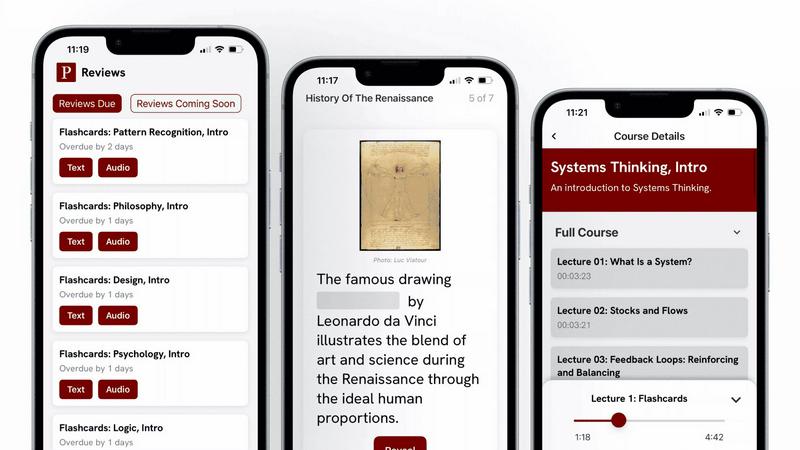
Polym's foundational feature is its deliberate architecture around proven learning strategies. Unlike passive podcasts or audiobooks, every piece of content is structured to incorporate retrieval practice (active recall), spaced repetition (strategic review intervals), and interleaving (mixing related topics). This transforms listening from a passive activity into an active mental workout, scientifically optimized to cement knowledge into long-term memory and combat natural forgetting.
Curated Curriculum of Foundational Subjects
The app offers a thoughtfully selected library of medium-form courses, abbreviated versions, and audio flashcards across essential disciplines. Subjects range from technical fields like Statistics, Probability, and Algorithms to conceptual domains like Logic, Philosophy, and History. This curriculum is designed to build a versatile intellectual foundation that is relevant across professional fields and enriches everyday reasoning and decision-making.
Audio-Optimized Technical Content
Polym specifically tackles the challenge of presenting technical and mathematical concepts in an audio format. It focuses on the abstract principles and conceptual understandings of these fields, which translate effectively to listening. This approach allows learners to grasp the core ideas behind complex subjects without getting bogged down by notation, making advanced topics accessible during a commute or workout.
Focused Review with Term-Only Courses
Beyond conceptual courses, Polym provides "term-only" courses that serve as ultra-abbreviated audio flashcards. This feature allows for efficient, focused review of key definitions, theorems, and principles without any explanatory fluff. It's the perfect tool for quick reinforcement, memory priming before a deeper study session, or a rapid refresher on core vocabulary from any subject.
Use Cases
Interactive Circle of Fifths
Beginner Music Education
For beginners, the Interactive Circle of Fifths serves as an essential educational tool, providing foundational knowledge of music theory. It simplifies complex concepts and enables newcomers to learn chord progressions and scales through interactive visualization, making the learning process enjoyable and effective.
Advanced Composition
Advanced musicians can leverage the Interactive Circle of Fifths to explore sophisticated chord progressions and harmonization techniques. By experimenting with the chord sequencer and harmonized scales, they can create unique compositions that push the boundaries of their musical creativity.
Improvisation Practice
Musicians looking to enhance their improvisational skills can use the extensive scale library to practice playing over different chord progressions. The tool's ability to visualize how chords relate to scales allows users to make informed choices in their improvisation, leading to more dynamic performances.
Teaching Tool for Instructors
Music educators can incorporate the Interactive Circle of Fifths into their teaching methodologies to demonstrate chord relationships and scales to their students. Its visual and auditory features provide a multifaceted approach to music theory, making it a valuable resource in the classroom setting.
Polym
The Professional Skill Enhancer
A data analyst uses Polym during their daily commute to solidify their grasp of statistical inference and probability theory. The spaced repetition sessions ensure the core concepts behind their daily work remain sharp, while interleaving with logic courses improves their overall analytical reasoning, making them more effective and insightful in their role.
The Aspiring Polymath
A lifelong learner with interests spanning history, philosophy, and computer science uses Polym to build connective tissue between disparate fields. The app's curriculum allows them to systematically explore new domains, while the active recall features ensure that insights from philosophy inform their understanding of AI ethics, creating a rich, interconnected web of knowledge.
The Exam & Certification Preparer
A professional preparing for a certification exam (e.g., in economics or project management) uses Polym's abbreviated courses and term-only flashcards for on-the-go review. The retrieval practice strengthens memory recall for key models and definitions, complementing their textbook study and turning downtime into productive, high-yield revision sessions.
The Critical Thinker & Decision-Maker
An individual seeking to improve their everyday decision-making and media literacy uses Polym's courses on logical fallacies, cognitive biases, and scientific reasoning. The audio format makes it easy to absorb these mental models, and the app's system ensures they become ingrained, helping the user to instinctively identify flawed arguments and make more rational choices in their personal and professional life.
Overview
About Interactive Circle of Fifths
The Interactive Circle of Fifths is an innovative musical tool that serves as a bridge between music theory and practical application, tailored for musicians at all levels. This dynamic platform demystifies the relationships between chords in various keys, promoting a richer understanding of harmony and scale construction. It caters to beginners who are just starting their musical journey, as well as advanced musicians seeking to refine their skills and explore intricate chord progressions. By providing both visual and auditory representations of chord interactions, users can effectively grasp the connections between different musical elements. The product features intuitive visualizers for piano and guitar, making it easier to learn fingerings while simultaneously understanding theoretical concepts. Additionally, it covers a diverse range of scales, including pentatonic, blues, diatonic, and diminished, positioning the Interactive Circle of Fifths as an essential resource for anyone looking to expand their musical vocabulary and enhance their improvisation skills.
About Polym
Polym is not just another audio learning app; it is a paradigm shift in how adults acquire and, more importantly, retain foundational knowledge. It directly confronts the universal challenge of the "forgetting curve," where passively consumed information quickly fades. Polym's core mission is to transform fleeting exposure into durable understanding. It achieves this by delivering a curated curriculum in subjects like Statistics, Economics, Computer Science, AI, Philosophy, and History through a unique, science-backed audio format. The app is engineered for the perpetually curious professional, the aspiring polymath, and any lifelong learner who values depth over breadth. Its primary value proposition lies in seamlessly integrating three powerful cognitive science principles—retrieval practice, spaced repetition, and interleaving—into the listening experience. This means Polym doesn't just feed you information; it actively trains your brain to store and recall it, building a lasting mental framework of the world's most critical concepts. It's for those who believe true learning is measured not by what you've heard, but by what you remember and can apply.
Frequently Asked Questions
Interactive Circle of Fifths FAQ
How does the Interactive Circle of Fifths help with music theory?
The Interactive Circle of Fifths visually demonstrates the relationships between chords and scales, enabling users to understand music theory concepts more clearly. By providing both visual and auditory examples, it makes complex ideas more accessible.
Is the Interactive Circle of Fifths suitable for all skill levels?
Yes, the tool is designed for musicians of all skill levels, from complete beginners to advanced players. Its comprehensive features cater to a wide range of learning needs, ensuring everyone can benefit from its resources.
Can I use the Interactive Circle of Fifths for both piano and guitar?
Absolutely! The Interactive Circle of Fifths includes dedicated visualizers for both piano and guitar, allowing users to learn fingerings and chords specific to each instrument, enhancing their overall musical abilities.
What types of scales are included in the Interactive Circle of Fifths?
The tool features an extensive library of scales, including pentatonic, blues, diatonic, and diminished scales. Each scale is explained in detail, helping users understand its applications and unique characteristics in various musical contexts.
Polym FAQ
What research supports the learning strategies Polym uses?
The methodologies are deeply rooted in cognitive science. Retrieval practice, spaced repetition, and interleaving are among the most robustly studied and effective techniques for long-term retention. Extensive research, including meta-analyses published in peer-reviewed journals, demonstrates their superiority over passive review and massed practice (cramming). You can explore foundational research on these topics through resources like the National Institutes of Health (NIH) database.
Who is Polym really for?
Polym is designed for a broad audience of intellectually curious adults. It is ideal for professionals who want to reinforce and retain foundational knowledge relevant to their field; for lifelong learners and polymaths building a broad base of understanding; for students or exam-takers needing efficient review; and for anyone seeking to sharpen their critical thinking, reasoning, and decision-making skills through a structured, science-backed approach.
What subjects does Polym cover?
The curriculum focuses on foundational subjects that foster critical thinking and broad understanding. This includes Logic, Logical Fallacies, Cognitive Biases, Statistics, Probability, Scientific Research, Algorithms, Economics, Philosophy, and History. The selection prioritizes concepts that are widely applicable and form the bedrock of rational thought across multiple disciplines.
How does Polym handle technical/math content in audio format?
Polym takes a deliberate approach by focusing on the conceptual and abstract layers of technical subjects that are well-suited for audio. Instead of presenting dense equations or code, it emphasizes the underlying principles, intuitions, and applications. This allows listeners to grasp the "why" and "how" of complex ideas, strengthening their ability to apply concepts even if they aren't visually following along with written notation.
Alternatives
Interactive Circle of Fifths Alternatives
The Interactive Circle of Fifths is a dynamic educational tool designed to help musicians grasp music theory, focusing on the intricate relationships between chords and scales. As a resource that caters to all skill levels, it proves invaluable for both beginners and seasoned players looking to enhance their understanding of harmony. Users often seek alternatives to the Interactive Circle of Fifths due to factors such as pricing, specific features that may better suit their needs, or compatibility with different platforms. When exploring alternatives, it is essential to consider the breadth of features offered, such as visualization tools and the variety of scales available. Additionally, users should assess how well an alternative integrates with their preferred instrument and whether it provides a user-friendly experience. Ultimately, the right choice will depend on individual learning styles and specific musical goals.
Polym Alternatives
Polym is an innovative audio learning app that belongs to the educational technology and lifelong learning category. It distinguishes itself by using active learning techniques like retrieval practice and spaced repetition to help users deeply retain foundational knowledge across subjects like philosophy, economics, and computer science, moving beyond passive content consumption. Users may seek alternatives for various reasons, including budget constraints, a preference for different content formats like video or text, the need for platform-specific apps, or a desire for learning paths focused on different skills or subjects. The search often stems from a need to find the right tool that aligns with an individual's specific learning style, goals, and practical circumstances. When evaluating alternatives, consider the core learning methodology. Does the platform facilitate active engagement or is it purely passive? Assess the breadth and depth of the content library to ensure it covers your areas of interest. Finally, examine the user experience, including platform availability, interface design, and how well the tool integrates into your daily routine for consistent, long-term learning.