
Fallom vs OpenMark AI
Side-by-side comparison to help you choose the right AI tool.

Fallom provides real-time observability for AI agents, ensuring complete visibility and cost transparency into LLM.
Last updated: February 28, 2026

OpenMark AI benchmarks 100+ LLMs on your task: cost, speed, quality & stability. Browser-based; no provider API keys for hosted runs.
Visual Comparison
Fallom
OpenMark AI
Overview
About Fallom
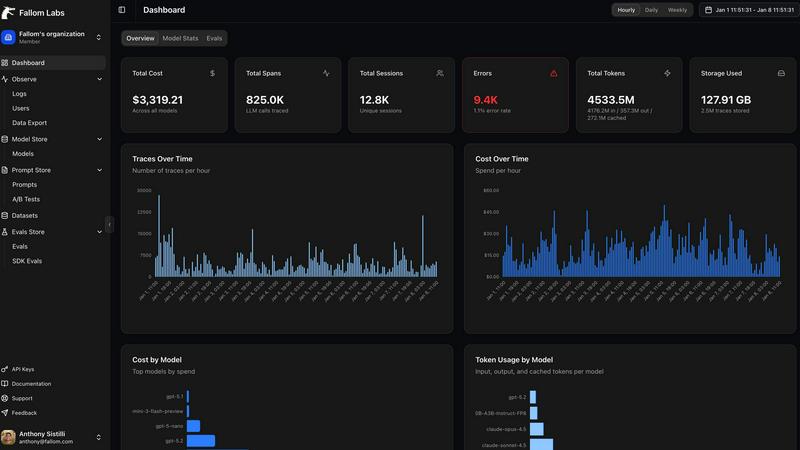
Fallom is an innovative AI-native observability platform tailored for the dynamic and complex landscape of Large Language Model (LLM) and AI agent applications. Designed to provide critical visibility, Fallom empowers engineering and product teams to operate AI-driven features reliably and efficiently in production environments. By delivering comprehensive end-to-end tracing for every LLM call, Fallom captures essential data such as prompts, outputs, tool and function calls, token usage, latency, and cost per call. This granular visibility is crucial for organizations striving to demystify AI systems, moving away from the traditional "black box" approach. Built on the open standard OpenTelemetry, Fallom ensures vendor neutrality and seamless integration, allowing teams to work with leading model providers such as OpenAI, Anthropic, and Google. With actionable insights structured from telemetry data, Fallom offers features like session-level context, timing waterfalls for multi-step workflows, and enterprise-grade compliance tools. These capabilities not only support adherence to regulations like the EU AI Act and GDPR but also enable organizations to debug issues promptly, optimize performance and costs, and confidently scale their AI initiatives.
About OpenMark AI
OpenMark AI is a web application for task-level LLM benchmarking. You describe what you want to test in plain language, run the same prompts against many models in one session, and compare cost per request, latency, scored quality, and stability across repeat runs, so you see variance, not a single lucky output.
The product is built for developers and product teams who need to choose or validate a model before shipping an AI feature. Hosted benchmarking uses credits, so you do not need to configure separate OpenAI, Anthropic, or Google API keys for every comparison.
You get side-by-side results with real API calls to models, not cached marketing numbers. Use it when you care about cost efficiency (quality relative to what you pay), not just the cheapest token price on a datasheet.
OpenMark AI supports a large catalog of models and focuses on pre-deployment decisions: which model fits this workflow, at what cost, and whether outputs are consistent when you run the same task again. Free and paid plans are available; details are shown in the in-app billing section.