
Dubvid vs PoYo API
Side-by-side comparison to help you choose the right AI tool.

Dubvid
Dubvid quickly dubs your audio and video into multiple languages with natural voices, enhancing global reach.
Last updated: February 27, 2026

PoYo API
PoYo API gives developers one unified platform for premium AI image, video, music, and chat generation.
Last updated: February 28, 2026
Visual Comparison
Dubvid
PoYo API
Feature Comparison
Dubvid
Seamless Uploading
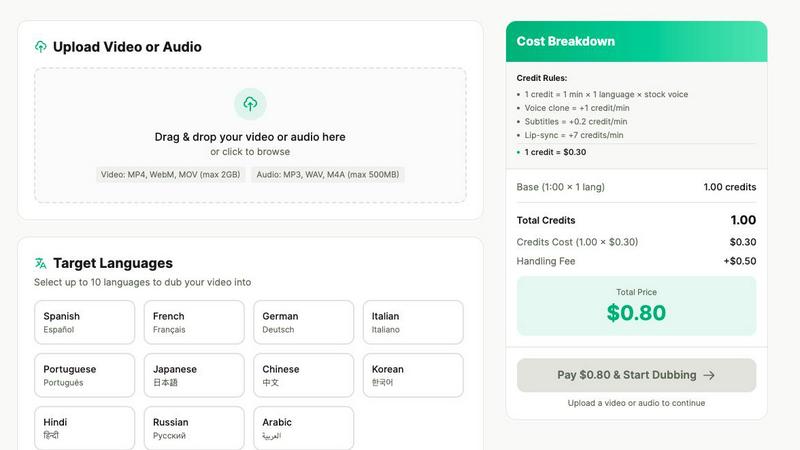
Dubvid supports a variety of video formats including MP4, MOV, and WebM, allowing users to upload their content effortlessly. The platform's drag-and-drop feature makes it easy to get started, accommodating files up to 500MB. This user-friendly interface ensures that anyone, regardless of technical background, can use the service without complications.
Advanced Voice Options
Users can choose from a selection of natural AI voices or opt to clone their own voice for a more personalized touch. This feature is particularly appealing for creators who want their unique vocal characteristics to be preserved, ensuring authenticity in their dubbed content. Additionally, the optional lip-sync feature enhances the realism of the dubbing by matching the audio to the mouth movements in the video.
Multi-Language Support
Dubvid offers support for over 10 languages, allowing creators to choose their target audience based on specific regions or demographics. This extensive language library empowers users to reach a wider audience, breaking down language barriers and fostering global engagement. The platform's ability to quickly translate and adapt content makes it an invaluable tool for anyone looking to expand their international presence.
Flexible Pricing Model
Dubvid operates on a usage-based credit system, allowing users to pay only for the minutes they localize. This eliminates the burden of subscriptions and provides an affordable solution for creators and businesses of all sizes. With a transparent pricing calculator, users can easily estimate their costs based on the length of the video, the number of languages, and additional features like subtitles and lip-sync.
PoYo API
Unified Multi-Model API Gateway
PoYo API consolidates access to a vast library of over 500 specialized AI models for image, video, music, and chat generation through a single, consistent endpoint. This eliminates the need for developers to manage disparate API keys, documentation, and billing systems from multiple providers. The unified gateway standardizes request and response formats, streamlining the development process and allowing for rapid prototyping and switching between state-of-the-art models like Nano Banana, Sora 2, Claude Sonnet, and Suno v5 without rewriting core application logic.
Flexible Credit-Based Pricing Model
Departing from the industry norm of rigid monthly subscriptions, PoYo employs a transparent, pay-as-you-go credit system. Users purchase credits that never expire and are consumed based on the specific model and task complexity. This model provides exceptional financial flexibility, enabling startups to control costs tightly and large enterprises to scale usage based on real demand without vendor lock-in. The pricing is notably competitive, with features like uniform pricing for different image resolutions offering clear value against competitors.
Enterprise-Grade Infrastructure & Security
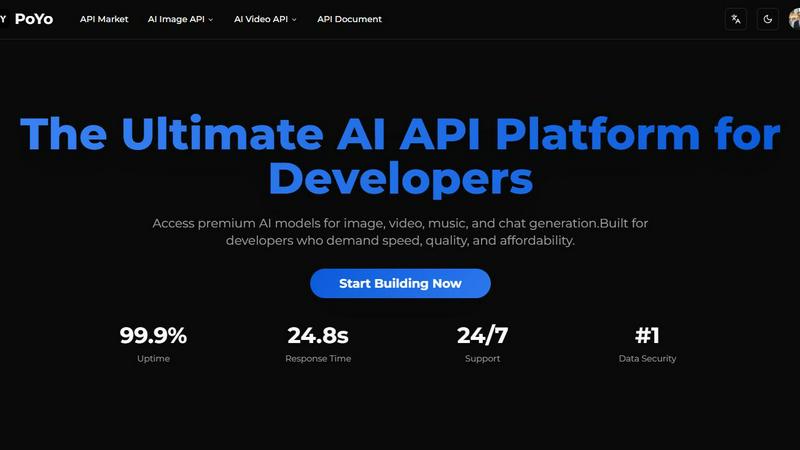
The platform is built with professional and security-conscious teams in mind. It guarantees 99.9% uptime and ultra-low latency, supporting high-concurrency requests essential for public-facing applications. Security is paramount; API keys are stored with encryption following industry standards, and a zero-knowledge architecture ensures sensitive credentials remain protected. Comprehensive audit logging provides teams with the necessary tools for compliance monitoring and security oversight.
Developer-Centric Tools & Support
PoYo prioritizes developer experience with practical tools that accelerate integration. This includes a free playground for testing all models without commitment, a simple two-endpoint async API for easy implementation, and webhook support for efficient task lifecycle management. Crucially, this is backed by 24/7 technical support from human experts and robust monitoring systems, ensuring developers receive actionable help and can maintain reliable service for their own end-users.
Use Cases
Dubvid
Content Creation for Social Media
Short-form creators can leverage Dubvid to dub their content for platforms like YouTube Shorts, Instagram Reels, and TikTok. By localizing their videos into multiple languages, they can significantly increase their reach and engage with audiences worldwide, thus multiplying their impact on social media.
Educational Resource Localization
Educators can utilize Dubvid to translate lessons, tutorials, and webinars for a global audience. This capability allows them to share knowledge across linguistic boundaries, making quality education accessible to learners everywhere, regardless of their native language.
Customer Support Enhancement
Businesses can improve their customer support by localizing instructional videos and product demos with Dubvid. By providing support content in the native languages of their customers, companies can reduce ticket volumes and improve user satisfaction, ensuring that help is always available in the language the customer understands best.
Podcast Expansion
Podcasters can effortlessly release their episodes in new languages using Dubvid, thus reaching broader audiences without the need for extensive production efforts. Whether for audio or video podcasts, creators can maintain the essence of their content while appealing to non-English speaking listeners, expanding their community globally.
PoYo API
Content Creation & Marketing Automation
Marketing teams and content agencies can leverage PoYo to automate and scale the generation of visual and audio assets. This includes creating unique social media graphics, promotional videos, and custom background music for campaigns. By integrating the API into their workflows, they can produce high-volume, on-brand content dynamically, responding to trends in real-time while significantly reducing reliance on manual design work and stock media libraries.
Next-Generation SaaS Applications
SaaS developers can embed advanced AI capabilities directly into their products using PoYo as the engine. For instance, a design tool could integrate AI image generation for mockups, a video editing platform could offer AI-powered scene extension, or a productivity app could include an intelligent chat assistant. This allows SaaS companies to enhance their feature set and competitive edge without investing millions in training their own foundational models.
AI-Powered Entertainment & Media
Gaming studios, interactive media producers, and entertainment platforms can use PoYo's diverse APIs to create immersive, dynamic experiences. This ranges from generating in-game assets and character dialogues on-the-fly, to composing adaptive soundtracks, or even creating short narrative video clips for interactive stories. The API's low latency and high concurrency make it suitable for real-time or near-real-time applications in entertainment.
Research, Prototyping & Innovation
Researchers, indie developers, and innovation labs benefit from PoYo's accessible playground and flexible pricing to experiment with the frontier of AI. They can rapidly prototype new applications, compare the outputs of hundreds of leading models for a specific task, and validate concepts before committing to large-scale development. This lowers the barrier to entry for exploring generative AI's potential across countless domains.
Overview
About Dubvid
Dubvid is a groundbreaking AI-powered platform that transforms the way creators, businesses, and brands approach video and audio dubbing. It allows users to effortlessly connect with a global audience by simply uploading their original video content. With a few clicks, users can select from a range of target languages, and Dubvid will automatically translate and recreate the audio, preserving the natural tone, pacing, and emotional nuances of the original voice. This innovative solution negates the need for traditional studios, voice actors, or cumbersome editing processes, making it accessible to anyone, regardless of their technical expertise. Whether you are a YouTuber aiming to broaden your viewer base, an educator looking to share knowledge across borders, or a marketing team focused on localizing content rapidly, Dubvid enables you to scale your reach internationally in mere minutes instead of weeks. Supporting over 10 languages, Dubvid is revolutionizing content creation by bridging language barriers and engaging diverse audiences with ease.
About PoYo API
PoYo API stands as a paradigm shift in the developer-centric AI landscape, moving beyond a simple aggregation of models to become a holistic infrastructure platform. It is engineered for developers, startups, and established enterprises who seek to integrate cutting-edge generative AI—spanning images, video, music, and conversational chat—without the operational overhead typically associated with managing multiple vendor APIs. Its core value proposition is a trifecta of simplicity, performance, and cost-efficiency. By providing a single, unified API key and a standardized interface to over 500 premium AI models, PoYo dramatically reduces integration complexity and development time. This is further amplified by a unique credit-based pricing model that eschews recurring subscriptions, allowing teams to pay only for actual consumption and scale predictably. Underpinning this accessibility is a robust foundation of enterprise-grade security, 99.9% uptime SLA, and sub-50ms response times, ensuring that applications built on PoYo are not only powerful and affordable but also production-ready and reliable from day one.
Frequently Asked Questions
Dubvid FAQ
How does Dubvid ensure voice quality during dubbing?
Dubvid utilizes advanced AI technology to replicate natural voice characteristics, ensuring that the dubbed content retains the original tone, pacing, and emotional depth. Users can select from various AI voices or clone their own for added personalization.
What formats does Dubvid support for video uploads?
Dubvid supports multiple video formats including MP4, MOV, and WebM, allowing for flexibility in file types. Users can upload files up to 500MB, making it convenient for various types of video content.
Is there a limit on the number of languages I can dub my content into?
While users can select multiple target languages for dubbing, the total number of languages will depend on the credits used for each localization. The platform allows you to choose as many languages as needed within the credit system.
Can I try Dubvid before committing to payment?
Yes, Dubvid offers a free trial that includes two credits for dubbing up to 60 seconds of audio or video. This allows users to experience the quality and functionality of the service without requiring a credit card.
PoYo API FAQ
How does the credit-based pricing work?
Credits are the universal currency on PoYo. You purchase a pack of credits (which do not expire) and different AI models consume a specific number of credits per task. For example, generating an image with Nano Banana 2 might cost $0.025 worth of credits, while a more complex video generation with Sora 2 Pro might cost $0.50. You only pay for the tasks you successfully complete, and your credit balance scales with your usage, eliminating monthly subscription fees.
Is there a free tier or way to test the API?
Yes, PoYo provides a comprehensive free testing environment. You can access the interactive playground on each model's page to experiment with generation parameters, submit prompts, and see outputs without spending any credits or providing a credit card. This allows you to evaluate model quality, fine-tune your requests, and ensure the API meets your needs before any financial commitment.
What happens if a generation task fails?
PoYo's system is designed with developer cost in mind. If a generation task fails due to a system or model error on PoYo's side, you are not charged any credits for that attempt. The platform also provides manual retry options from your dashboard for full control over your workflow, ensuring you only pay for successful, usable outputs.
How does the API handle long-running tasks like video generation?
For tasks that take longer to process, such as video generation, PoYo uses an efficient asynchronous API design. You submit a task and receive a unique task ID. You can then either poll for results using this ID or, more efficiently, configure a webhook URL to which PoYo will send an instant automatic callback notification the moment your task is completed, enabling seamless integration into automated workflows.
Alternatives
Dubvid Alternatives
Dubvid is an advanced AI-powered platform that focuses on audio and video dubbing, allowing creators, businesses, and brands to easily connect with global audiences. By automating the dubbing process, Dubvid streamlines the creation of multilingual content, making it accessible to users across various sectors, from education to marketing. However, users often seek alternatives to Dubvid for a variety of reasons, including pricing structures, specific feature sets, and compatibility with different platforms. When searching for an alternative, it's essential to consider the quality of voice synthesis, available languages, ease of use, and the overall effectiveness of the dubbing process. Ensuring that the chosen solution aligns with your unique content needs and goals will enhance your outreach efforts.
PoYo API Alternatives
PoYo API is a unified platform providing developers with streamlined access to over 500 premium AI models for generating images, videos, music, and chat. It falls within the AI Assistants and generative AI API category, designed to simplify integration through a single key and a flexible credit system. Developers often explore alternatives for various reasons. These can include specific budgetary constraints, the need for different or more specialized AI models not covered, or requirements for a particular deployment model like on-premise solutions. Platform-specific needs, such as deeper integration with certain cloud ecosystems or different support structures, also drive the search for other options. When evaluating alternatives, key considerations should include the breadth and quality of the available AI models, the transparency and structure of the pricing model, and the reliability measured in uptime and latency. Security protocols and the quality of developer support are also critical factors that can significantly impact the success of an AI-powered project.