
DemandBird vs Postproxy
Side-by-side comparison to help you choose the right AI tool.

DemandBird
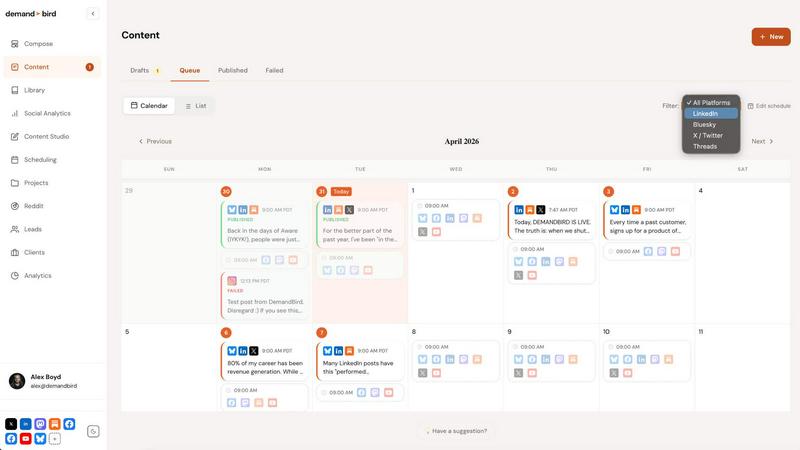
DemandBird is a social media scheduler that powerfully manages dozens of channels while keeping the process elegantly simple for you.
Last updated: April 4, 2026

Postproxy
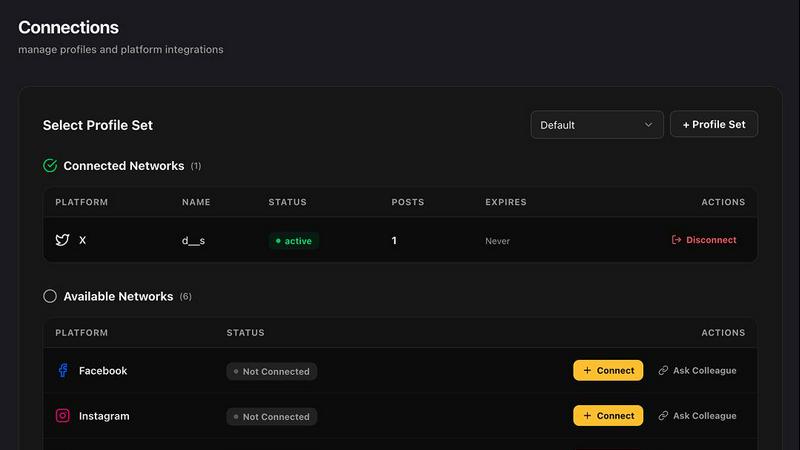
Postproxy's single API publishes your content reliably across all major social networks.
Last updated: February 28, 2026
Visual Comparison
DemandBird
Postproxy
Feature Comparison
DemandBird
AI-Powered Content Repurposing
This is the cornerstone of DemandBird's innovation. Instead of requiring a user to manually rewrite a single piece of content for each social network, you simply paste your original long-form post or idea. DemandBird's AI then automatically generates tailored versions for each connected platform. It intelligently adjusts the copy to be punchier for X/Twitter, more professional for LinkedIn, and conversational for Bluesky or Threads, all while preserving the core message. This feature directly attacks the biggest time-sink in multi-platform publishing.
Voice Training & Personalization
To ensure the AI adaptations don't sound generic or robotic, DemandBird allows you to train the system on your unique writing style. By analyzing your past content, it learns your specific tone, frequently used phrases, and stylistic nuances. This means every auto-generated adaptation across platforms will authentically sound like you, just optimized for the different format and audience expectations of each network, maintaining brand and personal consistency.
Unified Cross-Platform Analytics
DemandBird consolidates performance data from all your connected channels into a single, coherent dashboard. This eliminates the need to juggle between the native analytics of LinkedIn, X, and other platforms. You can clearly see which content themes resonate, on which platforms, and at what times, providing a holistic view of your social media ROI and enabling data-driven decisions to refine your overall content strategy.
Smart Scheduling & Thread Builder
The platform goes beyond simple date/time selection with smart scheduling that suggests optimal posting times for each platform to maximize engagement. Furthermore, its thread builder feature expertly deconstructs long-form content like blog posts or detailed analyses into a coherent, engaging thread series. It identifies natural breakpoints and creates compelling hooks for each segment, making long-content dissemination on platforms like X/Twitter efficient and effective.
Postproxy
Unified Multi-Platform API
Postproxy's cornerstone feature is its single API endpoint that manages publishing across all supported social networks. This eliminates the need for developers to learn, implement, and maintain separate SDKs and integration logic for Facebook, Instagram, LinkedIn, X, and YouTube. A single POST request with your content and target profiles is all that's required, dramatically reducing code complexity and integration time while ensuring consistency across your publishing pipeline.
Automated Platform Compliance & Content Adaptation
Each social media platform has unique and often shifting rules regarding media formats, text limits, and post validation. Postproxy intelligently handles this "inconsistent rules" problem by automatically transforming and validating your content to meet each platform's specific requirements. This includes formatting text, resizing or converting media, and ensuring compliance, so the same core message publishes successfully everywhere without manual tweaking.
Robust Operational Reliability & Error Handling
Postproxy is engineered with operational failures in mind. It provides "delivery guarantees" by automatically managing rate limits, quotas, and flaky endpoints. The system includes intelligent retry mechanisms, clear publish state reporting, and handles silent drops or delayed errors that typically plague direct API integrations. This transforms publishing from an error-prone task into a deterministic process where success and failure states are explicit and actionable.
Centralized Authentication & Account Management
Dealing with OAuth tokens, app reviews, permission scopes, and account sprawl across multiple clients or brands is a significant burden. Postproxy centralizes all authentication, securely storing tokens and handling automatic refresh cycles. This simplifies connecting and managing dozens of social media profiles and pages, providing a single control plane for access and permissions without the platform-specific bureaucracy.
Use Cases
DemandBird
Scaling Content for Marketing Agencies
Marketing agencies managing multiple client accounts can use DemandBird to dramatically increase output and consistency. A single campaign idea or client announcement can be swiftly transformed into a cohesive, multi-platform content suite for each client, ensuring message alignment while saving countless hours of manual adaptation. This allows agencies to scale their services without proportionally scaling their labor costs.
Building a Cohesive Personal Brand
Serious creators, founders, and thought leaders use DemandBird to maintain an active, consistent presence across key professional networks without being overwhelmed. They can write a deep, insightful piece once and trust the tool to repurpose key takeaways into appropriate formats for LinkedIn articles, X threads, and Substack snippets, all in their authentic voice, strengthening their brand authority everywhere simultaneously.
Repurposing Long-Form Content
Bloggers, newsletter writers, and video creators can leverage DemandBird to extract maximum value from their primary content. A single YouTube video script or newsletter issue can be automatically adapted into promotional threads, LinkedIn posts summarizing key points, and teaser clips for other social channels, effectively recycling one piece of work into a week's worth of platform-specific content.
Managing Enterprise Social Media Workflows
For marketing teams within larger organizations, DemandBird streamlines collaboration and approval processes. The content library allows teams to store, resurface, and remix successful past posts. Combined with the unified scheduling calendar and analytics, it provides a centralized command center for all corporate social channels, improving coordination and strategic oversight.
Postproxy
Automating AI-Generated Content Workflows
Teams using Large Language Models (LLMs) or AI agents to generate social content can integrate Postproxy as the final, reliable output layer. Instead of building custom adapters for each platform to normalize AI output, they can send generated content directly to Postproxy's API. This enables fully automated pipelines where AI creates content and Postproxy ensures it is properly formatted and published across all chosen networks without manual intervention.
Powering Multi-Client Social Media Management Tools
Agencies and SaaS platforms that manage social media for multiple clients face immense complexity with account sprawl and platform access. Postproxy acts as a unified backend, allowing these tools to offer multi-platform publishing without building complex, fragile integrations in-house. It handles authentication for all client accounts and provides a stable interface, letting the tool focus on its core UI and client management features.
Enhancing No-Code/Low-Code Automation
Users of automation platforms like n8n, Zapier, or Make can leverage Postproxy to create robust, multi-step workflows that include social publishing. A workflow can trigger from a new blog post, CRM update, or scheduled event, generate a summary, and then use a single Postproxy action node to publish it everywhere, replacing multiple, less reliable platform-specific nodes and simplifying the entire automation build.
Enabling Event-Driven and Scheduled Publishing at Scale
Development teams can integrate Postproxy's API directly into their CI/CD pipelines, internal dashboards, or product-led growth engines. This allows for publishing based on system events—like a new product launch, version update, or milestone achievement—directly from their core systems. Whether publishing ten announcements or ten thousand promotional posts, the same reliable logic applies, enabling scalable, programmatic communication.
Overview
About DemandBird
DemandBird is a sophisticated social media scheduling tool engineered to solve the most significant bottleneck in multi-channel content strategy: the arduous process of transforming a single idea into polished, platform-specific posts. It moves beyond the basic calendar functionality of traditional schedulers by integrating AI-powered content repurposing directly into the workflow. The core value proposition is profound simplicity: you write your core content or idea once, and DemandBird intelligently adapts it for LinkedIn, X/Twitter, Bluesky, Substack, and other channels, meticulously matching the appropriate tone, length, and format for each unique audience. This eliminates the tedious, time-consuming cycle of manual rewriting and copy-pasting across multiple tabs. The platform then seamlessly schedules this adapted content in one unified flow, complete with built-in analytics and AI assistance to refine your strategy. Designed for marketing teams, agencies, and serious creators who manage a high-volume presence across numerous platforms, DemandBird promises to reclaim approximately 45 minutes per post, turning content creation from a fragmented chore into a streamlined, outcome-focused operation.
About Postproxy
Postproxy is a transformative infrastructure layer designed to solve the complex, operational nightmare of multi-platform social media publishing. At its core, it is a unified API that abstracts away the chaos of dealing with individual platform APIs like Instagram, Facebook, YouTube, LinkedIn, and X. For developers, automators, and businesses scaling their digital presence, Postproxy replaces a tangled web of platform-specific integrations, OAuth flows, and inconsistent rules with a single, reliable endpoint. Its primary value proposition is turning publishing from a fragile, high-maintenance task into predictable, scalable infrastructure. It is explicitly built for modern tech stacks, seamlessly integrating with automation tools like n8n and Zapier, content generation pipelines powered by LLMs, and CI/CD workflows. By handling authentication, rate limits, content adaptation, retries, and analytics automatically, Postproxy allows teams to focus on creating and strategizing content rather than debugging API failures and managing platform bureaucracy.
Frequently Asked Questions
DemandBird FAQ
How does DemandBird's AI repurposing differ from just using ChatGPT?
While generic AI tools can rewrite text, DemandBird's AI is specifically fine-tuned for social media platform nuances. It doesn't just shorten text; it understands the distinct cultural tones, character limits, hashtag conventions, and optimal content structures for LinkedIn, X, Bluesky, etc., and applies this knowledge systematically within a dedicated scheduling workflow, which ChatGPT does not provide.
Can I edit the AI-generated adaptations before they are scheduled?
Absolutely. DemandBird operates on a "create, adapt, review, schedule" model. The AI provides a first draft adaptation for each platform, but you have full control to review, tweak, refine, or completely rewrite any suggestion before it enters the scheduling queue. The AI is an assistant, not an autopilot.
What platforms does DemandBird currently support?
Based on the provided content, DemandBird explicitly supports LinkedIn, X/Twitter, Bluesky, and Substack. The platform is built to be extensible, suggesting ongoing addition of more channels. It also offers a Chrome extension, API, and MCP support for advanced integrations into existing workflows.
Is there a risk all my platform content will look too similar?
This is where the Voice Training and the nuanced AI repurposing shine. The tool is designed to avoid uniformity. It strategically varies the presentation of the core idea to suit each platform's environment—making it professional, punchy, or conversational as needed—so your audience on each network receives content that feels native and appropriately tailored, not a repetitive cross-post.
Postproxy FAQ
What platforms does Postproxy support?
Postproxy currently supports publishing to Instagram, Facebook, YouTube, LinkedIn, and X (formerly Twitter). The platform handles each network's unique API, converting your content and media to meet their specific format requirements and publishing rules through a single, unified request.
How does Postproxy handle authentication for my social accounts?
Postproxy manages the entire OAuth flow for you. You connect your social media accounts through a secure onboarding process. Postproxy then securely stores the necessary tokens and automatically handles token refreshes in the background, eliminating the need for you to manage platform-specific authentication logic or worry about expired tokens.
What happens if a post fails on one platform?
Postproxy provides explicit publish states for every platform targeted in a request. If a post fails on one network due to a rate limit, quota, or content error, Postproxy will automatically retry according to its logic where possible and report the specific failure reason. Posts to other platforms in the same request will continue independently, and you receive clear, actionable status updates for each.
Is Postproxy suitable for high-volume publishing?
Absolutely. Postproxy is designed to turn publishing into scalable infrastructure. It handles rate limits and quotas intelligently, and its unified API means the process for publishing ten items is identical to publishing ten thousand. This deterministic logic, combined with robust error handling, makes it ideal for businesses and tools that need to publish content at scale reliably.
Alternatives
DemandBird Alternatives
DemandBird is a social media management platform designed to streamline the process of creating and publishing content across multiple networks. It falls into the category of AI-powered scheduling and content repurposing tools, specifically engineered to help teams and creators maintain a consistent, high-volume presence without constant manual effort. Users often explore alternatives to any software for a variety of reasons. Common drivers include budget constraints, the need for different or more specialized features, or a requirement to support social platforms not covered by their current tool. Some may seek a simpler interface for a smaller team, while others might need deeper analytics or more advanced collaboration workflows. When evaluating other options, it's crucial to align the tool's capabilities with your core needs. Key considerations should include the specific social networks you use, the importance of AI for content adaptation, the scale of your scheduling and reporting requirements, and how well the tool integrates into your existing marketing stack. The goal is to find a solution that removes friction, not adds it.
Postproxy Alternatives
Postproxy is a developer-centric social media publishing API, falling into the category of automation and integration tools. It simplifies the complex process of posting to multiple platforms like Instagram, Facebook, and LinkedIn by providing a single, unified endpoint. This approach handles the technical intricacies of authentication, content formatting, and platform-specific rules behind the scenes. Users often explore alternatives for various practical reasons. These can include budget constraints, the need for different feature sets like advanced analytics or niche platform support, or a preference for a different user interface, such as a full dashboard versus a pure API. Some may seek tools that integrate more tightly with their existing marketing stack or offer different scalability options. When evaluating alternatives, key considerations should include the specific social platforms you need to support, the required level of technical integration (API vs. no-code builder), the robustness of features like scheduling, analytics, and content adaptation, and of course, the total cost of ownership. Security, reliability, and the quality of developer documentation are also critical factors for long-term success.