
Cosy vs Playwriter
Side-by-side comparison to help you choose the right AI tool.

Cosy automates member onboarding and introductions in Slack, boosting engagement while saving you valuable time.
Last updated: February 28, 2026

Playwriter
Playwriter lets AI agents control your actual Chrome browser with all your logins and extensions intact.
Last updated: March 18, 2026
Visual Comparison
Cosy
Playwriter

Feature Comparison
Cosy
Automate Onboarding
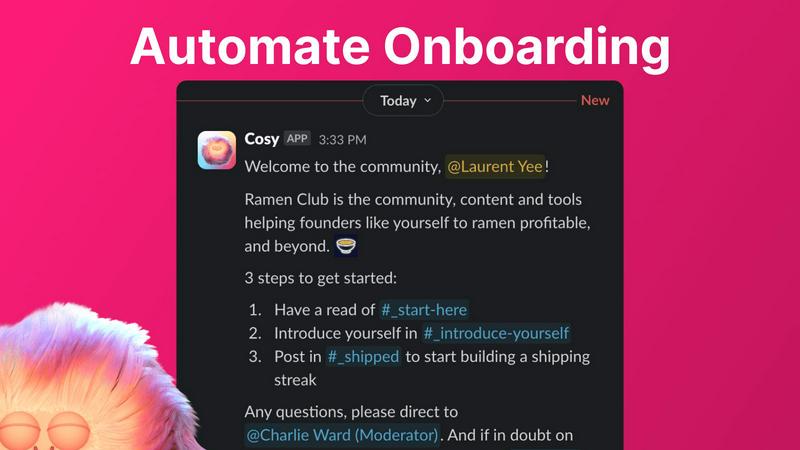
Cosy allows you to create and automate up to 10 distinct onboarding welcome DM sequences. These messages can come from you, a team member, or the Cosy bot itself, ensuring each new member feels welcomed. You can customize the content, including names, links, and emojis, as well as set specific time delays for when these messages are sent, making the onboarding process efficient and personalized.
Connect Your Members
The tool enhances community engagement by automatically introducing opted-in members to each other via direct messages. This feature operates on a regular cadence that you can customize, ensuring that members have opportunities to connect and collaborate. With a simple setup, you can create a more cohesive community where members engage with one another seamlessly.
Member Directory
Cosy provides a searchable member directory, allowing community members to easily find and connect with each other without leaving Slack. You can customize fields in member profiles and notify members to fill them out, ensuring that everyone has the opportunity to showcase their interests and expertise. This simplifies networking within the community and fosters deeper connections.
Content Highlights
With Cosy, you can instantly surface the top 10 most engaging posts from your community or identify unreplied messages in a channel. Using quick slash commands, community managers can access insights about engagement levels, enabling them to promote valuable discussions and ensure members are not missing out on important conversations.
Playwriter
Your Authenticated Browser Session
Playwriter's core feature is its ability to let AI agents operate within your existing Chrome window. This is not a simulated or fresh instance; it's the browser you use daily, complete with all logged-in accounts (like Google, GitHub, or social media), installed extensions (password managers, ad blockers), and accumulated cookies. This eliminates the constant friction of re-authentication, bypasses many anti-bot measures that flag "new" browsers, and allows agents to perform tasks in environments that are otherwise inaccessible to automated tools.
Comprehensive Playwright API Access
Unlike other solutions that expose a limited, curated set of browser actions, Playwriter provides agents with the full, unadulterated power of the Playwright automation library through a single execute command. This means an agent can write and run any Playwright code—from complex interactions and network interception to performance profiling and taking accessibility snapshots. This flexibility is far superior to rigid tool schemas, enabling sophisticated automation scripts that can adapt to virtually any website or task.
Advanced Debugging and Inspection Suite
Playwriter equips developers and agents with deep inspection capabilities. It includes a built-in debugger with breakpoints, live code editing, and network request interception. Crucially, it generates lightweight "accessibility snapshots" (5-20KB) that provide a semantic, structured view of the page for the AI, which is far more efficient and context-rich than sending full 100KB+ screenshots. This suite allows for precise troubleshooting and understanding of page state.
Seamless Human-AI Collaboration
The tool is designed for a shared control model. You can watch the AI interact with websites in real-time on your screen. When the agent encounters a CAPTCHA, a consent popup, or an unexpected UI flow, you can simply pause, intervene manually to resolve the issue, and then let the agent continue. This collaborative loop combines AI efficiency for repetitive tasks with human intuition for edge cases, creating a powerful hybrid workflow.
Use Cases
Cosy
Streamlined Onboarding Process
Cosy is perfect for community managers who want to streamline the onboarding process. By automating welcome messages, new members receive a warm introduction to the community, which helps them feel included and engaged from day one. This process saves time and ensures no new member feels overlooked.
Enhanced Member Interactions
Community leaders can leverage Cosy to encourage member interactions through automated introductions. This feature not only helps members connect with others who share similar interests but also fosters a sense of belonging, making it easier for individuals to engage in meaningful conversations.
Efficient Member Management
The searchable member directory simplifies member management for community leaders. By allowing members to create and edit their profiles, it fosters an organized environment where members can easily find and connect with each other, enhancing the overall community experience.
Promoting Engaging Content
Cosy's content highlight feature enables community managers to promote engaging discussions effectively. By surfacing the most interacted posts, managers can encourage further exploration and participation in topics that resonate within the community, leading to a more vibrant and active environment.
Playwriter
Automated Testing and QA with Real User Data
QA engineers and developers can use Playwriter to create and run automated tests in a browser that mirrors a real user's state. This allows for testing complex, multi-step user journeys that depend on being logged into specific accounts (e.g., testing a purchase flow from cart to checkout while logged into a payment profile), providing far more accurate and reliable test results than isolated, stateless browser instances.
AI-Powered Research and Data Extraction
Researchers, analysts, and content creators can task AI agents with gathering information from websites that require login or have complex, interactive interfaces. An agent can navigate a personal LinkedIn feed, extract data from a web-based SaaS dashboard, or monitor a private forum, all using the user's established identity and session, automating tedious data collection tasks.
Automated Social Media and Content Management
Marketing professionals and social media managers can leverage Playwriter to automate posting schedules, engagement, or analytics gathering across platforms like Twitter, Facebook, or Instagram. Since the agent operates within the authenticated browser, it can interact with these platforms' often-fragile and login-protected interfaces without triggering security locks.
Development and Debugging Assistance
Software developers can use Playwriter as a powerful co-pilot for front-end development. An AI agent can be instructed to reproduce a bug, intercept network calls to inspect API payloads, edit CSS live to test styling changes, or generate snapshots of a component's accessibility tree, significantly speeding up the debugging and development process.
Overview
About Cosy
Cosy is an innovative tool tailored to enhance community engagement within Slack, ideal for community managers and team leaders. It automates critical aspects of community management, including onboarding new members, fostering meaningful connections, and maintaining a safe environment for discussions. By offering features such as automated welcome messages and member introductions, Cosy significantly streamlines the integration process for newcomers. The platform includes a searchable member directory, enabling users to find and connect with peers based on shared interests or expertise. Additionally, by surfacing engaging content and moderating discussions, Cosy ensures that community interactions are not only productive but also enriching. Its primary value proposition lies in saving time and effort, allowing community leaders to cultivate a vibrant, engaged atmosphere that thrives on collaboration and connection. With Cosy, teams can focus on building relationships rather than getting lost in administrative tasks.
About Playwriter
Playwriter is a paradigm-shifting tool that redefines how AI agents interact with the web. It solves the fundamental flaw in most browser automation for AI: isolation. Traditional methods force agents to operate in sterile, headless browser instances devoid of personal context—no saved logins, no trusted extensions, and no cookies, which often triggers bot detection systems. Playwriter takes the opposite approach. It is a Chrome extension and CLI that grants AI agents direct, programmatic control over your actual browser session. This means the agent works within a browser that already has your authenticated sessions, custom extensions, and user profile intact. By leveraging the powerful Playwright API through a simple MCP (Model Context Protocol) server, it provides a single, flexible execution tool instead of a limited set of predefined actions. This results in more robust, human-like browsing that avoids detection, reduces memory overhead, and enables a true collaborative workflow between human and AI.
Frequently Asked Questions
Cosy FAQ
What platforms does Cosy integrate with?
Cosy is designed specifically for Slack, enhancing community engagement within this platform. It leverages Slack's features to provide a seamless experience for users.
How does Cosy automate member introductions?
Cosy automates member introductions by regularly pairing opted-in community members in direct messages. The frequency and timing of these introductions can be customized to suit the needs of the community.
Can I customize the member directory fields?
Yes, Cosy allows you to create a customizable member directory, where you can select up to 10 fields for members to fill in. This flexibility helps cater the directory to your community's specific needs.
Is there a limit on how many members can use Cosy?
Cosy offers a plan for up to 250 members for free, while there is a 30-day trial available for unlimited members. This allows communities of various sizes to experience the benefits of the tool.
Playwriter FAQ
How does Playwriter differ from a traditional headless browser?
Traditional headless browsers are launched as separate, isolated processes with no user data. Playwriter attaches directly to your existing, running Chrome session. The key differences are profound: you keep all logins and extensions, you avoid bot detection that targets "fresh" browser fingerprints, you use less system memory by not duplicating Chrome, and you can collaborate in real-time with the AI.
Is my browsing data sent to a remote server?
No. Playwriter is designed with privacy and security as a priority. All communication happens locally on your machine. The Chrome extension connects to a local WebSocket relay server (on localhost:19988), and your CLI or MCP client connects to the same local server. No browsing data, credentials, or session cookies are transmitted to any remote service.
What happens if the AI gets stuck or encounters a CAPTCHA?
This is where Playwriter's collaborative design shines. You can see the browser acting in real-time. If a CAPTCHA or a complex modal appears, you can simply click the extension icon to detach control for that tab, solve the challenge yourself manually, and then re-attach the extension. The agent will then continue its task from the new state, creating a seamless human-in-the-loop workflow.
Can I use Playwriter with any AI assistant or IDE?
Yes, due to its implementation of the Model Context Protocol (MCP), Playwriter is client-agnostic. It works seamlessly with any MCP-compatible client, including popular AI-powered IDEs like Cursor, Windsurf, and Claude Desktop, as well as code editors like VS Code through appropriate extensions. The open-source MIT license also allows for extensive customization and integration.
Alternatives
Cosy Alternatives
Cosy is an innovative tool designed to automate member onboarding and enhance community engagement within Slack, placing it squarely in the productivity and management category. Users often seek alternatives to Cosy for various reasons, including pricing considerations, feature sets that may better align with their specific needs, or compatibility with different platforms. Additionally, organizations may look for solutions that offer unique functionalities or more flexibility in customization. When choosing an alternative, it’s essential to evaluate the specific features offered, the ease of use, and how well it integrates with existing systems. Consider whether the alternative can effectively facilitate member interactions, support onboarding processes, and maintain a safe and engaging community environment. Features like automated communication, member directories, and customization options can significantly influence your decision-making process.
Playwriter Alternatives
Playwriter is an open-source automation tool that provides AI agents with direct, authenticated access to a user's actual Chrome browser session. It belongs to the growing category of browser automation and AI agent tooling, designed to bridge the gap between AI capabilities and real-world web interaction. By leveraging the user's existing browser, it enables complex workflows that require logins, extensions, and bypassing common bot detection mechanisms. Users often seek alternatives for various practical reasons. These can include budget constraints, specific feature requirements not covered by a single tool, or compatibility needs with different operating systems or development environments. Some may prioritize a different licensing model, require a managed cloud service over a local tool, or need integration with a particular stack outside of the MCP (Model Context Protocol) ecosystem. When evaluating options in this space, key considerations should include the depth of browser control offered, the method of session handling (fresh vs. authenticated), and the quality of debugging and observability features. Security is paramount, especially concerning how the tool accesses and manages sensitive browser data. Additionally, assess the flexibility of the automation API, the supported client applications, and the overall philosophy of the project, whether it's open-source or commercially focused.