
Code Word Solver - Missing Words Finder vs Psychiatry Exams
Side-by-side comparison to help you choose the right AI tool.

Code Word Solver - Missing Words Finder
Effortlessly solve codewords with our intuitive Missing Words Finder and crack those puzzles like an expert.
Last updated: February 28, 2026

Psychiatry Exams
Master MRCPsych exams with AI explanations, recalled questions, and expert community support.
Last updated: March 1, 2026
Visual Comparison
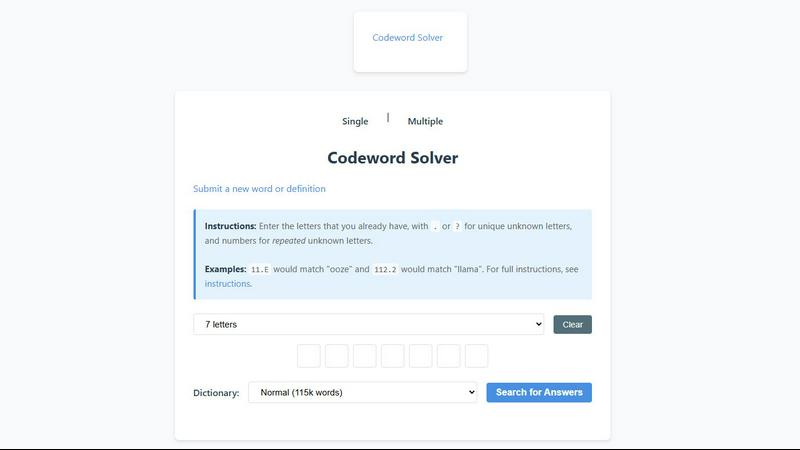
Code Word Solver - Missing Words Finder
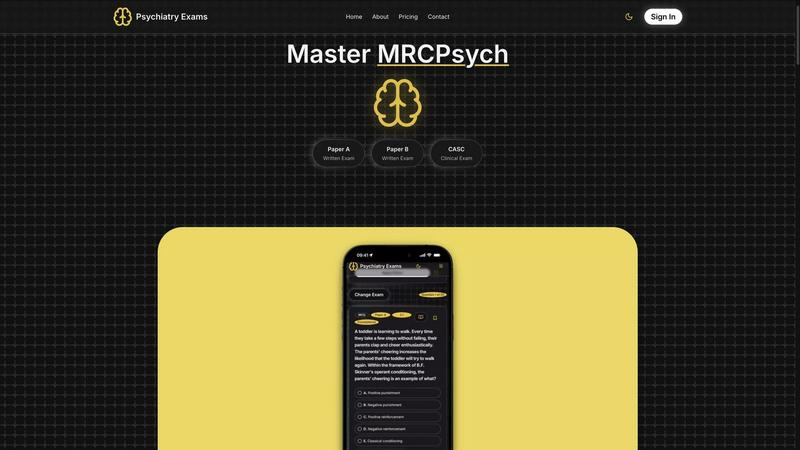
Psychiatry Exams
Feature Comparison
Code Word Solver - Missing Words Finder
Single Pattern Solving
This feature allows users to enter a single word pattern into the solver to receive a list of matching word candidates. By simply inputting the known letters along with placeholders for unknowns, the tool quickly filters through its extensive database to present potential solutions. This is particularly useful for those who may have partial information and want to find answers without endless guessing.
Multi-Pattern Solving
Multi-pattern solving enables users to input two patterns simultaneously, facilitating the resolution of linked words side-by-side. This feature is especially beneficial when the same number-to-letter relationships appear across different words, making it easier to solve interconnected puzzles. It enhances strategic problem-solving by allowing users to visualize how words relate to one another within the puzzle grid.
Advanced Pattern Input
The advanced pattern input system allows users to specify what they know with precision. By using symbols like "." or "?" for unknown letters and numbers for repeated unknown letters, users can make the most of the information they have. For example, entering "112.2" can yield words like "llama," ensuring that repeat letters stay consistent throughout the puzzle.
Customizable Difficulty Dictionaries
Code Word Solver offers a choice of dictionary sizes to cater to different players and puzzle difficulties. Users can select from hard (260k words), normal (115k words), or easy (20k words) dictionaries, ensuring that the word list matches their skill level and the complexity of the puzzles they are tackling. This flexibility enhances user satisfaction and helps improve solving outcomes.
Psychiatry Exams
Verified Recalled Question Bank
The cornerstone of the platform is its extensive library of over 2,400 questions, including 1,960 directly recalled from recent MRCPsych exam sittings. These questions are not simply archived; they are meticulously adapted, verified for accuracy, and contextualized by a team of eight NHS Consultants. This provides trainees with an unparalleled insight into the format, style, and clinical focus of the actual exams, offering a significant strategic advantage over generic commercial question banks.
AI-Powered Explanations & Syllabus Mapping
Every question is supported by comprehensive, multi-layered explanations generated by advanced AI systems (Claude Opus 4.5, Gemini 3, GPT 5.2) that are specifically trained on the official Royal College of Psychiatrists syllabus. This ensures explanations are not just factually correct but are pedagogically aligned with college learning objectives. The entire content library is mapped to the full syllabus for Paper A, Paper B, and CASC, giving users confidence they are covering all necessary material.
Active Learning & Peer Community
Psychiatry Exams moves beyond passive memorization through its innovative "Earn AI Credits" system. Users earn credits by contributing and peer-reviewing questions, which deepens their own understanding. This active engagement is supported by a vibrant, consultant-moderated WhatsApp community with dedicated discussion channels for each exam sitting, fostering collaborative learning, motivation, and real-time support from peers and experts.
Spaced Repetition Flashcard System
To combat knowledge decay and promote long-term retention, the platform integrates a sophisticated flashcard system utilizing spaced repetition algorithms. Users can create flashcards from any question or concept, and the system schedules reviews at optimal intervals to cement learning. This transforms isolated facts into durable knowledge, crucial for both exam success and clinical application.
Use Cases
Code Word Solver - Missing Words Finder
Casual Puzzle Solving
For casual puzzle enthusiasts who enjoy solving codewords during their leisure time, Code Word Solver provides an efficient way to decode puzzles without the frustration of guesswork. Users can quickly input known letters and receive potential answers, allowing them to enjoy their hobby more fully.
Competitive Puzzle Challenges
In competitive settings, such as puzzle-solving tournaments or contests, speed and accuracy are crucial. Code Word Solver enables participants to identify answers rapidly, giving them a competitive edge. Utilizing the multi-pattern feature can significantly reduce solving time during these high-pressure situations.
Educational Tool for Language Learning
Teachers and students can leverage Code Word Solver as an educational tool to enhance vocabulary and spelling skills. By engaging with puzzles and discovering new words, learners can improve their language comprehension in a fun and interactive way.
Community Contributions and Improvements
Code Word Solver encourages community engagement by allowing users to submit new words and definitions to improve the word database over time. This feature not only enriches the resource for all users but also fosters a sense of collaboration and contribution among puzzle enthusiasts.
Psychiatry Exams
The Systematic Exam Candidate
A trainee at the start of their revision cycle uses the platform's full syllabus coverage and mapped study notes to create a structured study plan. They work through topics methodically, using the recalled question bank to test their knowledge and the AI explanations to fill gaps in understanding, ensuring no part of the curriculum is missed.
The Active Contributor
A user seeking to deepen their conceptual grasp engages heavily with the active learning model. They regularly submit recalled questions for peer review and provide feedback on others' submissions. This process of creation and critique forces a higher-order engagement with the material, solidifying their knowledge and earning AI credits in the process.
The Community-Driven Learner
A trainee who finds solitary revision demotivating leverages the platform's integrated community. They participate in WhatsApp group discussions on challenging topics, join consultant-moderated group calls, and use the peer support network to stay accountable, share resources, and reduce the isolation of exam preparation.
The Last-Minute Revise
In the final weeks before the exam, a candidate uses the platform to focus on high-yield practice. They take timed mock exams built from recalled questions, use the flashcard system to rapidly review weak areas identified by analytics, and seek clarification on tricky points through the community, ensuring their preparation is targeted and efficient.
Overview
About Code Word Solver - Missing Words Finder
Code Word Solver - Missing Words Finder is an innovative tool designed to enhance your experience with codeword puzzles, also known as code-cracker puzzles. This online solver helps users decode challenging puzzles by narrowing down possible word answers based on the patterns they already have. Ideal for puzzle enthusiasts of all skill levels, the solver is particularly valuable for those who may struggle with guesswork. By transforming letters into numbers (1–26), the tool allows you to establish a consistent mapping across the entire puzzle. Whether you are a casual player or a dedicated puzzler, this tool streamlines the solving process. With options for single word or multiple pattern solving, users can maximize their efficiency and enjoy a more enjoyable puzzle-solving experience.
About Psychiatry Exams
Psychiatry Exams is a transformative digital platform engineered to redefine preparation for the MRCPsych examinations. It addresses the core challenges faced by psychiatry trainees: the exorbitant cost of commercial resources, the fragmentation of study materials, and the passive, often isolating nature of traditional revision. The platform consolidates the entire exam ecosystem—from official syllabus content and high-yield question banks to mock exams and peer support—into a single, intelligent, and mobile-friendly membership. Its primary user base consists of dedicated psychiatry trainees across all stages, from CT1 to ST6, who seek not just to pass their exams but to build a consultant-level clinical understanding.
The platform's revolutionary value proposition lies in its synthesis of authentic, recalled exam content with cutting-edge pedagogical technology. Unlike static question banks, it leverages a vast repository of questions verified by NHS Consultants and enriches them with AI-powered explanations from leading models like Claude Opus and GPT-5.2, all trained on the Royal College syllabus. More than just a study tool, Psychiatry Exams pioneers an active learning methodology. It incentivizes users to contribute to and peer-review the question bank, turning passive consumers into engaged creators. This, combined with a consultant-moderated community and a sophisticated flashcard system, transforms exam preparation from a solitary financial burden into a dynamic, collaborative, and intellectually rigorous journey that builds critical thinking skills essential for future practice.
Frequently Asked Questions
Code Word Solver - Missing Words Finder FAQ
How does the Code Word Solver work?
The Code Word Solver works by allowing users to enter known letters and patterns, using symbols for unknowns. It then filters through its extensive dictionary to provide possible word matches based on the input patterns.
Can I use the solver for multiple words at the same time?
Yes, the multi-pattern solving feature allows you to input two patterns simultaneously, making it easier to solve linked words side-by-side, especially when there are shared number-to-letter relationships.
What should I do if I find a word that is not in the database?
If you come across a word that is missing from the database, you can submit it along with its definition. This helps improve the tool's coverage over time, contributing to a richer solving experience for all users.
Is there a limit to the number of patterns I can enter?
While the tool is designed for efficient solving, it is recommended to keep the input to two patterns at once for optimal performance and clarity. This approach helps maintain focus and increases the chances of finding accurate solutions.
Psychiatry Exams FAQ
How accurate and reliable are the recalled questions?
The recalled questions are the platform's most valued asset. Every submitted question undergoes a rigorous verification and adaptation process by a panel of eight NHS Consultants who are familiar with the MRCPsych exam. This ensures clinical accuracy, relevance to the current syllabus, and appropriateness for training purposes, making them a highly reliable reflection of the exam's content and style.
What makes the AI explanations better than standard answer rationales?
The AI explanations are powered by state-of-the-art models specifically fine-tuned on the Royal College syllabus and psychiatric textbooks. This means they provide nuanced, context-rich explanations that link back to core learning objectives, rather than just stating a correct answer. They synthesize consultant expertise with the latest evidence, offering deeper insights into the "why" behind each answer.
How does the "Earn AI Credits" system work?
The system incentivizes active participation. Users earn +2 AI credits for each question they submit to the bank. If their submitted question is approved by the consultant moderators, they receive a +3 credit bonus. These credits can be used within the platform, fostering a collaborative ecosystem where users contribute to and benefit from the collective knowledge pool.
Is the platform sufficient as a standalone resource for MRCPsych?
Psychiatry Exams is designed as a comprehensive, all-in-one hub that consolidates the key resources needed to pass: a question bank, syllabus notes, mock exams, and a learning community. While it covers the entire syllabus and uses official reading lists, most successful candidates view it as a primary, interactive core resource that effectively replaces expensive commercial question banks and courses, though it may be supplemented with personal note-taking and textbook reading.
Alternatives
Code Word Solver - Missing Words Finder Alternatives
Code Word Solver - Missing Words Finder is a specialized online tool designed to assist users in solving codeword puzzles quickly and efficiently. By analyzing the letter-number relationships inherent in codewords, this solver empowers users to decode puzzles with confidence. As part of the broader category of puzzle-solving tools, it caters to enthusiasts looking for an edge in their code-breaking endeavors. Users often seek alternatives to such tools for various reasons, including pricing, specific features, or compatibility with their preferred platforms. When exploring alternatives, it's essential to consider the tool's user interface, the range of features offered, and the quality of the word database. These factors can significantly influence the effectiveness and enjoyment of the puzzle-solving experience.
Psychiatry Exams Alternatives
Psychiatry Exams is a comprehensive digital learning platform in the education and learning category, specifically engineered to support psychiatry trainees preparing for the challenging MRCPsych examinations. It consolidates high-yield resources into a single, intelligent membership. Candidates often explore alternatives for various reasons, including budget constraints, a preference for different learning methodologies, or the need for a platform with a specific feature focus, such as pure question banks versus in-depth theory modules. The search for a different user experience or community structure also drives this exploration. When evaluating any study tool, key considerations should include the clinical accuracy and provenance of its content, the depth and pedagogical value of its explanations, and how well it supports active, critical thinking over rote memorization. Alignment with the official syllabus and the quality of expert or peer support are also crucial differentiators.