
CCAPI vs Renderly
Side-by-side comparison to help you choose the right AI tool.

CCAPI
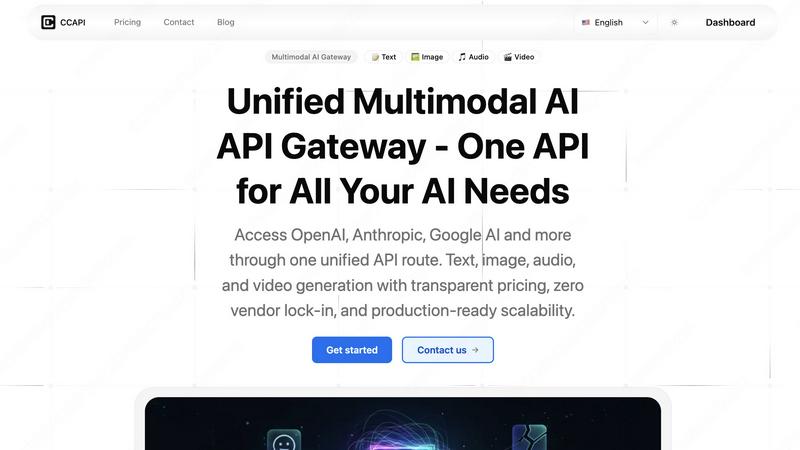
CCAPI is your all-in-one AI API gateway for seamless access to diverse models across text, image, audio, and video.
Last updated: February 28, 2026

Renderly
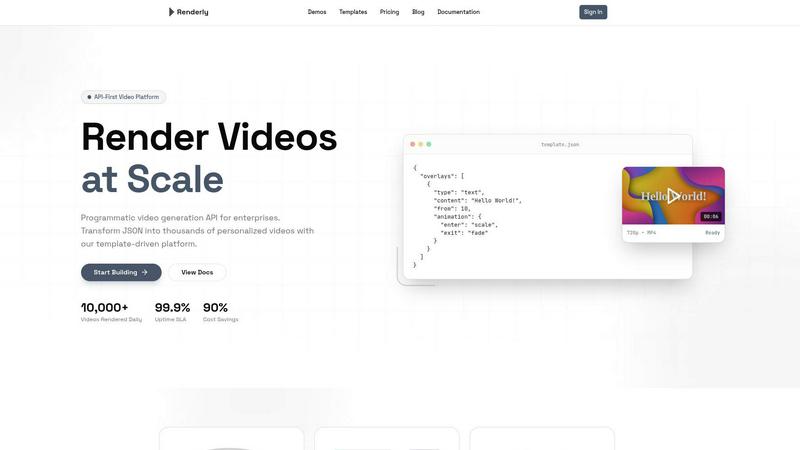
Renderly's API transforms JSON into thousands of personalized videos programmatically.
Last updated: February 28, 2026
Visual Comparison
CCAPI
Renderly
Feature Comparison
CCAPI
Unified Access to Multiple Providers
CCAPI aggregates services from various AI providers, allowing developers to access multiple models for text, image, audio, and video generation through a single endpoint. This streamlines the development process and reduces the complexity of managing different APIs.
Smart Routing and Auto-Failover
The smart routing feature ensures that if one provider is unavailable, CCAPI automatically switches to another provider without any interruption in service. This auto-failover capability safeguards against downtime, ensuring that applications remain operational and responsive.
OpenAI-Compatible Endpoints
CCAPI provides OpenAI-compatible endpoints, enabling developers to easily migrate existing applications to its platform. By simply changing the base URL in their code, developers can access a wider array of AI models without the need for significant code changes.
Real-Time Usage Dashboard
The platform includes a comprehensive usage dashboard that tracks real-time metrics such as costs, latency, and success rates. This transparency allows developers to monitor their API usage effectively and optimize their applications for better performance and cost-efficiency.
Renderly
Programmatic Video Generation API
The cornerstone of Renderly is its RESTful API, designed for high-volume, automated video creation. Developers can send a POST request with a JSON payload containing template references and dynamic variables to instantly trigger a render. The API provides endpoints for checking job status, managing render queues, and retrieving finished videos, complete with webhook support for asynchronous workflows. This feature turns video production into a programmable utility, seamlessly integrable into any software stack for automated, data-driven content pipelines.
Template-Driven JSON Configuration
Renderly utilizes a powerful template system where videos are defined and controlled through JSON configuration files. Users create a master template in the online editor, specifying scenes, layers (text, images, video clips), animations, and timing. Dynamic elements are marked as variables. To generate personalized videos, the API simply swaps these variables with values from an incoming JSON object. This approach offers immense flexibility, version control capabilities, and the ability to manage complex video designs as code, enabling consistent branding and rapid iteration.
Enterprise-Grade Scalable Infrastructure
Built on a cloud-native, auto-scaling architecture, Renderly's infrastructure is engineered for demanding workloads. It automatically provisions resources to handle spikes from one to thousands of concurrent rendering jobs, ensuring consistent performance and speed regardless of volume. This eliminates the need for businesses to manage their own rendering farms or worry about capacity planning, providing an elastic, reliable backbone for mission-critical video production at any scale.
Transparent Credit-Based Pricing
Renderly employs a transparent, consumption-based pricing model centered on credits. Users pay only for the seconds of video they actually render, with costs decreasing through volume discounts. This model contrasts with fixed monthly subscriptions or expensive per-video fees of competitors, directly enabling the advertised up to 90% cost savings. The pricing is designed to be predictable and scalable alongside business needs, aligning cost directly with output.
Use Cases
CCAPI
Content Generation for Marketing
Marketers can utilize CCAPI to generate compelling text content, such as blog posts, social media updates, and promotional materials. With access to high-quality language models, they can enhance their content strategies and engage their audience more effectively.
Video Creation for Educational Purposes
Educators can harness the video generation capabilities of CCAPI to create instructional videos or visual aids. By inputting specific prompts, they can produce high-quality videos that cater to various learning styles, enhancing the educational experience for students.
Chatbot Development
Developers can leverage CCAPI to build intelligent chatbots that utilize advanced natural language processing models. By integrating these capabilities, businesses can improve customer support, automate tasks, and create interactive user experiences.
Multimedia Content Production
Creative professionals can use CCAPI for multimedia projects, including video, audio, and image generation. This versatility allows artists and content creators to experiment with different formats and deliver innovative content across various platforms.
Renderly
Personalized Marketing & Communication
Businesses can generate thousands of unique video messages for email campaigns, product launches, or customer win-backs. By merging a customer database (names, purchase history) with a video template, Renderly can produce individualized videos that address each recipient by name, showcase relevant products, or celebrate milestones, dramatically increasing engagement rates compared to static content.
Bulk Social Media Content Creation
Content teams and agencies can automate the production of social media clips for platforms like TikTok, Instagram Reels, and YouTube Shorts. A single template can be adapted with different text overlays, hashtags, and product images to create hundreds of variations for A/B testing, regional campaigns, or daily posting schedules, freeing creators from repetitive editing tasks.
Data Visualization & Reporting
Transform complex datasets into compelling motion graphics and explainer videos. Renderly can take structured data (e.g., quarterly sales figures, user analytics, sports statistics) and dynamically generate charts, graphs, and animated text summaries within a video format. This is ideal for creating automated weekly report videos, investor updates, or interactive educational content.
E-commerce & Onboarding Sequences
E-commerce platforms can integrate Renderly to create personalized video receipts, shipping notifications, or product tutorials featuring the specific items a customer purchased. Similarly, SaaS companies can automate user onboarding by generating welcome videos that include the new user's name and company logo, providing a tailored and engaging first experience directly through their app.
Overview
About CCAPI
CCAPI is a revolutionary API platform designed to provide developers with seamless access to a multitude of AI services from leading providers such as OpenAI, Anthropic, Google AI, and many more. By unifying these services under a single API, CCAPI simplifies the process of integrating advanced AI capabilities into applications, enabling developers to focus on innovation without the hassle of managing multiple endpoints. The platform supports various modalities, including text, image, audio, and video generation, all through one OpenAI-compatible route. With a remarkable 99.9% success rate and 24/7 monitoring, CCAPI ensures high availability and reliability for developers seeking to harness the power of AI. Whether you are building chatbots, content generation tools, or multimedia applications, CCAPI provides the flexibility and efficiency needed to accelerate development and enhance user experiences.
About Renderly
Renderly is a modern video infrastructure platform engineered to automate and scale video production through code. It fundamentally shifts the paradigm from manual, time-consuming video editing to a programmatic, API-driven approach. At its core, Renderly allows developers and creators to transform simple JSON data into thousands of unique, high-quality videos. This is achieved via a template-driven system where users design a video template once and then dynamically populate it with personalized text, images, and data variables via API calls. The platform serves a dual audience: developers in need of a robust, reliable API for embedding video generation into applications (like for marketing automation, user onboarding, or data visualization), and content creators or marketing teams looking to produce bulk social media content, personalized customer messages, or data-driven motion graphics without manual effort. Its primary value proposition is threefold: unprecedented scalability to handle from one to hundreds of thousands of concurrent renders, significant cost reduction (advertised as up to 90% savings), and a developer-first experience that prioritizes seamless integration, comprehensive documentation, and enterprise-grade reliability with a 99.9% uptime SLA.
Frequently Asked Questions
CCAPI FAQ
What types of AI models does CCAPI support?
CCAPI supports a variety of AI models across multiple modalities, including text, image, audio, and video generation. Notable providers include OpenAI, Anthropic, Google AI, and more.
How does smart routing work?
Smart routing automatically directs requests to the best available provider based on their availability and performance. If one provider experiences downtime, CCAPI seamlessly switches to another provider to maintain service continuity.
Is there a waiting list for accessing CCAPI?
No, CCAPI offers instant API access with no waiting list. Developers can sign up and start integrating the API immediately without delays.
Can I use my existing API keys with CCAPI?
Yes, CCAPI allows you to bring your own API keys and endpoints for any OpenAI-compatible provider, offering flexibility and customization for your specific needs.
Renderly FAQ
What kind of videos can I create with Renderly?
You can create a wide variety of video content, including personalized marketing messages, social media clips, data-driven motion graphics, explainer videos, and automated reports. The platform supports text overlays, images, animations, and scene transitions, all configurable via JSON templates. The limit is primarily defined by your template design and the dynamic data you feed into the API.
How does the API integration work?
Integration is straightforward. First, you design a template using Renderly's online editor or by defining a JSON structure. This template includes placeholder variables. Then, you use Renderly's SDKs or direct REST API calls from your application. You send a POST request to the /render endpoint with your template ID and a JSON object containing the values for your variables. The API returns a job ID, and you can poll the /status endpoint or use webhooks to retrieve the final video URL upon completion.
Is Renderly suitable for high-volume, enterprise workloads?
Absolutely. Renderly is built specifically for enterprise-scale video generation. Its auto-scaling, cloud-native infrastructure is designed to handle thousands of concurrent render jobs reliably, backed by a 99.9% uptime SLA. Features like comprehensive documentation, webhooks, SOC 2 compliance, and volume discounts are all tailored to meet the security, reliability, and performance demands of large organizations.
How does the credit-based pricing model calculate costs?
You purchase credits, and each credit corresponds to a second of rendered video output (at standard definition). The cost per credit decreases with higher volume purchases. You are only charged for the final duration of each video you generate. The platform provides a cost calculator tool to help estimate expenses, and billing is transparent, with detailed usage reports to track consumption.
Alternatives
CCAPI Alternatives
CCAPI, a unified multimodal AI API gateway, serves as a one-stop solution for developers seeking streamlined access to various AI services, including those from OpenAI, Anthropic, and Google AI. By integrating capabilities for text, image, audio, and video generation, it caters to a wide array of development needs. However, users often find themselves searching for alternatives due to factors such as pricing structures, specific feature sets, or compatibility with particular platforms. When exploring alternatives, it’s crucial to evaluate several key aspects: the breadth of AI services offered, ease of integration, pricing models, and the overall user experience. Additionally, considering customer support and documentation can significantly impact the effectiveness of an API solution in meeting diverse development requirements.
Renderly Alternatives
Renderly is a video infrastructure platform that automates video production through code, falling into the category of programmable video generation and editing tools. It enables users to create thousands of personalized or data-driven videos via API or an online editor, moving beyond manual rendering. Users often explore alternatives for various reasons. These can include budget constraints, the need for different feature sets like more advanced editing or simpler interfaces, or specific platform requirements such as deeper integration with certain tech stacks or different output formats. When evaluating other options, key considerations should be the core automation capabilities, API robustness, scalability for bulk projects, ease of use for your team's skill set, and the overall cost structure. The right fit balances technical power with your specific production workflow needs.