
Agent to Agent Testing Platform vs WearView
Side-by-side comparison to help you choose the right AI tool.

Agent to Agent Testing Platform
TestMu AI validates AI agents for bias, toxicity, and reliability across all interaction modes.
Last updated: February 28, 2026

WearView
WearView uses AI to instantly transform your product photos into realistic model shots.
Last updated: March 1, 2026
Visual Comparison
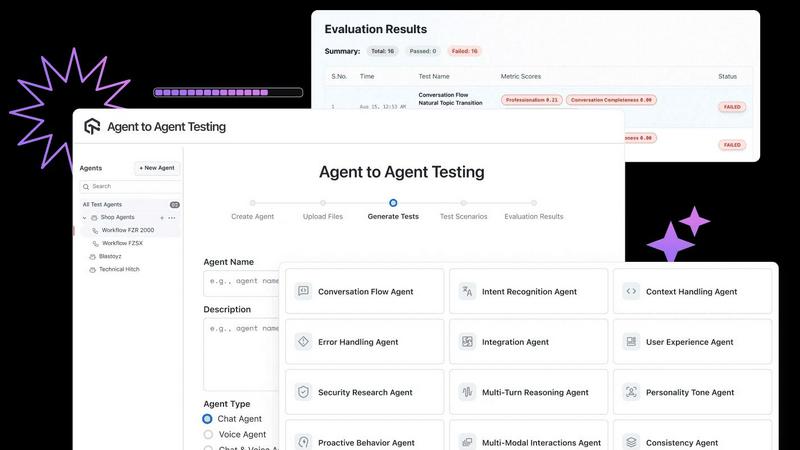
Agent to Agent Testing Platform
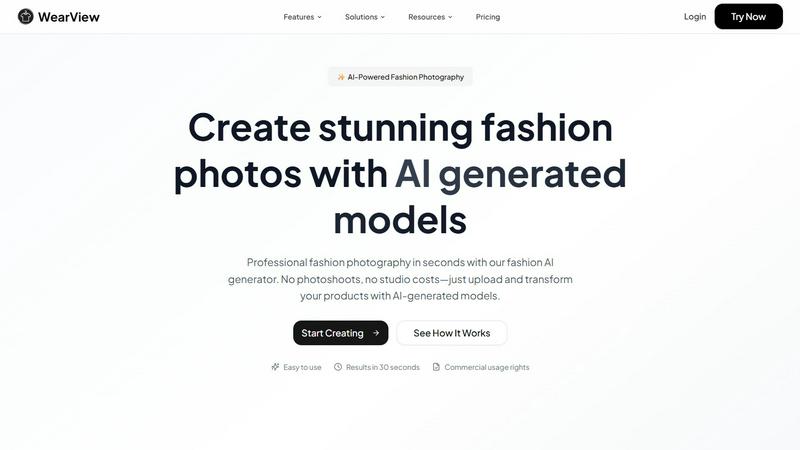
WearView
Feature Comparison
Agent to Agent Testing Platform
Autonomous Multi-Agent Test Generation
The platform deploys a suite of over 17 specialized AI agents, each designed to probe different aspects of the Agent Under Test (AUT). These include agents focused on personality tone, data privacy, intent recognition, and more. This multi-agent system autonomously generates diverse, complex test scenarios that simulate real human conversation patterns, uncovering edge cases and interaction failures that manual or scripted testing would inevitably miss, ensuring comprehensive behavioral validation.
True Multi-Modal Understanding and Testing
Going far beyond text-based analysis, this feature allows testers to define requirements using diverse inputs such as images, audio files, and video. By uploading PRDs or directly specifying multi-modal prompts, teams can gauge how their AI agent processes and responds to real-world, mixed-media inputs. This ensures the agent's performance is robust across all interaction types it is designed to handle, mirroring actual user environments.
Diverse Persona-Based Synthetic User Testing
To test like real humans, the platform enables simulations using a wide variety of predefined and custom user personas, such as an "International Caller" or a "Digital Novice." Each persona exhibits different behaviors, needs, and interaction styles. This diversity ensures the AI agent is evaluated for effectiveness and empathy across the entire spectrum of its intended user base, highlighting potential biases or performance drops with specific demographics.
Integrated Regression Testing with Risk Scoring
The platform facilitates end-to-end regression testing for AI agents with intelligent risk scoring. After changes or updates, it automatically re-runs test suites and provides a detailed risk assessment, highlighting potential areas of concern. This allows teams to prioritize critical issues, optimize testing efforts, and maintain a high standard of quality and reliability throughout the agent's development lifecycle with clear, actionable insights.
WearView
AI Virtual Try-On Studio
This core feature allows users to visualize garments on a variety of AI-generated models with photorealistic accuracy. By uploading a product image, brands can instantly see how different outfits look on diverse body types and in various settings, transforming static product listings into dynamic, engaging visual experiences that help customers make confident purchasing decisions.
Product to Model Transform
Specifically designed for e-commerce, this feature effortlessly converts basic flat-lay or mannequin shots into compelling lifestyle photography. It intelligently maps the garment onto a chosen model, handling complex details like fabric drape, shadows, and fit to create a natural, catalog-ready image without the need for a physical photoshoot or studio.
AI Model Creation & Consistency
WearView provides tools to generate unique, diverse AI models from text descriptions, offering full control over ethnicity, age, style, and appearance. Crucially, it enables brands to maintain consistent model personas across multiple campaigns, ensuring a cohesive brand identity and reliable visual storytelling over time.
AI Pose Control & Video Animation
Beyond static images, WearView offers precise control over model posing and dynamic video generation. Users can direct specific poses and angles for perfect catalog imagery, and also bring collections to life with AI-powered video animations that showcase garments in motion, significantly enhancing engagement on social media and digital ads.
Use Cases
Agent to Agent Testing Platform
Pre-Production Validation for Customer Service Chatbots
Before launching a new customer support chatbot, enterprises can use the platform to simulate thousands of customer inquiries, from simple FAQ retrieval to complex, multi-issue troubleshooting. This validates the agent's accuracy, escalation logic, policy adherence, and tone, ensuring it reduces live agent handoffs and maintains brand professionalism before interacting with real customers.
Compliance and Safety Auditing for Financial Voice Assistants
Banks and fintech companies deploying voice-activated assistants for balance inquiries or transactions require stringent compliance checks. The platform tests for data privacy violations, hallucination of financial data, and appropriate security escalation protocols. It autonomously probes for toxic or biased responses under stress, ensuring the agent meets strict regulatory and ethical standards.
Scalable Performance Benchmarking for Sales AI Agents
Sales teams implementing AI agents for lead qualification can benchmark performance at scale. The platform uses diverse buyer personas to test the agent's ability to recognize purchase intent, handle objections, and provide accurate product information across countless simulated conversations, providing metrics on effectiveness and conversion pathway reliability.
Continuous Monitoring and Improvement of Healthcare Assistants
For healthcare providers using AI for patient intake or symptom triage, consistent and accurate performance is critical. The platform enables continuous regression testing after every model update, checking for hallucinations in medical advice, maintaining empathy in tone, and ensuring correct handoff to human professionals, thereby mitigating risk and improving patient trust over time.
WearView
Rapid E-commerce Catalog Production
Online retailers can launch entire seasonal collections in days instead of months. By uploading warehouse product photos, they can generate hundreds of consistent, high-quality model shots for their website, eliminating the massive cost and coordination of traditional photoshoots and dramatically speeding up time-to-market.
Inclusive and Diverse Brand Campaigns
Brands aiming to showcase inclusivity can effortlessly generate a wide spectrum of models representing different ethnicities, ages, and body types. This allows for authentic marketing campaigns that resonate with broader audiences without the logistical challenges and high costs associated with casting diverse talent for physical shoots.
Agile Marketing and Social Content Creation
Marketing teams and influencers can produce a constant stream of fresh, professional visual content for social media, email campaigns, and digital advertising. The ability to quickly visualize new outfits on different models and in various poses supports agile marketing strategies and boosts engagement metrics like click-through rates.
Prototyping and Design Visualization
Fashion designers and product developers can use WearView to visualize prototypes and design concepts before committing to physical samples. This enables faster iteration, better decision-making in the design phase, and the ability to create compelling pre-launch marketing materials to gauge consumer interest.
Overview
About Agent to Agent Testing Platform
Agent to Agent Testing Platform represents a paradigm shift in quality assurance, engineered specifically for the unpredictable and autonomous nature of modern AI agents. As enterprises rapidly deploy conversational AI across chatbots, voice assistants, and phone-calling agents, traditional testing frameworks—designed for deterministic, static software—fail to capture the dynamic, multi-turn complexities of agentic systems. This platform is the first AI-native quality and assurance framework built to close that critical gap. It provides a unified environment to rigorously validate AI behavior before production, simulating thousands of real-world user interactions across chat, voice, and multimodal channels. By moving beyond simple prompt checks to evaluate full conversational flows, it empowers development and QA teams to proactively uncover long-tail failures, edge cases, and subtle interaction flaws. The core value proposition lies in its autonomous, multi-agent testing approach, which leverages over 17 specialized AI agents to generate tests, assess key metrics like bias, toxicity, and hallucination, and ensure reliability, safety, and policy compliance at scale. It is designed for organizations that rely on AI for customer service, sales, support, and other mission-critical interactions, offering them the confidence that their AI agents will perform as intended for every user.
About WearView
WearView is not merely a software tool; it is a foundational shift in the economics and creative process of fashion visual content. It stands as an AI-powered virtual try-on and fashion photography platform, engineered to dismantle the traditional barriers of the industry. By allowing users to generate professional, on-model lifestyle imagery from a simple flat-lay or hanger shot, WearView effectively democratizes high-end fashion presentation. This technology is designed for a broad spectrum of users, from ambitious independent designers and e-commerce retailers to established fashion brands and enterprise-level operations. Its core value proposition is multifaceted, addressing critical pain points with surgical precision. It delivers staggering reductions in visual production costs and time-to-market, slashing the former by up to 90% and accelerating the latter tenfold. Beyond efficiency, it enhances commercial performance by boosting online conversion rates and average order value through superior, realistic visuals. Furthermore, it grants unparalleled creative flexibility and brand consistency, enabling the generation of diverse, inclusive AI models that can be precisely controlled and reused across campaigns. In essence, WearView transforms a logistical and financial bottleneck into a strategic, scalable asset.
Frequently Asked Questions
Agent to Agent Testing Platform FAQ
What makes Agent-to-Agent Testing different from traditional QA?
Traditional QA is built for deterministic software with predictable inputs and outputs. AI agents, however, are probabilistic and engage in dynamic, multi-turn conversations. Agent-to-Agent Testing is a native framework designed for this complexity. It uses other AI agents to generate and evaluate full conversational flows across modalities, testing for emergent behaviors, reasoning flaws, and real-world interaction patterns that scripted tests cannot replicate.
What key metrics does the platform evaluate for an AI agent?
The platform provides deep, actionable evaluation across a plethora of key AI performance and safety metrics. This includes assessing the agent for bias and toxicity in its responses, identifying hallucinations (fabricated information), and measuring effectiveness, accuracy, empathy, and professionalism. It also validates specific functional logic like escalation protocols and data privacy compliance.
Can I test voice and phone-calling agents, or is it only for chatbots?
Absolutely. The platform is built for true multi-modal testing. It supports the validation of AI agents across all major interaction channels: text-based chat, voice assistants, and inbound/outbound phone-calling agents. You can define test scenarios that simulate authentic voice or hybrid interactions, ensuring your agent performs reliably regardless of how the user communicates.
How does the platform handle test scenario creation?
The platform offers two powerful approaches. First, it provides autonomous test generation where its library of specialized AI agents creates diverse, production-like scenarios. Second, it allows teams to access a library of hundreds of pre-built scenarios or create completely custom scenarios tailored to specific business needs and user journeys, offering both flexibility and comprehensive coverage.
WearView FAQ
How realistic are the AI-generated model photos?
WearView utilizes advanced generative AI models trained specifically on fashion imagery to produce highly photorealistic results. The technology accurately simulates fabric texture, drape, lighting, and shadows, ensuring the garment integrates naturally with the AI model. The output is professional-grade and trusted by thousands of businesses for their commercial platforms.
Do I own the rights to the images I create?
Yes, absolutely. A key benefit of WearView is that full commercial image rights are included. There are no hidden licensing fees or royalties. Every image you generate is yours to use forever across all marketing channels, including your website, social media, paid advertising, and print catalogs.
What kind of product photo do I need to upload?
The platform is designed for flexibility. You can upload a photo of your garment on a hanger, laid flat on a surface, or even on a person. No professional photography equipment is required. The AI is engineered to work with these common inputs and transform them into a professional on-model shot.
Can I create videos with WearView?
Yes, the platform includes an AI Fashion Video Generator feature. This allows you to bring your static model images to life by creating short, dynamic video animations. These videos are perfect for capturing attention on social media feeds, website banners, and digital advertisements to increase engagement.
Alternatives
Agent to Agent Testing Platform Alternatives
Agent to Agent Testing Platform is a specialized AI-native quality assurance framework designed for validating the behavior of autonomous AI agents. It belongs to the AI Assistants and agentic systems testing category, focusing on multi-turn, multimodal interactions that traditional software QA tools cannot adequately assess. Users often explore alternatives for various reasons, including budget constraints, the need for different feature sets like integration with specific development environments, or requirements for a more general-purpose testing solution that covers non-agentic software as well. Some may seek platforms with different pricing models or those that focus on a narrower aspect of testing, such as only chat-based interfaces. When evaluating an alternative, key considerations should include the platform's ability to simulate complex, real-world user interactions across your required channels (voice, chat, etc.), its methodology for generating edge-case tests, and the depth of its validation for security, compliance, and operational logic. The ideal solution should provide scalable, automated testing that mirrors production complexity to ensure agent reliability and safety before deployment.
WearView Alternatives
WearView is an AI-powered virtual try-on and fashion photography platform, falling under the category of AI assistants for visual content creation. It transforms simple product photos into realistic model shots, aiming to save time and reduce costs for fashion brands and e-commerce retailers. Users often explore alternatives for various reasons. Budget constraints can lead to a search for different pricing models or free tiers. Some may need specific integrations with their existing e-commerce platform, while others might prioritize different features, such as more granular control over AI models or alternative output formats that better suit their marketing channels. When evaluating alternatives, consider the core value you need. Key factors include the realism and quality of the AI-generated imagery, the cost structure relative to your volume, the ease of use and speed of the workflow, and the ability to maintain brand consistency across generated visuals. The right tool should align with your specific operational and creative requirements.