
Agent to Agent Testing Platform vs Kane AI
Side-by-side comparison to help you choose the right AI tool.

Agent to Agent Testing Platform
TestMu AI validates AI agents for bias, toxicity, and reliability across all interaction modes.
Last updated: February 28, 2026

Kane AI
Kane AI simplifies quality engineering by enabling teams to effortlessly create and manage tests using natural language.
Last updated: February 28, 2026
Visual Comparison
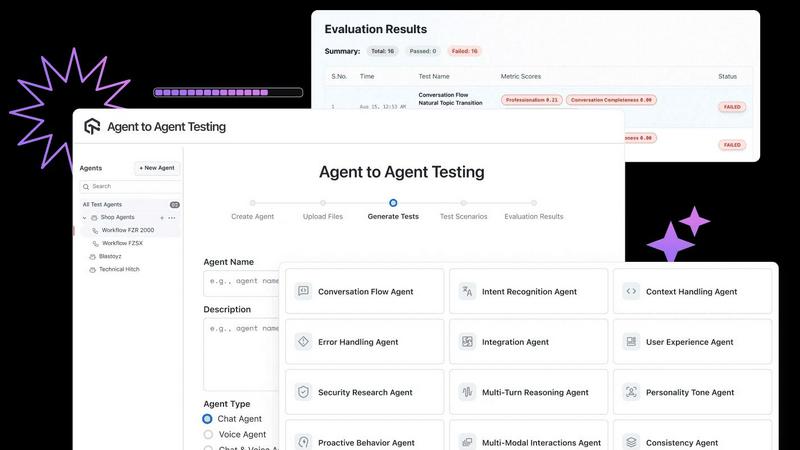
Agent to Agent Testing Platform
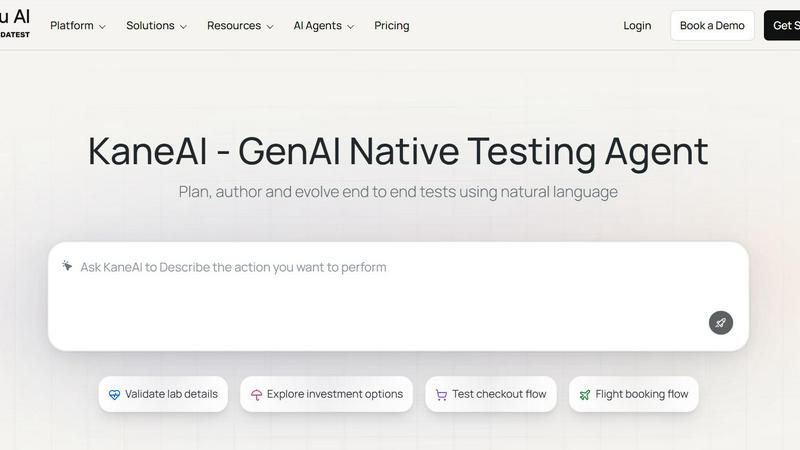
Kane AI
Feature Comparison
Agent to Agent Testing Platform
Autonomous Multi-Agent Test Generation
The platform deploys a suite of over 17 specialized AI agents, each designed to probe different aspects of the Agent Under Test (AUT). These include agents focused on personality tone, data privacy, intent recognition, and more. This multi-agent system autonomously generates diverse, complex test scenarios that simulate real human conversation patterns, uncovering edge cases and interaction failures that manual or scripted testing would inevitably miss, ensuring comprehensive behavioral validation.
True Multi-Modal Understanding and Testing
Going far beyond text-based analysis, this feature allows testers to define requirements using diverse inputs such as images, audio files, and video. By uploading PRDs or directly specifying multi-modal prompts, teams can gauge how their AI agent processes and responds to real-world, mixed-media inputs. This ensures the agent's performance is robust across all interaction types it is designed to handle, mirroring actual user environments.
Diverse Persona-Based Synthetic User Testing
To test like real humans, the platform enables simulations using a wide variety of predefined and custom user personas, such as an "International Caller" or a "Digital Novice." Each persona exhibits different behaviors, needs, and interaction styles. This diversity ensures the AI agent is evaluated for effectiveness and empathy across the entire spectrum of its intended user base, highlighting potential biases or performance drops with specific demographics.
Integrated Regression Testing with Risk Scoring
The platform facilitates end-to-end regression testing for AI agents with intelligent risk scoring. After changes or updates, it automatically re-runs test suites and provides a detailed risk assessment, highlighting potential areas of concern. This allows teams to prioritize critical issues, optimize testing efforts, and maintain a high standard of quality and reliability throughout the agent's development lifecycle with clear, actionable insights.
Kane AI
Intelligent Test Generation
Kane AI utilizes natural language processing to enable intelligent test generation, allowing users to communicate their test objectives effortlessly. By entering high-level instructions, teams can automatically create detailed test cases without needing coding skills, significantly speeding up the authoring process.
Unified Testing Approach
Kane AI supports an all-in-one flow testing methodology that allows teams to plan, author, and evolve end-to-end tests. This feature ensures comprehensive testing across databases, APIs, and UI, eliminating silos and ensuring that every layer of the application is validated effectively.
Smart Bug Detection
This feature enables Kane AI to automatically identify failures during test execution. It allows users to create and assign bug tickets directly in JIRA or Azure DevOps, ensuring that issues are promptly addressed and improving overall team collaboration and response times.
Dynamic Test Data Generation
Kane AI can automatically generate dynamic test data during the authoring process. This capability allows teams to create realistic and variable-rich testing scenarios without manual setup, ensuring that tests are robust and adaptable to different conditions.
Use Cases
Agent to Agent Testing Platform
Pre-Production Validation for Customer Service Chatbots
Before launching a new customer support chatbot, enterprises can use the platform to simulate thousands of customer inquiries, from simple FAQ retrieval to complex, multi-issue troubleshooting. This validates the agent's accuracy, escalation logic, policy adherence, and tone, ensuring it reduces live agent handoffs and maintains brand professionalism before interacting with real customers.
Compliance and Safety Auditing for Financial Voice Assistants
Banks and fintech companies deploying voice-activated assistants for balance inquiries or transactions require stringent compliance checks. The platform tests for data privacy violations, hallucination of financial data, and appropriate security escalation protocols. It autonomously probes for toxic or biased responses under stress, ensuring the agent meets strict regulatory and ethical standards.
Scalable Performance Benchmarking for Sales AI Agents
Sales teams implementing AI agents for lead qualification can benchmark performance at scale. The platform uses diverse buyer personas to test the agent's ability to recognize purchase intent, handle objections, and provide accurate product information across countless simulated conversations, providing metrics on effectiveness and conversion pathway reliability.
Continuous Monitoring and Improvement of Healthcare Assistants
For healthcare providers using AI for patient intake or symptom triage, consistent and accurate performance is critical. The platform enables continuous regression testing after every model update, checking for hallucinations in medical advice, maintaining empathy in tone, and ensuring correct handoff to human professionals, thereby mitigating risk and improving patient trust over time.
Kane AI
Streamlined Test Automation
Kane AI is ideal for organizations looking to streamline their test automation efforts. Teams can easily author tests using natural language, making it accessible for users with varying technical backgrounds, thus accelerating the overall automation process.
Enhanced API Testing
With its ability to validate APIs alongside UI flows, Kane AI allows teams to create a seamless testing strategy that covers all aspects of an application. This integration ensures that no gaps exist between backend and frontend testing, resulting in higher quality software.
Real-time Network Validation
Kane AI's real-time network checks enable teams to verify network responses, statuses, and payloads during test execution. This ensures that applications perform reliably under various network conditions, which is crucial for user satisfaction.
Inclusive Accessibility Testing
Kane AI is designed to incorporate accessibility testing seamlessly into the automation workflow. This feature enables teams to deliver inclusive user experiences without slowing down their release cycles, ensuring compliance with accessibility standards.
Overview
About Agent to Agent Testing Platform
Agent to Agent Testing Platform represents a paradigm shift in quality assurance, engineered specifically for the unpredictable and autonomous nature of modern AI agents. As enterprises rapidly deploy conversational AI across chatbots, voice assistants, and phone-calling agents, traditional testing frameworks—designed for deterministic, static software—fail to capture the dynamic, multi-turn complexities of agentic systems. This platform is the first AI-native quality and assurance framework built to close that critical gap. It provides a unified environment to rigorously validate AI behavior before production, simulating thousands of real-world user interactions across chat, voice, and multimodal channels. By moving beyond simple prompt checks to evaluate full conversational flows, it empowers development and QA teams to proactively uncover long-tail failures, edge cases, and subtle interaction flaws. The core value proposition lies in its autonomous, multi-agent testing approach, which leverages over 17 specialized AI agents to generate tests, assess key metrics like bias, toxicity, and hallucination, and ensure reliability, safety, and policy compliance at scale. It is designed for organizations that rely on AI for customer service, sales, support, and other mission-critical interactions, offering them the confidence that their AI agents will perform as intended for every user.
About Kane AI
Kane AI is a revolutionary GenAI-native testing agent developed by TestMu AI, specifically designed to empower high-speed Quality Engineering teams. By leveraging natural language processing, Kane AI simplifies the entire test automation lifecycle, making it accessible to users with varying levels of technical expertise. This innovative platform facilitates test authoring, management, debugging, and evolution, significantly reducing the time and effort required to initiate and scale automated testing. Unlike traditional low-code solutions, Kane AI adeptly handles intricate workflows across various programming languages and frameworks, ensuring robust performance without compromise. With features like Intelligent Test Planner and multi-language code export, Kane AI aligns testing efforts with overarching business objectives, enabling teams to automate tests with ease. Its seamless integration with tools like JIRA enhances collaboration, while capabilities such as API testing and contextual bug detection provide comprehensive coverage and reliability. Ultimately, Kane AI streamlines the testing process, accelerates software delivery, and enhances overall product quality.
Frequently Asked Questions
Agent to Agent Testing Platform FAQ
What makes Agent-to-Agent Testing different from traditional QA?
Traditional QA is built for deterministic software with predictable inputs and outputs. AI agents, however, are probabilistic and engage in dynamic, multi-turn conversations. Agent-to-Agent Testing is a native framework designed for this complexity. It uses other AI agents to generate and evaluate full conversational flows across modalities, testing for emergent behaviors, reasoning flaws, and real-world interaction patterns that scripted tests cannot replicate.
What key metrics does the platform evaluate for an AI agent?
The platform provides deep, actionable evaluation across a plethora of key AI performance and safety metrics. This includes assessing the agent for bias and toxicity in its responses, identifying hallucinations (fabricated information), and measuring effectiveness, accuracy, empathy, and professionalism. It also validates specific functional logic like escalation protocols and data privacy compliance.
Can I test voice and phone-calling agents, or is it only for chatbots?
Absolutely. The platform is built for true multi-modal testing. It supports the validation of AI agents across all major interaction channels: text-based chat, voice assistants, and inbound/outbound phone-calling agents. You can define test scenarios that simulate authentic voice or hybrid interactions, ensuring your agent performs reliably regardless of how the user communicates.
How does the platform handle test scenario creation?
The platform offers two powerful approaches. First, it provides autonomous test generation where its library of specialized AI agents creates diverse, production-like scenarios. Second, it allows teams to access a library of hundreds of pre-built scenarios or create completely custom scenarios tailored to specific business needs and user journeys, offering both flexibility and comprehensive coverage.
Kane AI FAQ
What is Kane AI?
Kane AI is a GenAI-native testing agent that simplifies the test automation lifecycle by using natural language for test authoring, management, and execution, making it accessible to all team members.
How does Kane AI improve collaboration?
Kane AI integrates with tools like JIRA and Azure DevOps, allowing teams to create test cases, report bugs, and manage testing workflows in one unified platform, enhancing communication and collaboration.
Can Kane AI handle complex workflows?
Yes, Kane AI is designed to manage complex testing workflows across various programming languages and frameworks without compromising performance, making it suitable for diverse development environments.
Is Kane AI suitable for enterprise-level use?
Absolutely. Kane AI is built for enterprise readiness, featuring security protocols like SSO, RBAC, and audit logs to meet rigorous organizational standards, ensuring safe and efficient team management.
Alternatives
Agent to Agent Testing Platform Alternatives
Agent to Agent Testing Platform is a specialized AI-native quality assurance framework designed for validating the behavior of autonomous AI agents. It belongs to the AI Assistants and agentic systems testing category, focusing on multi-turn, multimodal interactions that traditional software QA tools cannot adequately assess. Users often explore alternatives for various reasons, including budget constraints, the need for different feature sets like integration with specific development environments, or requirements for a more general-purpose testing solution that covers non-agentic software as well. Some may seek platforms with different pricing models or those that focus on a narrower aspect of testing, such as only chat-based interfaces. When evaluating an alternative, key considerations should include the platform's ability to simulate complex, real-world user interactions across your required channels (voice, chat, etc.), its methodology for generating edge-case tests, and the depth of its validation for security, compliance, and operational logic. The ideal solution should provide scalable, automated testing that mirrors production complexity to ensure agent reliability and safety before deployment.
Kane AI Alternatives
Kane AI is a pioneering GenAI-native testing agent that belongs to the category of AI Assistants, specifically tailored for Quality Engineering teams. It facilitates the planning, creation, and evolution of tests through natural language interactions, offering a streamlined approach to test automation and quality assurance. Users often seek alternatives to Kane AI due to various reasons, including pricing constraints, differing feature sets, or specific platform requirements that may better align with their organizational needs. When considering alternatives, it's crucial to evaluate several factors, such as the ease of integration with existing workflows, the range of supported programming languages and frameworks, and the overall user experience. Additionally, users should look for capabilities that enhance automation efficiency, like intelligent test generation and seamless collaboration features, to ensure their testing processes remain effective and adaptable.