
Agent to Agent Testing Platform vs AI Detector
Side-by-side comparison to help you choose the right AI tool.

Agent to Agent Testing Platform
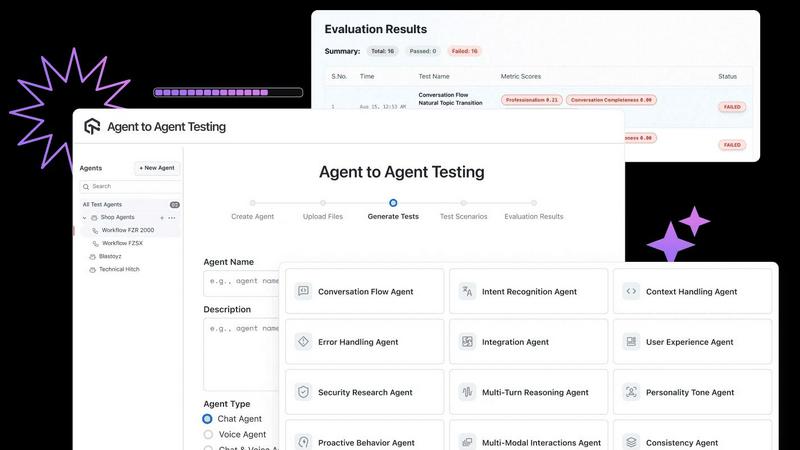
TestMu AI validates AI agents for bias, toxicity, and reliability across all interaction modes.
Last updated: February 28, 2026
AI Detector
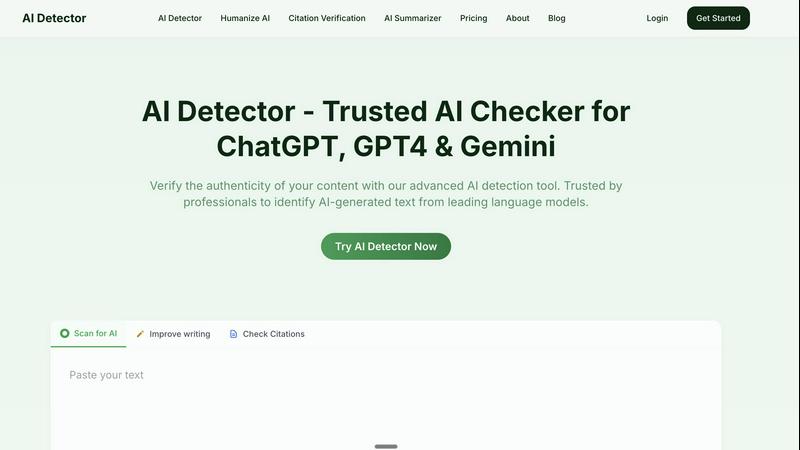
Ensure content authenticity with AI Detector, the trusted tool for identifying AI-generated text from top models.
Last updated: March 1, 2026
Visual Comparison
Agent to Agent Testing Platform
AI Detector
Feature Comparison
Agent to Agent Testing Platform
Autonomous Multi-Agent Test Generation
The platform deploys a suite of over 17 specialized AI agents, each designed to probe different aspects of the Agent Under Test (AUT). These include agents focused on personality tone, data privacy, intent recognition, and more. This multi-agent system autonomously generates diverse, complex test scenarios that simulate real human conversation patterns, uncovering edge cases and interaction failures that manual or scripted testing would inevitably miss, ensuring comprehensive behavioral validation.
True Multi-Modal Understanding and Testing
Going far beyond text-based analysis, this feature allows testers to define requirements using diverse inputs such as images, audio files, and video. By uploading PRDs or directly specifying multi-modal prompts, teams can gauge how their AI agent processes and responds to real-world, mixed-media inputs. This ensures the agent's performance is robust across all interaction types it is designed to handle, mirroring actual user environments.
Diverse Persona-Based Synthetic User Testing
To test like real humans, the platform enables simulations using a wide variety of predefined and custom user personas, such as an "International Caller" or a "Digital Novice." Each persona exhibits different behaviors, needs, and interaction styles. This diversity ensures the AI agent is evaluated for effectiveness and empathy across the entire spectrum of its intended user base, highlighting potential biases or performance drops with specific demographics.
Integrated Regression Testing with Risk Scoring
The platform facilitates end-to-end regression testing for AI agents with intelligent risk scoring. After changes or updates, it automatically re-runs test suites and provides a detailed risk assessment, highlighting potential areas of concern. This allows teams to prioritize critical issues, optimize testing efforts, and maintain a high standard of quality and reliability throughout the agent's development lifecycle with clear, actionable insights.
AI Detector
Advanced AI Detection
AI Detector employs state-of-the-art technology to identify content generated by leading AI language models such as ChatGPT, GPT-4, and Gemini. This feature provides users with a reliable way to differentiate between human-written and AI-generated text, ensuring accuracy in verification.
Detailed Analytics
Users receive comprehensive reports that include sentence-level analysis, confidence scores, and metrics indicating the likelihood of AI involvement in the text. This detailed feedback allows users to understand their content better and make informed decisions about revisions.
Multilingual Support
AI Detector is designed to recognize AI-generated content across multiple languages with exceptional accuracy. This feature broadens its usability, catering to a global audience and ensuring that users from diverse linguistic backgrounds can benefit from its capabilities.
Privacy Focused
With a commitment to user privacy, AI Detector ensures that all submitted text remains confidential. The tool does not store or share user content with third parties, providing peace of mind to users concerned about data security.
Use Cases
Agent to Agent Testing Platform
Pre-Production Validation for Customer Service Chatbots
Before launching a new customer support chatbot, enterprises can use the platform to simulate thousands of customer inquiries, from simple FAQ retrieval to complex, multi-issue troubleshooting. This validates the agent's accuracy, escalation logic, policy adherence, and tone, ensuring it reduces live agent handoffs and maintains brand professionalism before interacting with real customers.
Compliance and Safety Auditing for Financial Voice Assistants
Banks and fintech companies deploying voice-activated assistants for balance inquiries or transactions require stringent compliance checks. The platform tests for data privacy violations, hallucination of financial data, and appropriate security escalation protocols. It autonomously probes for toxic or biased responses under stress, ensuring the agent meets strict regulatory and ethical standards.
Scalable Performance Benchmarking for Sales AI Agents
Sales teams implementing AI agents for lead qualification can benchmark performance at scale. The platform uses diverse buyer personas to test the agent's ability to recognize purchase intent, handle objections, and provide accurate product information across countless simulated conversations, providing metrics on effectiveness and conversion pathway reliability.
Continuous Monitoring and Improvement of Healthcare Assistants
For healthcare providers using AI for patient intake or symptom triage, consistent and accurate performance is critical. The platform enables continuous regression testing after every model update, checking for hallucinations in medical advice, maintaining empathy in tone, and ensuring correct handoff to human professionals, thereby mitigating risk and improving patient trust over time.
AI Detector
Academic Integrity
Students and educators can utilize AI Detector to ensure that academic papers and assignments maintain originality. By verifying the authenticity of submissions, this tool helps uphold academic integrity and prevent issues related to plagiarism.
Content Creation
Bloggers and content creators can employ AI Detector to confirm that their writing remains authentic and engaging. Ensuring originality not only boosts credibility but also enhances audience connection and engagement.
Professional Reports
In the corporate world, maintaining the originality of reports and presentations is crucial. AI Detector allows professionals to verify that their documents reflect their own insights and ideas, thereby preserving their professional reputation.
Language Learning
Language learners can use AI Detector to evaluate their writing skills by comparing their text against AI-generated content. This helps them refine their writing, develop their voice, and ensure their work is genuinely their own.
Overview
About Agent to Agent Testing Platform
Agent to Agent Testing Platform represents a paradigm shift in quality assurance, engineered specifically for the unpredictable and autonomous nature of modern AI agents. As enterprises rapidly deploy conversational AI across chatbots, voice assistants, and phone-calling agents, traditional testing frameworks—designed for deterministic, static software—fail to capture the dynamic, multi-turn complexities of agentic systems. This platform is the first AI-native quality and assurance framework built to close that critical gap. It provides a unified environment to rigorously validate AI behavior before production, simulating thousands of real-world user interactions across chat, voice, and multimodal channels. By moving beyond simple prompt checks to evaluate full conversational flows, it empowers development and QA teams to proactively uncover long-tail failures, edge cases, and subtle interaction flaws. The core value proposition lies in its autonomous, multi-agent testing approach, which leverages over 17 specialized AI agents to generate tests, assess key metrics like bias, toxicity, and hallucination, and ensure reliability, safety, and policy compliance at scale. It is designed for organizations that rely on AI for customer service, sales, support, and other mission-critical interactions, offering them the confidence that their AI agents will perform as intended for every user.
About AI Detector
AI Detector is a pioneering tool designed to navigate the complexities of the digital landscape where the authenticity of content is paramount. As AI-generated text becomes increasingly prevalent, this tool serves a critical function for professionals, educators, and creators who value originality and integrity in their work. By utilizing advanced algorithms, AI Detector effectively identifies content produced by major language models like ChatGPT, GPT-4, and Gemini. The tool is not merely a verification system; it acts as a digital gatekeeper, empowering users to assess the authenticity of their content, whether it be a corporate report, academic paper, or blog post. AI Detector stands out by providing a nuanced analysis that highlights AI-generated sentences while offering confidence scores, enabling users to gain clear insights into their text's originality. With a design philosophy that emphasizes accuracy, privacy, and fairness, it minimizes false positives and cultural biases, ensuring that users can trust their results. Trusted by millions, AI Detector is an essential resource for maintaining the integrity of professional and academic communication.
Frequently Asked Questions
Agent to Agent Testing Platform FAQ
What makes Agent-to-Agent Testing different from traditional QA?
Traditional QA is built for deterministic software with predictable inputs and outputs. AI agents, however, are probabilistic and engage in dynamic, multi-turn conversations. Agent-to-Agent Testing is a native framework designed for this complexity. It uses other AI agents to generate and evaluate full conversational flows across modalities, testing for emergent behaviors, reasoning flaws, and real-world interaction patterns that scripted tests cannot replicate.
What key metrics does the platform evaluate for an AI agent?
The platform provides deep, actionable evaluation across a plethora of key AI performance and safety metrics. This includes assessing the agent for bias and toxicity in its responses, identifying hallucinations (fabricated information), and measuring effectiveness, accuracy, empathy, and professionalism. It also validates specific functional logic like escalation protocols and data privacy compliance.
Can I test voice and phone-calling agents, or is it only for chatbots?
Absolutely. The platform is built for true multi-modal testing. It supports the validation of AI agents across all major interaction channels: text-based chat, voice assistants, and inbound/outbound phone-calling agents. You can define test scenarios that simulate authentic voice or hybrid interactions, ensuring your agent performs reliably regardless of how the user communicates.
How does the platform handle test scenario creation?
The platform offers two powerful approaches. First, it provides autonomous test generation where its library of specialized AI agents creates diverse, production-like scenarios. Second, it allows teams to access a library of hundreds of pre-built scenarios or create completely custom scenarios tailored to specific business needs and user journeys, offering both flexibility and comprehensive coverage.
AI Detector FAQ
How does AI Detector work?
AI Detector uses advanced algorithms to analyze text and identify patterns characteristic of AI-generated content. It compares the structure and language used in the text against known benchmarks from AI language models, providing users with reliability in detection.
What is the accuracy rate of AI Detector?
AI Detector boasts an impressive accuracy rate of over 99.9%. This high level of precision ensures that users can trust the results, making it a dependable tool for verifying the authenticity of their written work.
Who benefits from AI Detector's AI content detector?
A wide range of individuals and organizations can benefit from AI Detector, including students, educators, content creators, and professionals. Anyone who values originality and authenticity in their written work can leverage this tool to maintain integrity.
Will my text get plagiarized or be available online if I check it on AI Detector?
No, AI Detector prioritizes user privacy and security. The tool does not store or share any of the text submitted for analysis, ensuring that users can verify their content without the risk of it being plagiarized or made publicly available.
Alternatives
Agent to Agent Testing Platform Alternatives
Agent to Agent Testing Platform is a specialized AI-native quality assurance framework designed for validating the behavior of autonomous AI agents. It belongs to the AI Assistants and agentic systems testing category, focusing on multi-turn, multimodal interactions that traditional software QA tools cannot adequately assess. Users often explore alternatives for various reasons, including budget constraints, the need for different feature sets like integration with specific development environments, or requirements for a more general-purpose testing solution that covers non-agentic software as well. Some may seek platforms with different pricing models or those that focus on a narrower aspect of testing, such as only chat-based interfaces. When evaluating an alternative, key considerations should include the platform's ability to simulate complex, real-world user interactions across your required channels (voice, chat, etc.), its methodology for generating edge-case tests, and the depth of its validation for security, compliance, and operational logic. The ideal solution should provide scalable, automated testing that mirrors production complexity to ensure agent reliability and safety before deployment.
AI Detector Alternatives
In the digital age, AI Detector stands out as a vital tool within the realm of AI detection technology. This innovative solution is designed to verify the authenticity of content, specifically targeting text generated by advanced language models like ChatGPT, GPT-4, and Gemini. As the demand for reliable content verification grows, many users seek alternatives for a variety of reasons, including pricing, feature sets, and compatibility with specific platforms. When searching for alternatives to AI Detector, users should consider several key factors. These include the accuracy of detection algorithms, the depth of analysis provided, and the overall user experience. Additionally, potential users may want to evaluate whether the alternative offers features that cater to their specific needs, such as detailed analytics or integration capabilities with other tools.