
Agent to Agent Testing Platform vs AgentSea
Side-by-side comparison to help you choose the right AI tool.

Agent to Agent Testing Platform
TestMu AI validates AI agents for bias, toxicity, and reliability across all interaction modes.
Last updated: February 28, 2026

AgentSea
AgentSea, now Okara.ai, lets you chat privately with multiple AI models in one seamless conversation.
Last updated: March 1, 2026
Visual Comparison
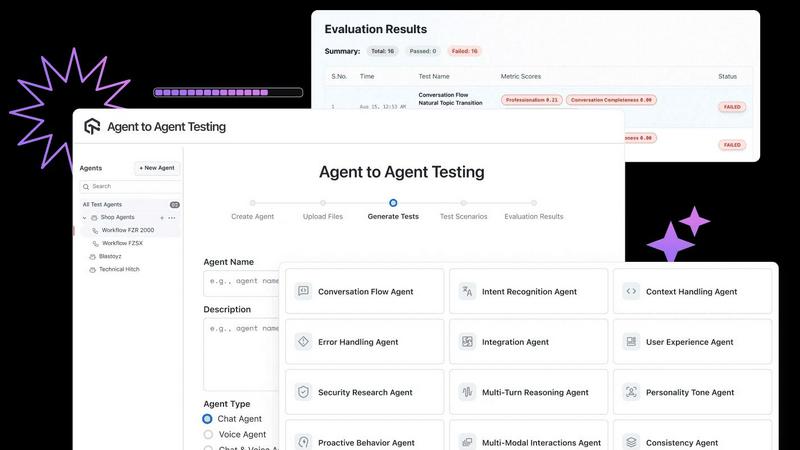
Agent to Agent Testing Platform
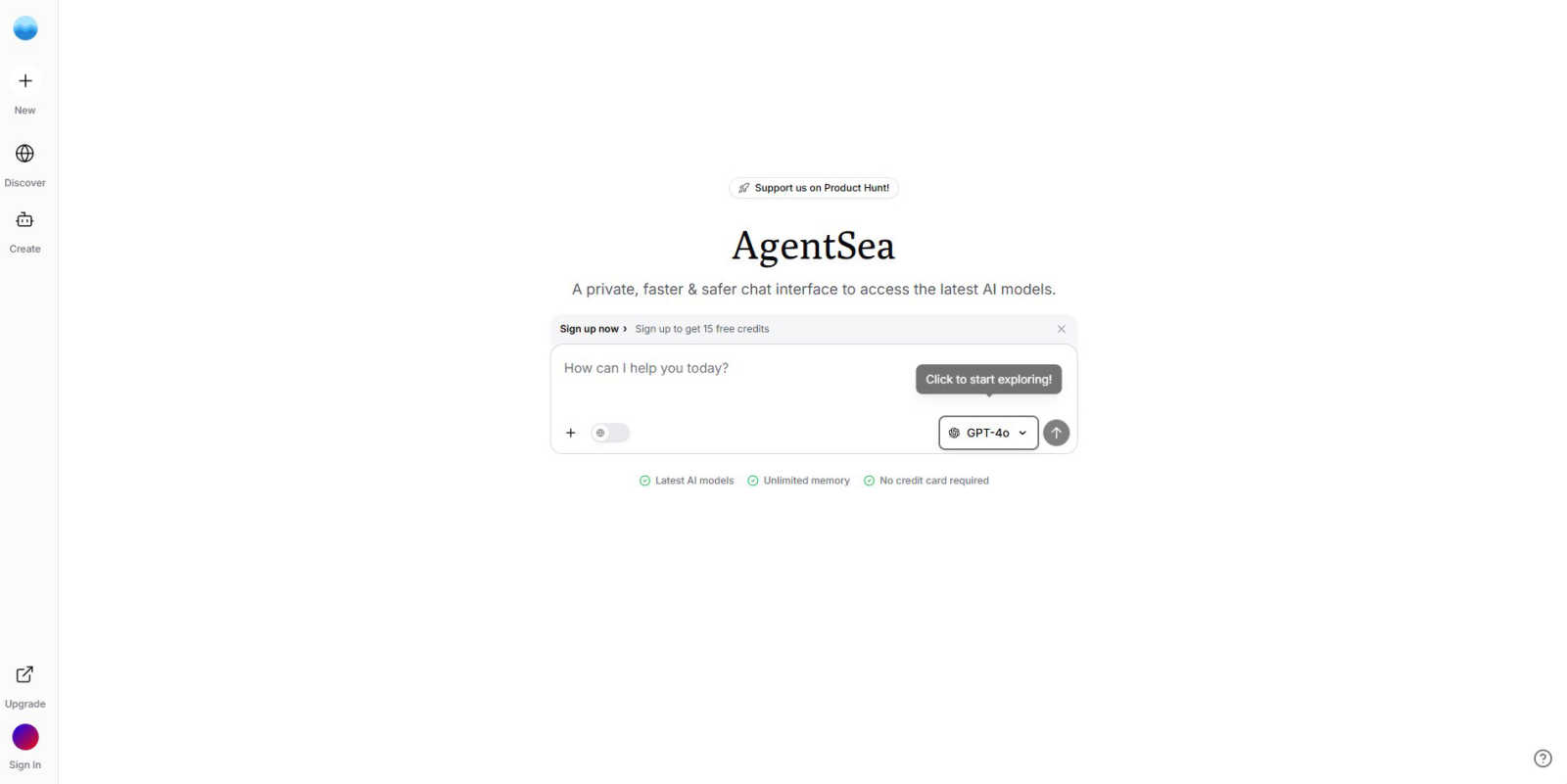
AgentSea
Feature Comparison
Agent to Agent Testing Platform
Autonomous Multi-Agent Test Generation
The platform deploys a suite of over 17 specialized AI agents, each designed to probe different aspects of the Agent Under Test (AUT). These include agents focused on personality tone, data privacy, intent recognition, and more. This multi-agent system autonomously generates diverse, complex test scenarios that simulate real human conversation patterns, uncovering edge cases and interaction failures that manual or scripted testing would inevitably miss, ensuring comprehensive behavioral validation.
True Multi-Modal Understanding and Testing
Going far beyond text-based analysis, this feature allows testers to define requirements using diverse inputs such as images, audio files, and video. By uploading PRDs or directly specifying multi-modal prompts, teams can gauge how their AI agent processes and responds to real-world, mixed-media inputs. This ensures the agent's performance is robust across all interaction types it is designed to handle, mirroring actual user environments.
Diverse Persona-Based Synthetic User Testing
To test like real humans, the platform enables simulations using a wide variety of predefined and custom user personas, such as an "International Caller" or a "Digital Novice." Each persona exhibits different behaviors, needs, and interaction styles. This diversity ensures the AI agent is evaluated for effectiveness and empathy across the entire spectrum of its intended user base, highlighting potential biases or performance drops with specific demographics.
Integrated Regression Testing with Risk Scoring
The platform facilitates end-to-end regression testing for AI agents with intelligent risk scoring. After changes or updates, it automatically re-runs test suites and provides a detailed risk assessment, highlighting potential areas of concern. This allows teams to prioritize critical issues, optimize testing efforts, and maintain a high standard of quality and reliability throughout the agent's development lifecycle with clear, actionable insights.
AgentSea
Unified AI Model Access
AgentSea eliminates the need for multiple accounts and subscriptions by providing a single gateway to a diverse range of AI models. This includes top-tier proprietary models from leading labs as well as a curated selection of powerful open-source alternatives. Users can instantly compare outputs, leverage specific model strengths for different tasks, and explore the entire AI frontier from one dashboard, dramatically simplifying the model selection and testing process.
Persistent Context & Multi-Model Dialogue
This groundbreaking feature allows for seamless switching between different AI models, agents, and tools without losing the conversation's history or context. Imagine starting a complex analysis with one model, switching to a specialized coding agent for implementation, and then consulting a creative writer for documentation—all within the same continuous thread. This creates a collaborative, multi-expert dialogue that was previously impossible with isolated AI interfaces.
Library of Specialized AI Agents
Beyond raw model access, AgentSea provides a vast library of hundreds of pre-configured, task-specific AI agents. These agents are fine-tuned for roles such as data analysis, legal review, creative writing, code debugging, or academic research. Users can deploy these expert agents instantly into their workflow, saving the time and expertise required to engineer effective prompts and workflows for each unique professional task.
Private & Secure Workspace
Privacy is a core tenet of the platform. AgentSea is designed as a private command center where sensitive business data, proprietary code, or confidential research can be processed without being used for model training or exposed across multiple third-party platforms. This secure, consolidated environment is critical for enterprises, consultants, and individuals handling intellectual property or private information.
Use Cases
Agent to Agent Testing Platform
Pre-Production Validation for Customer Service Chatbots
Before launching a new customer support chatbot, enterprises can use the platform to simulate thousands of customer inquiries, from simple FAQ retrieval to complex, multi-issue troubleshooting. This validates the agent's accuracy, escalation logic, policy adherence, and tone, ensuring it reduces live agent handoffs and maintains brand professionalism before interacting with real customers.
Compliance and Safety Auditing for Financial Voice Assistants
Banks and fintech companies deploying voice-activated assistants for balance inquiries or transactions require stringent compliance checks. The platform tests for data privacy violations, hallucination of financial data, and appropriate security escalation protocols. It autonomously probes for toxic or biased responses under stress, ensuring the agent meets strict regulatory and ethical standards.
Scalable Performance Benchmarking for Sales AI Agents
Sales teams implementing AI agents for lead qualification can benchmark performance at scale. The platform uses diverse buyer personas to test the agent's ability to recognize purchase intent, handle objections, and provide accurate product information across countless simulated conversations, providing metrics on effectiveness and conversion pathway reliability.
Continuous Monitoring and Improvement of Healthcare Assistants
For healthcare providers using AI for patient intake or symptom triage, consistent and accurate performance is critical. The platform enables continuous regression testing after every model update, checking for hallucinations in medical advice, maintaining empathy in tone, and ensuring correct handoff to human professionals, thereby mitigating risk and improving patient trust over time.
AgentSea
Cross-Disciplinary Research & Development
Researchers and developers can leverage multiple AI experts in a single session. A scientist could use one model to generate hypotheses from a dataset, a code-specialized agent to write analysis scripts, and a technical writing agent to draft the paper's methodology—all while maintaining perfect context. This accelerates the R&D cycle by integrating diverse AI competencies into a unified workflow.
Content Creation & Multi-Format Strategy
Content creators and marketers can orchestrate entire campaigns within AgentSea. A user could brainstorm ideas with a creative model, generate draft copy, switch to an agent optimized for SEO keyword analysis, and then use another to adapt the core message into social media posts, video scripts, and blog outlines, ensuring brand and contextual consistency across all formats effortlessly.
Complex Business Analysis & Decision Support
Business analysts and consultants can deconstruct complex problems using a panel of AI specialists. They could upload financial data for one agent to summarize trends, use a risk-assessment agent to evaluate scenarios, and consult a strategic planning model to generate recommendations. The persistent context ensures each analysis builds upon the last, creating a comprehensive, AI-augmented business intelligence report.
Software Development & Technical Workflow
Developers can use AgentSea as an integrated coding companion. They can explain a problem to a general model, switch to a dedicated code-generation agent for implementation, use a debugging specialist to troubleshoot errors, and finally, employ a documentation agent to comment the code—all within a single, context-aware session that understands the entire project's scope and history.
Overview
About Agent to Agent Testing Platform
Agent to Agent Testing Platform represents a paradigm shift in quality assurance, engineered specifically for the unpredictable and autonomous nature of modern AI agents. As enterprises rapidly deploy conversational AI across chatbots, voice assistants, and phone-calling agents, traditional testing frameworks—designed for deterministic, static software—fail to capture the dynamic, multi-turn complexities of agentic systems. This platform is the first AI-native quality and assurance framework built to close that critical gap. It provides a unified environment to rigorously validate AI behavior before production, simulating thousands of real-world user interactions across chat, voice, and multimodal channels. By moving beyond simple prompt checks to evaluate full conversational flows, it empowers development and QA teams to proactively uncover long-tail failures, edge cases, and subtle interaction flaws. The core value proposition lies in its autonomous, multi-agent testing approach, which leverages over 17 specialized AI agents to generate tests, assess key metrics like bias, toxicity, and hallucination, and ensure reliability, safety, and policy compliance at scale. It is designed for organizations that rely on AI for customer service, sales, support, and other mission-critical interactions, offering them the confidence that their AI agents will perform as intended for every user.
About AgentSea
AgentSea, now operating under the new brand Okara.ai, is a transformative platform engineered to consolidate the fragmented artificial intelligence landscape into a single, private command center. It moves beyond the concept of a simple chatbot, positioning itself as an integrated workspace for sophisticated AI interaction. The platform directly tackles the modern professional's dilemma of managing numerous AI subscriptions, browser tabs, and model-specific interfaces. By unifying access to leading standard models like GPT-4 and Claude, alongside a vast array of open-source models and hundreds of specialized, pre-built AI agents, AgentSea creates a seamless ecosystem. Its most innovative feature, persistent context, allows users to fluidly switch between different models and tools within the same session without losing their conversational thread, enabling a truly continuous and collaborative multi-model workflow. Designed with power users in mind—including developers, data scientists, researchers, content creators, and businesses—it delivers a triple-layered value proposition: supreme convenience through unification, enterprise-grade privacy for sensitive projects, and cost-effective, predictable access to a broad suite of AI capabilities for a flat monthly fee. In essence, AgentSea (Okara.ai) flips the script, creating an environment where the AI infrastructure adapts to the user's workflow, providing a powerful and private hub for the future of AI-augmented work.
Frequently Asked Questions
Agent to Agent Testing Platform FAQ
What makes Agent-to-Agent Testing different from traditional QA?
Traditional QA is built for deterministic software with predictable inputs and outputs. AI agents, however, are probabilistic and engage in dynamic, multi-turn conversations. Agent-to-Agent Testing is a native framework designed for this complexity. It uses other AI agents to generate and evaluate full conversational flows across modalities, testing for emergent behaviors, reasoning flaws, and real-world interaction patterns that scripted tests cannot replicate.
What key metrics does the platform evaluate for an AI agent?
The platform provides deep, actionable evaluation across a plethora of key AI performance and safety metrics. This includes assessing the agent for bias and toxicity in its responses, identifying hallucinations (fabricated information), and measuring effectiveness, accuracy, empathy, and professionalism. It also validates specific functional logic like escalation protocols and data privacy compliance.
Can I test voice and phone-calling agents, or is it only for chatbots?
Absolutely. The platform is built for true multi-modal testing. It supports the validation of AI agents across all major interaction channels: text-based chat, voice assistants, and inbound/outbound phone-calling agents. You can define test scenarios that simulate authentic voice or hybrid interactions, ensuring your agent performs reliably regardless of how the user communicates.
How does the platform handle test scenario creation?
The platform offers two powerful approaches. First, it provides autonomous test generation where its library of specialized AI agents creates diverse, production-like scenarios. Second, it allows teams to access a library of hundreds of pre-built scenarios or create completely custom scenarios tailored to specific business needs and user journeys, offering both flexibility and comprehensive coverage.
AgentSea FAQ
What is the relationship between AgentSea and Okara.ai?
AgentSea has been rebranded as Okara.ai. The platform, its features, and its core mission remain the same; only the name has changed. Users visiting the old AgentSea domain will be redirected to the new Okara.ai website. This rebranding reflects the platform's evolution and its commitment to providing a unified AI workspace.
How does the "Persistent Context" feature actually work?
Persistent context means the platform maintains the full history and state of your conversation as you switch between different AI models and specialized agents. Unlike using separate tabs or chats where each instance is isolated, AgentSea (Okara.ai) carries over all previous prompts, responses, and uploaded files. This allows each new model or agent you engage to have immediate, full understanding of the ongoing project.
Who is the ideal user for AgentSea (Okara.ai)?
The platform is designed for professionals and power users who regularly interact with multiple AI systems. This includes software developers, data scientists, academic researchers, content strategists, business analysts, and consultants. Anyone frustrated by juggling different AI tools and seeking a more integrated, efficient, and private workspace will find significant value in the consolidated approach.
Is my data private and secure on the platform?
Yes, robust privacy and security are foundational to the platform's design. It acts as a private command center, meaning your conversations, uploaded documents, and generated outputs are not used to train public AI models. The platform is built to provide a secure environment for handling sensitive business information, proprietary code, and confidential research data.
Alternatives
Agent to Agent Testing Platform Alternatives
Agent to Agent Testing Platform is a specialized AI-native quality assurance framework designed for validating the behavior of autonomous AI agents. It belongs to the AI Assistants and agentic systems testing category, focusing on multi-turn, multimodal interactions that traditional software QA tools cannot adequately assess. Users often explore alternatives for various reasons, including budget constraints, the need for different feature sets like integration with specific development environments, or requirements for a more general-purpose testing solution that covers non-agentic software as well. Some may seek platforms with different pricing models or those that focus on a narrower aspect of testing, such as only chat-based interfaces. When evaluating an alternative, key considerations should include the platform's ability to simulate complex, real-world user interactions across your required channels (voice, chat, etc.), its methodology for generating edge-case tests, and the depth of its validation for security, compliance, and operational logic. The ideal solution should provide scalable, automated testing that mirrors production complexity to ensure agent reliability and safety before deployment.
AgentSea Alternatives
AgentSea, now rebranded as Okara.ai, is a unified AI assistant platform designed to consolidate access to multiple large language models into a single, private conversation. It solves the common problem of fragmentation, where users must switch between different services and interfaces to utilize various AI capabilities. Users explore alternatives for several practical reasons. Budget constraints lead some to seek free tiers or different pricing models. Others may prioritize a specific feature set, like deeper integration with certain tools, or have platform-specific needs not fully addressed. The desire for a simpler interface or a different approach to AI interaction also drives this search. When evaluating alternatives, key considerations include the range and quality of AI models available, the platform's approach to privacy and data security, and the overall cost structure. The ability to maintain context across different tools and the depth of specialized agents or features for your specific use case are also critical differentiators to assess.