

HiAPI
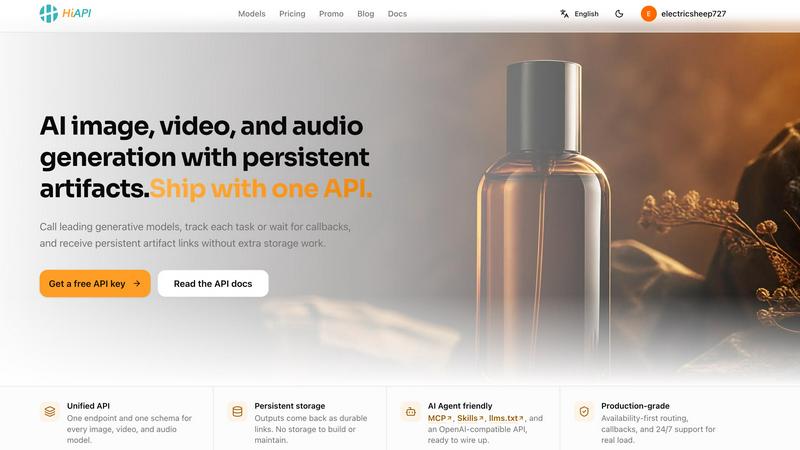
HiAPI unifies image, video, and audio generation with persistent storage and callbacks through a single production-grade API.
About HiAPI
HiAPI is a developer-first unified AI API gateway that fundamentally reimagines how developers integrate generative AI into their applications. Rather than managing multiple API keys, disparate billing systems, and complex integration patterns for each individual AI model provider, HiAPI offers a single, cohesive platform where developers can access a curated selection of leading image, video, and audio generation models through one unified endpoint. The platform is built from the ground up with a developer-centric philosophy, supporting OpenAI-compatible request formats to minimize the learning curve, unified billing to eliminate administrative overhead, and transparent pay-as-you-go pricing that scales with your usage. HiAPI is designed for a broad spectrum of users, from indie developers building AI-powered side projects to enterprise teams deploying production-grade generative AI workflows. The platform's core value proposition lies in its ability to abstract away the complexities of dealing with multiple AI providers, offering persistent artifact storage so that generated images, videos, and audio files are returned as durable links without requiring developers to build and maintain their own storage infrastructure. Additionally, HiAPI is uniquely positioned for the age of AI agents, providing MCP (Model Context Protocol) tools, reusable Skills, and an llms.txt configuration file that allows both human developers and autonomous AI agents to discover, call, and compose HiAPI's capabilities seamlessly. With support for cutting-edge models like Seedream 5.0 Pro for text-to-image and image-to-image generation, alongside other industry-leading models such as GPT Image 2, FLUX 1.1 Pro, and MiniMax Music 2.6, HiAPI positions itself as a comprehensive, production-ready solution that prioritizes reliability, transparency, and developer experience.
Features of HiAPI
Unified API with One Endpoint
HiAPI eliminates the fragmentation of managing multiple AI model providers by offering a single, unified API endpoint for all image, video, and audio generation tasks. Developers pass the base model name as a parameter to call any supported model through the exact same POST /v1/tasks endpoint, with model-specific input parameters validated per request. This architectural decision drastically reduces integration time and complexity, allowing developers to switch between models or add new ones to their workflows without rewriting code. The unified schema also includes optional fields for routing (such as beta or ext routes), persistent storage settings, and callback URLs, making the API both simple to start with and powerful enough for advanced use cases. Furthermore, the API supports idempotency keys, ensuring that retries do not create duplicate tasks, which is critical for production reliability.
Persistent Artifact Storage
One of HiAPI's most compelling features is its built-in persistent storage for all generated artifacts. Instead of generating files that require developers to set up and maintain their own cloud storage buckets, HiAPI returns outputs as durable, low-cost artifact links. By simply setting the storage parameter to "persistent" in the API request, developers receive a stable URL that can be used indefinitely for serving images, videos, or audio files to end users. This feature eliminates a significant engineering burden, as there is no need to build download pipelines, manage file expiration, or handle storage scaling. The persistent artifact links are designed for production use, ensuring that content remains accessible for applications that require long-term asset retention, such as e-commerce product images, marketing materials, or user-generated content galleries.
AI Agent Friendly Integration
HiAPI is purpose-built for the emerging ecosystem of AI agents and autonomous workflows. The platform offers multiple integration pathways designed to be discovered and used by both human developers and AI agents. This includes MCP (Model Context Protocol) tools that provide agent-accessible functions for HiAPI workflows, reusable Skills that offer pre-configured agent instructions for common generation tasks, and an llms.txt file that provides a comprehensive documentation index for AI agents to understand the platform's capabilities. Developers can simply paste the llms.txt prompt into their agent, and the agent can autonomously decide whether to use Skills, Remote MCP, or the direct API as the setup path. This multi-modal integration strategy makes HiAPI compatible with leading AI agents like Claude, Cursor, and Codex, significantly reducing the time from concept to implementation.
Production-Grade Reliability and Callbacks
HiAPI is engineered for production workloads with an emphasis on availability and operational simplicity. The platform features availability-first routing, which intelligently directs requests to the most reliable infrastructure, and a robust callback system that notifies developers upon task completion. Instead of requiring developers to poll the API to check the status of a generation task, HiAPI allows developers to specify a callback URL in their request. When the task reaches a final state, HiAPI sends an HTTP POST request to that URL with the task details and artifact links. This event-driven architecture is ideal for asynchronous workflows, allowing applications to scale without wasting resources on polling. Combined with 24/7 support for real load, these features ensure that HiAPI can handle everything from prototype testing to high-volume production deployments without compromising on reliability.
Use Cases of HiAPI
Automated Content Creation for Marketing Teams
Marketing teams can leverage HiAPI to automate the generation of visual assets for campaigns, social media posts, and advertisements. By integrating the unified API into their content management systems, teams can programmatically generate images using models like GPT Image 2 or Seedream 5.0 Pro based on product descriptions or campaign themes. The persistent artifact storage ensures that all generated assets are immediately accessible via durable links, eliminating the need for manual file downloads and uploads. With the callback feature, marketing automation platforms can be notified when a batch of images is ready, allowing for seamless integration into publishing workflows. This use case dramatically reduces the time from concept to published asset, enabling marketing teams to iterate faster and test more creative variations.
Dynamic Video Generation for E-Commerce
E-commerce platforms can use HiAPI to dynamically generate product demonstration videos using models like Seedance 2.0, which supports cinematic video with native audio and multi-shot consistency. By passing product images and descriptive prompts through the unified API, developers can create personalized video content for each product listing without manual video production. The pay-as-you-go pricing model makes this economically viable even for large catalogs, as costs scale directly with usage. The persistent artifact links can be embedded directly into product pages, providing customers with rich, engaging visual experiences that improve conversion rates. Additionally, the idempotency key feature ensures that video generation requests can be safely retried in case of network issues without duplicating content.
AI-Powered Music and Audio Production
Musicians, podcasters, and audio content creators can integrate HiAPI into their production workflows to generate original music and sound effects using models like MiniMax Music 2.6. This model turns prompts and lyrics into complete songs, with an instrumental mode for background tracks. By using the unified API, creators can build applications that generate custom soundtracks for videos, background music for presentations, or unique audio branding for products. The callback mechanism is particularly valuable here, as audio generation can take longer than image tasks, and the event-driven notification allows creators to continue working while the model processes their request. The transparent pricing ensures that creators can estimate costs accurately before generating large volumes of audio content.
AI Agent-Driven Creative Workflows
Developers building AI agents can use HiAPI as a backbone for creative generation tasks. For example, an AI agent tasked with creating a marketing campaign can autonomously use the MCP tools to generate images, videos, and audio assets, then compose them into a cohesive output. The agent can read the llms.txt documentation to understand the available models and their parameters, then use the unified API to submit tasks, monitor their progress via callbacks, and retrieve the persistent artifact links for final delivery. This use case is particularly powerful for building autonomous content generation pipelines, where an agent can handle everything from ideation to asset production without human intervention. The Skills feature provides reusable instruction sets that agents can follow for common workflows, further reducing the complexity of agent development.
Frequently Asked Questions
How does HiAPI's unified API work with different AI models?
HiAPI uses a single POST /v1/tasks endpoint for all supported models. To call a specific model, you pass its base name in the "model" field of the request body, such as "gpt-image-2/text-to-image" or "seedream-5.0-pro/text-to-image". The "input" field contains model-specific parameters that are validated per request, ensuring you only send parameters that the target model supports. This design allows you to switch between models by simply changing the model name and adjusting the input parameters, without modifying your API integration code. The platform also supports optional routing parameters for accessing beta or extended model versions, giving you flexibility in which model variant you use.
What is persistent artifact storage and how does it work?
Persistent artifact storage is a feature that returns generated outputs as durable, low-cost links instead of requiring you to download and store files yourself. When you set the "storage" parameter to "persistent" in your API request, HiAPI stores the generated image, video, or audio file on its infrastructure and returns a stable URL in the task response. This URL can be used indefinitely to serve the content to end users, eliminating the need for you to build and maintain your own storage system. The storage is designed for production use, with high availability and low latency for content delivery. You only pay for the generation cost, and the storage cost is included in the transparent pricing model.
How does HiAPI support AI agents and autonomous workflows?
HiAPI provides three primary integration pathways for AI agents. First, MCP (Model Context Protocol) tools give agents direct access to HiAPI workflows as callable functions. Second, Skills are reusable agent instructions that define common generation workflows, which agents can follow step-by-step. Third, the llms.txt file provides a comprehensive documentation index that agents can read to understand the platform's capabilities and API structure. Developers can paste the llms.txt prompt into their agent, and the agent can autonomously decide which integration method is best for the task. This multi-modal approach ensures compatibility with leading AI agents like Claude, Cursor, and Codex, allowing for seamless integration into agent-driven applications.
What models are currently available on HiAPI?
HiAPI offers a curated selection of leading generative AI models for image, video, and audio generation. Image models include GPT Image 2 for OpenAI image generation with sharp text rendering, Nano Banana 2 for fast Google Gemini Flash image generation with strong character consistency, FLUX 1.1 Pro for high-fidelity image generation from Black Forest Labs, and Seedream 5.0 Pro from ByteDance for flagship image generation and editing with sharper text rendering. Video models include Seedance 2.0 from ByteDance for cinematic video with native audio and multi-shot consistency. Audio models include MiniMax Music 2.6, which turns prompts and lyrics into complete songs with an instrumental mode. The platform continues to add new models, and developers can explore all available models on the HiAPI website.
Pricing of HiAPI
HiAPI operates on a transparent, pay-as-you-go pricing model where every model lists its price upfront. This allows developers to review each model's cost before integration and estimate expenses clearly before a production launch. New users can sign up and receive up to $1 in free credits to test the platform and evaluate different models. There is no mention of tiered plans, subscription fees, or volume discounts in the provided context. Pricing is model-specific, meaning the cost per task varies depending on which model you use and the complexity of the generation. Developers are encouraged to visit the model details pages on the HiAPI website to check specific API usage costs, parameters, and pricing for each model before integrating it into their applications.
Similar to HiAPI

AI Album Cover Maker
Create release-ready album covers from a prompt or photo. Generate, refine, and export art for singles, EPs, mixtapes, and playlists.

Sprite Sheet Maker
A free browser-based toolkit for creating, cutting, converting, and previewing sprite sheet animations.


Vismuse
Create polished AI images and videos from prompts or references for social posts, ads, flyers, album covers, and campaigns.

Imagine2
Private browser-based AI image generation and editing with text-to-image, targeted edits, and multi-image references.

Kogashitsuka AI
An online AI image tool that enhances photos and illustrations at their original size or upscales them by 2x or 4x.

UGCad AI
AI UGC video ad Generator which Turn a URL, prompt, or template into a ready video ads

IsThisAIImage
Free AI image checker: upload a photo for AI-generated and deepfake scores, a clear verdict, and optional generator hints.