

Skene
Skene turns your own codebase into a prompt-driven growth engine you fully control.
About Skene
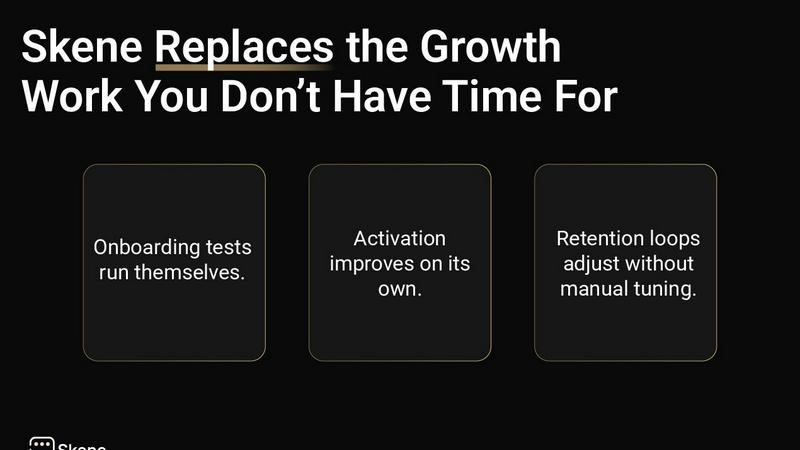
Skene is not just another growth tool; it's a foundational reimagining of how software achieves product-led growth (PLG). It functions as an AI-powered, fully automated PLG iteration engine that integrates as intrinsic infrastructure directly into your development environment. Unlike external services that bolt on with performance-draining snippets, Skene connects to your codebase and IDE, analyzing your application's structure and user interaction data to autonomously identify friction points, optimize critical user flows, and deploy improvements. Its core value proposition is the consolidation and automation of growth work: it replaces manual A/B testing, fragmented analytics dashboards, and brittle third-party scripts with a self-learning system that treats growth logic as version-controlled code you own. Designed for indie developers, early-stage startups, and established PLG companies, Skene acts as a "growth team in a box." It continuously optimizes key funnels like onboarding, activation, and retention, freeing engineering and product teams from constant manual optimization overhead. By deriving signals directly from the source code, it creates a powerful, actionable context layer for your AI agents and ensures your growth strategies evolve in lockstep with every product deployment, making data silos and performance-breaking external dependencies obsolete.
Features of Skene
Codebase-Native Signal Detection
Skene integrates directly with your repository and IDE, performing deep structural analysis to automatically detect growth signals and user friction points from your code itself. It scans framework patterns, component trees, and user flow logic to identify onboarding bottlenecks, activation opportunities, and retention risks without requiring manual instrumentation or external tagging. This creates a living, code-accurate map of your user journey.
Autonomous Growth Loop Implementation
Moving beyond analysis, Skene autonomously generates and deploys optimized growth loops. Based on its analysis, it can prompt engineers or AI agents to implement changes, or manage deployments itself to improve funnels. This transforms growth from a manual, campaign-based effort into a continuous, automated process that ships improvements as seamlessly as new features.
Prompt-Driven Growth Infrastructure
Growth logic becomes as malleable and promptable as any other part of your codebase. Developers and AI agents can interact with Skene's context layer using natural language prompts to query analytics, request optimizations for specific flows, or generate implementation code. This shifts the paradigm from configuring rigid dashboards to commanding an intelligent growth engine.
Self-Healing & Version-Controlled Logic
Because Skene's intelligence is built upon your actual code, its recommendations and implemented flows automatically update and adapt with every git commit and deployment. There's no risk of UI tour scripts breaking after a redesign; the growth logic is versioned and tested alongside the product, ensuring resilience and maintainability.
Use Cases of Skene
Accelerating Time-to-Value for New Users
For products struggling with user activation, Skene autonomously audits the onboarding funnel directly from the code, identifying unnecessary steps or confusing UI patterns. It then generates and implements streamlined flows, tooltips, or progress trackers to guide users to their "aha moment" faster, dramatically improving activation rates without constant manual experimentation.
Reducing Engineering Overhead on Growth Tasks
Engineering teams burdened with building and maintaining one-off analytics events, A/B test frameworks, and lifecycle emails can offload this work to Skene. It handles the instrumentation, analysis, and iterative optimization, allowing developers to focus on core product features while still shipping data-driven growth improvements.
Enabling AI Agents to Own Growth Outcomes
Companies leveraging AI agents for development can provide them with a rich, code-aware growth context layer via Skene. An agent can be tasked with "improving retention for feature X" and, using Skene's analysis and tooling, understand the current flow, propose changes, and even implement the necessary code modifications autonomously.
Consolidating a Fragmented Growth Stack
Startups tired of managing multiple point solutions for analytics, user onboarding, and email automation can replace them with Skene's unified infrastructure. It eliminates the performance tax of external scripts, breaks down data silos, and provides a single source of truth for growth logic that is owned, versioned, and evolved within the main codebase.
Frequently Asked Questions
How is Skene different from traditional customer experience software?
Traditional tools like tour builders or analytics platforms are external services that require manual configuration, rely on fragile DOM selectors that break with UI updates, and create data silos. Skene is infrastructure that reads your codebase to automatically generate and maintain context-aware flows. It updates itself with each deploy and keeps all logic and data within your owned code environment.
How long does it take to set up Skene?
Setup is designed to be exceptionally fast, typically under 60 seconds. You grant Skene read-only access to your GitHub or GitLab repository. It then automatically analyzes your codebase structure to generate initial PLG flows and insights without requiring any initial code changes or API integrations.
Is my source code secure with Skene?
Absolutely. Security is a primary design principle. Skene only ever requires read-only access to your repository. All code analysis is performed in a secure, isolated environment. Your proprietary code never becomes training data for external models, and you maintain full ownership and control.
What kind of analytics does Skene provide?
Skene offers a real-time analytics dashboard focused on actionable growth metrics. This includes user progress tracking, funnel completion rates, engagement heatmaps, and bottleneck identification. It provides insights like time-to-value and measures the direct impact of automated improvements, all derived from your codebase signals rather than external pageview trackers.
Explore more in this category:
Similar to Skene


PerPageFax
PerPageFax lets you send a fax online from any browser for a flat $0.50 per page — no account, no subscription, no fax machine.

OctoWatch DLP
Track staff & time. Free trial. Cloud/on-prem.

Fill PDF from Sheet
Fill PDF from Sheet automates the process of populating PDF forms from data in Excel, CSV, or Google Sheets.

linkwise.link
AI finds your lost links. Summarizes & tags URLs.
