

Image3D AI
Image3D AI instantly transforms any 2D image into a high-precision 3D model for printing or games.
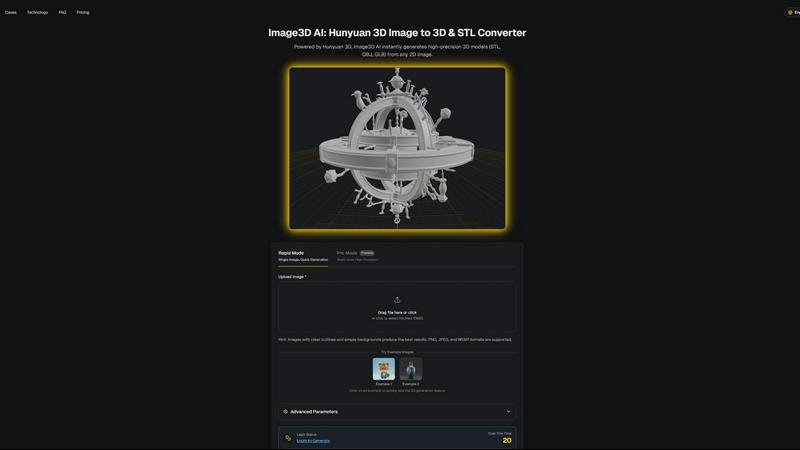
About Image3D AI
Image3D AI represents a paradigm shift in the digital creation landscape, fundamentally altering how three-dimensional content is generated. At its core, it is a sophisticated AI-powered platform that transforms static, two-dimensional images into fully-realized, production-ready 3D models in a matter of seconds. This is not a simple extrusion tool; it leverages Tencent's groundbreaking Hunyuan 3D engine to infer depth, geometry, and texture from flat visuals, producing high-fidelity assets with remarkable accuracy. The tool democratizes 3D modeling, dismantling the steep technical and time barriers traditionally associated with software like Blender or Maya. Its primary value proposition is immense time savings and enhanced creative productivity, allowing professionals and hobbyists alike to bypass weeks of manual labor. Whether you are a game developer needing rapid asset iteration, a designer creating AR experiences, a 3D printing enthusiast bringing sketches to life, or an e-commerce manager seeking interactive product showcases, Image3D AI provides a seamless, intuitive bridge from concept to three-dimensional reality. It empowers users to focus on the creative vision and application of the model, rather than the arduous technical process of building it from scratch.
Features of Image3D AI
Dual Generation Modes (Rapid & Pro)
Image3D AI caters to different project needs with two distinct operational modes. The Rapid Mode is designed for speed and simplicity, generating a 3D model from a single uploaded image in under a minute, perfect for quick concepts or simple objects. For projects demanding higher precision and physical accuracy, the Pro Mode utilizes multi-view images. By uploading several photos of an object from different angles (e.g., front, side, back), the AI performs a more comprehensive analysis, resulting in a superior, dimensionally accurate reconstruction ideal for professional 3D printing or detailed digital assets.
Multi-Format Export (STL, OBJ, GLB)
Understanding that a 3D model's utility lies in its compatibility, Image3D AI exports directly to the industry's most essential file formats. Users can download their creations as STL files, the universal standard for 3D printing; as OBJ files, widely compatible with traditional 3D editing suites like Maya and Blender for further refinement; or as GLB files, the modern, compact format perfect for web applications, AR experiences, and game engines, as it contains both model and texture data in a single file.
Advanced Parameter Controls
Beyond a simple one-click conversion, the platform offers users a degree of creative and technical control through advanced parameters. While the specifics are hinted at with modes like "Normal," "Low Poly," and "Geometry," this feature allows for tailoring the output. Users can prioritize mesh detail for printing, optimize for lower polygon counts for game performance, or balance texture quality with generation speed, ensuring the final model is optimized for its intended use case.
No-Skill-Required Interface & Free Testing
A cornerstone of its accessibility is an exceptionally user-friendly interface that requires zero prior 3D modeling knowledge. The process is as simple as dragging and dropping an image. Furthermore, the platform encourages experimentation by offering a library of free example images that users can test with, requiring no login or credit expenditure. This risk-free trial allows anyone to immediately experience the power of AI-driven 3D conversion and understand the quality of results possible.
Use Cases of Image3D AI
Game Development & Asset Creation
For indie developers and large studios alike, Image3D AI accelerates the prototyping and production pipeline. Concept art, character designs, and environmental props can be converted into base 3D meshes in seconds. These assets, especially when generated with PBR material support, provide a fantastic starting point that can be directly imported into engines like Unity or Unreal Engine for further detailing, texturing, and integration, drastically reducing initial modeling time.
E-commerce & Interactive Product Visualization
Online retailers can leverage this technology to create immersive shopping experiences. By converting standard 2D product photos into interactive 3D models, customers can rotate, zoom, and inspect items from every angle on a website. This "image to 3D" capability is also the first step toward creating Augmented Reality (AR) previews, allowing customers to visualize products in their own space, which can significantly boost engagement and reduce return rates.
3D Printing & Rapid Prototyping
The platform serves as a powerful "image to STL converter" for makers, hobbyists, and engineers. A simple sketch, a logo, or a photo of an object can be transformed into a watertight, manifold STL file ready for slicing and 3D printing. This opens up rapid prototyping to a much wider audience, enabling the physical creation of custom parts, artistic sculptures, educational models, and personalized gifts directly from a 2D idea.
Architectural Visualization & Design
Architects and interior designers can use Image3D AI to quickly generate basic 3D forms from sketches, floor plans, or inspiration images. While not a replacement for detailed CAD software, it provides a rapid method to create massing models or simple contextual assets for presentations and client reviews. This speeds up the early conceptual phases, allowing for faster iteration and more efficient communication of spatial ideas before committing to detailed modeling.
Frequently Asked Questions
What image formats and quality work best for conversion?
For optimal results, upload high-contrast images (PNG, JPEG, or WEBP) with clear, well-defined outlines and a simple, uncluttered background. The subject should be in focus with good lighting. Avoid blurry, dark, or overly complex images where the main object is obscured. Following these best practices dramatically increases the AI's ability to accurately interpret shape and depth.
What is the difference between Single Image and Multi-view modes?
Single Image mode (Rapid) uses AI inference to generate a 3D model from one picture, ideal for logos, sketches, or objects with an obvious shape. Multi-view mode (Pro) requires several photos of a real-world object from different angles. This provides the AI with more geometric data, leading to a physically accurate and higher-fidelity reconstruction, which is essential for precise 3D printing or detailed digital twins.
Which output file format should I choose?
The choice depends on your intended use. Select .STL if you plan to 3D print the model. Choose .OBJ if you intend to edit the model further in traditional 3D software like Blender, 3ds Max, or ZBrush. Opt for .GLB if you need the model for web display, AR/VR applications, or game engines, as it is a compact, modern format that includes textures and materials in a single file.
Is there a free tier or way to test the tool?
Yes, you can test Image3D AI's core functionality without creating an account or paying. The platform provides a selection of free example images that you can click to instantly generate a 3D model. This allows you to evaluate the speed, quality, and workflow of the tool before committing to any paid plans or uploading your own images.
Similar to Image3D AI

Presentation Intelligence
AI-native presentation and visual content platform that turns prompts, documents, images, videos, and data into polished, shareable decks.

Magic Eraser
AI photo editor for removing objects and backgrounds, enhancing images, and creating visuals across web and mobile.


PNG to SVG
Free, private image conversion tools that run entirely in your browser.


IsThisAIImage
Free AI image checker: upload a photo for AI-generated and deepfake scores, a clear verdict, and optional generator hints.

Merge Two Photos
Merge two photos free in your browser: side by side, stacked, overlay, or AI. Download a clean PNG, no watermark.

StopScroll
StopScroll is an AI thumbnail maker that generates YouTube thumbnail concepts from a URL, title, or prompt.